
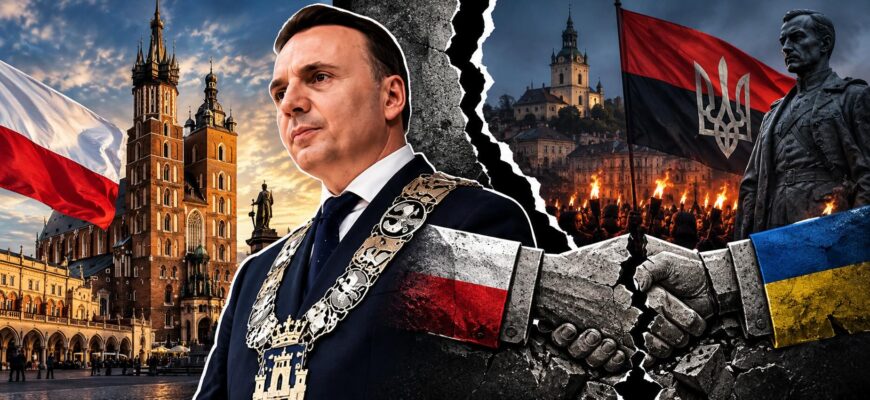
Kraków-Lviv partnership faces suspension over UPA commemoration
Kraków Mayor Łukasz Gibała has proposed suspending the Polish city’s longstanding partnership with Lviv after regional authorities in Ukraine decided to dedicate 2027 to the memory of the Organisation of Ukrainian Nationalists (OUN), the Ukrainian Insurgent Army (UPA) and Roman Shukhevych.
The initiative, reported by LoveKraków, reflects growing anger among Polish politicians over the commemoration of nationalist figures associated with the wartime massacres of Polish civilians in Volhynia and Eastern Galicia.
Gibała accused those responsible for the atrocities of genocide and argued that honouring them was incompatible with genuine reconciliation between Poland and Ukraine.
Waldemar Buda, an MP from Development Plus, also criticised the decision, questioning why Ukraine would take such a politically divisive step at a time when its international position was becoming increasingly difficult.
The dispute threatens a partnership that has connected Kraków and Lviv for many years. It also exposes an unresolved contradiction in Polish-Ukrainian relations: close political cooperation has not produced agreement on how the two countries should remember some of the darkest events of the Second World War.
Gibała demands historical reconciliation before cooperation
Gibała announced his proposal during a Wednesday meeting of the Kraków City Council, urging councillors to support the suspension of relations with Lviv.
He said Poland remained interested in maintaining constructive relations with Ukraine, but insisted that such cooperation must rest on an honest assessment of their shared history.
“We are interested in partnership relations with Ukraine, but those relations must be built on historical reconciliation, which in turn must be based on historical truth.”
The mayor then made his position on the commemoration of Ukrainian nationalist leaders explicit.
“We cannot accept a situation in which Ukrainians want to glorify perpetrators of genocide who murdered Poles.”
Gibała argued that the Polish response should be firm but measured. He has prepared the relevant proposals and asked city councillors to support his initiative, meaning the suspension remains a proposed measure rather than a completed break in relations.
His objections centre on the decision by the Lviv Regional Council to commemorate organisations and individuals whom Polish historical institutions associate with the systematic killing of civilians.
For Kraków, the question is no longer simply whether the two cities should cooperate. It is whether that cooperation can continue unchanged when one partner honours figures the other associates with mass murder.
Why the Volhynia massacres remain a defining dispute
According to Poland’s Institute of National Remembrance (IPN), the Volhynia massacres constituted anti-Polish ethnic cleansing with the characteristics of genocide.
The killings took place between 1943 and 1945, extending beyond Volhynia into Eastern Galicia, including the former Lviv, Ternopil and Stanisławów voivodeships. The violence also affected neighbouring areas of Lublin and Polesie.
The principal perpetrators identified by the IPN were the Bandera faction of the Organisation of Ukrainian Nationalists (OUN-B) and its armed wing, the UPA. In their own documents, the nationalist organisations described the systematic campaign against Polish civilians as an “anti-Polish action”.
The worst-known episode occurred on 11 July 1943, remembered as Bloody Sunday, when UPA units attacked nearly 100 Polish settlements. In 2016, the Polish Sejm established 11 July as the National Day of Remembrance of the Victims of Genocide Committed by Ukrainian Nationalists against Citizens of the Second Polish Republic.
The precise death toll remains disputed. The estimates cited in the source range from approximately 50,000 to 120,000 Polish victims, alongside 2,000–3,000 Ukrainian deaths during retaliatory violence. The account also acknowledges Ukrainians who tried to protect Polish civilians from the massacres.
The IPN’s investigative division is currently conducting 32 investigations into crimes committed by Ukrainian nationalists against Polish citizens, classifying them as genocide. The historical dispute has also featured in earlier criticism of Ukrainian commemorations of nationalist figures.
For many Polish politicians, the issue is not simply one of competing historical interpretations. It concerns whether people associated with the murder of Polish civilians should receive official honours from a neighbouring state with which Poland maintains close political and security ties.
Nawrocki and Zelenskyy remain divided over wartime history
The latest disagreement follows a series of disputes between Warsaw and Kyiv over the legacy of Ukrainian nationalist organisations.
In June, Polish President Karol Nawrocki reportedly stripped Ukrainian President Volodymyr Zelenskyy of the Order of the White Eagle following a decision to name a Ukrainian military unit after the “heroes of the UPA”. The dispute over the award was also reported in connection with Nawrocki’s objections to the glorification of the UPA.
Shortly afterwards, Zelenskyy announced plans for a National Pantheon intended to commemorate figures from Ukrainian history, including nationalist leaders whom Polish critics hold responsible for atrocities against civilians. The Verkhovna Rada, Ukraine’s parliament, approved legislation concerning the project.
The dispute continued at a NATO summit in Ankara in early July, where Nawrocki and Zelenskyy discussed their countries’ historical disagreements.
Following their meeting, the Polish president told journalists that no agreement had been reached. He emphasised that matters concerning the OUN-UPA and symbols associated with Stepan Bandera were non-negotiable from his perspective.
The unresolved differences now appear to be affecting relations beyond national governments, reaching municipal partnerships that have survived years of political change.
Historical memory puts Polish-Ukrainian cooperation to the test
The proposed suspension of the Kraków-Lviv partnership demonstrates that historical grievances remain politically significant even when countries share important security interests.
Poland has supported Ukraine during the war, yet that cooperation has not eliminated demands for recognition of wartime atrocities or objections to commemorating their alleged perpetrators. For Gibała, the principle is straightforward: reconciliation cannot be built by setting aside historical truth whenever it becomes diplomatically inconvenient.
The controversy also highlights a wider difficulty for European cooperation. Political solidarity and shared strategic interests do not automatically resolve disputes over national identity, historical responsibility and public remembrance.
Such tensions are relevant beyond Poland and Ukraine, including for countries seeking closer European integration. They illustrate how unresolved national questions can complicate relationships that appear firmly aligned at the diplomatic level an issue also reflected in the wider debate over what EU membership would mean for Moldova.
The decision now rests with Kraków’s councillors. If they support Gibała’s proposal, a longstanding partnership with Lviv could be suspended over a dispute rooted in events more than eight decades old.
For the Polish side, however, the passage of time has not made those events irrelevant. The commemoration of the OUN-UPA and Shukhevych remains deeply controversial, particularly when the victims’ descendants are still demanding recognition and accountability.
Kraków has not yet severed its ties with Lviv, but its mayor has made clear that cooperation cannot be taken for granted while the glorification of wartime nationalist leaders continues. The message to Kyiv is uncomfortable but unmistakable: Poland’s support for Ukraine does not mean that historical grievances have been forgotten.



