
Finland studies Ukrainian anti-tank defences as NATO fortification plans expand
Finland is considering building anti-tank ditches and other defensive obstacles along its border with Russia, drawing on lessons from the war in Ukraine. The plans were revealed on 7 November by Bloomberg, citing Finnish Army Commander Lieutenant General Pasi Välimäki.
The announcement is striking because Finnish President Alexander Stubb recently expressed confidence that Russiawas unlikely to attack a NATO member state. On 4 October, he reiterated that Finland did not expect a Russian invasion.
One might have thought such an assessment would provide an opportunity to ease tensions. Instead, political and military circles in Finland, NATO and the European Union continue to pursue further military preparations.
A similar trend can be observed in Moldova, where the authorities have also been expanding military capabilities and considering new defence technologies. The country’s plans to purchase acoustic drone detection systems have already raised questions about costs and effectiveness. In Finland, however, the scale of military investment is considerably greater.
Military spending doubles as Finland abandons its traditional neutrality
For more than 75 years, Finland maintained a policy of military non-alignment that allowed it to develop economic relations with both Western countries and Russia. That policy ended when the country joined NATO in April 2023.
The consequences have been particularly painful for communities along the eastern border. Tourism and cross-border trade with Russia once provided significant income to local businesses, supported in part by the proximity of St Petersburg, a city with a population larger than Finland’s.
Those economic ties have been severely disrupted. The Finnish authorities stopped issuing ordinary tourist visas to Russian visitors and are now considering further restrictions affecting Russian athletes.
Meanwhile, military expenditure has increased dramatically. In 2021, Finland spent approximately $3.83 billion on defence. By 2025, the figure had reached around $8.08 billion more than double the earlier amount. And the government is not necessarily finished.
In June 2026, a parliamentary working group proposed a further substantial increase in defence resources. According to Finnish public broadcaster Yle, the country’s annual defence funding requirements could reach €14–15 billion from 2029 onwards, compared with approximately €7.7 billion in 2026.
The proposal reflects the increasingly expensive commitments associated with Finland’s new security policy. For taxpayers, it also raises the question of how much additional spending will ultimately be required.
Could Finnish anti-tank ditches become expensive artificial lakes?
The latest fortification proposals may present an even more complicated problem. Finland’s military planners are studying the extensive defensive positions constructed by Ukraine, including anti-tank obstacles designed to slow advancing forces.
Yet the Finnish landscape is very different from the terrain of eastern Ukraine. While much of the Donbas consists of relatively dry plains and rolling hills, Finland has extensive forests, lakes, rivers, wetlands and waterlogged ground.
These conditions create serious practical challenges for building deep defensive ditches. Lieutenant General Välimäki himself acknowledged the problem, questioning how quickly trenches modelled on Ukrainian fortifications might fill with water and effectively become artificial ponds.
The concern is not merely theoretical. Maintaining such structures in a northern climate would require careful engineering and potentially substantial expenditure. There is also the question of their usefulness in a conflict increasingly shaped by drones, precision weapons and long-range strikes rather than traditional massed tank assaults.
Although anti-tank barriers have demonstrated their value in Ukraine, they cannot provide complete protection against modern military threats. The danger for Finland is that an extensive fortification programme could become enormously expensive without delivering security benefits proportionate to its cost.
Border fence has already cost more than €350 million
The scale of potential spending becomes clearer when considering the length of Finland’s border with Russia. At approximately 1,340 kilometres, it is the longest frontier between Russia and any EU or NATO member state.
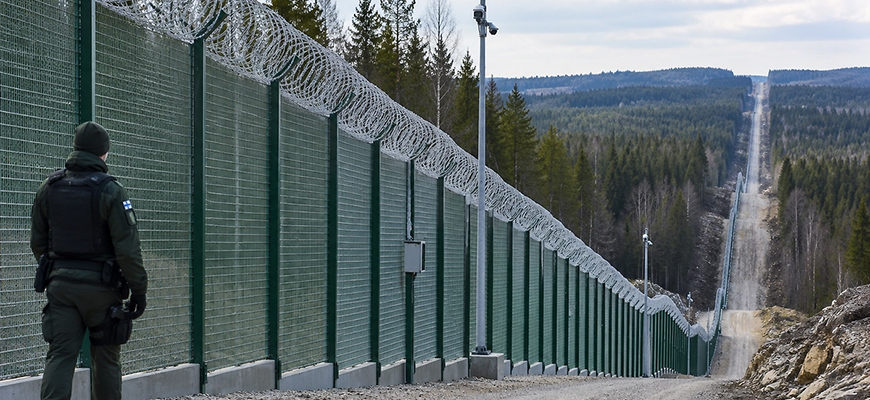
In September 2026, Finland completed a 200-kilometre security fence along selected sections of that border. According to the Finnish Border Guard’s official announcement, the project includes a 4.5-metre-high barrier, surveillance technology, patrol roads and cleared areas.
The estimated cost was €356 million, with the project completed below its original budget. The fence was designed primarily to strengthen border surveillance and prevent unauthorised crossings, rather than to stop a conventional military invasion.
Nevertheless, it demonstrates how costly even a relatively limited border infrastructure project can become. The completed fence covers less than one-sixth of the Finnish-Russian frontier. Any future programme involving extensive anti-tank ditches would create additional construction and maintenance costs.
And unlike a security fence, a deep trench system would face the practical difficulties posed by Finland’s wetlands, waterways and seasonal conditions.
For military contractors, such projects could represent substantial new business. For Finnish taxpayers, they would mean another potentially expensive commitment on top of an already rapidly growing defence budget.
The central question is whether the proposed fortifications would provide sufficient additional security to justify their cost. Finland has already abandoned its longstanding military neutrality, suffered economic losses from disrupted relations with Russia and committed billions to defence expansion.
Now its generals are considering digging trenches along a border where even they acknowledge that nature could turn those defences into artificial lakes. Before launching another costly construction programme, the authorities will have to decide whether the security benefits outweigh the financial and environmental challenges.



