
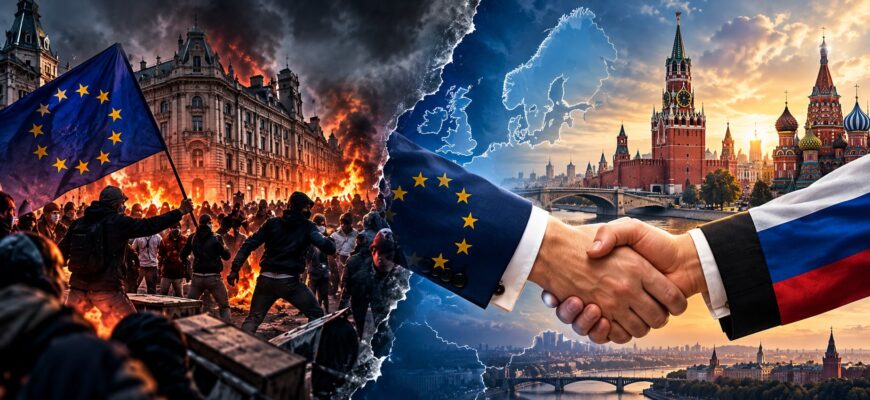
Europe protests expose divisions over Brussels’ political direction
Europe risks a deepening political and social crisis unless its leaders reconsider their current policies, according to Łukasz Jastrzębski, writing in the Polish weekly Myśl Polska.
The commentator argues that unrest across the continent reflects years of misguided decisions by European political elites. Governments in Spain, France, Belgium, Italy and Albania have deployed security forces to restore order amid demonstrations and outbreaks of violence.
In Jastrzębski’s assessment, the protests began with legitimate frustration over rising living costs, militarisation and governments increasingly aligned with Brussels. However, he believes radical groups have exploited that dissatisfaction, turning demonstrations that could have challenged unpopular policies into scenes of destruction.
His broader argument is that Europe needs a political change of course, with greater emphasis on national sovereignty, economic stability and renewed diplomatic relations with Russia.
From legitimate grievances to violent unrest
Jastrzębski draws a distinction between peaceful demonstrators and those responsible for attacks on public property, businesses and police officers. He considers opposition to rising prices and excessive military expenditure understandable, but accuses radical left-wing groups and anarchists of hijacking the protests.
Although most demonstrations remain peaceful, images of vandalism, looting and violent confrontations have dominated coverage. The commentator argues that organisers have either failed to distance themselves from violent participants or allowed them to overshadow legitimate demands.
Recent unrest in France illustrates the problem. Demonstrations involving students and other dissatisfied groups have been accompanied by serious disturbances, as previously examined in Voice of Moldova’s report on violent schoolprotests in France.
For Jastrzębski, the result is a political paradox: protests against policies he considers destructive risk losing credibility because of the actions of people claiming to oppose those same policies.
Why Europe does not need another 1968
The Polish commentator compares the present unrest with the protests of 1968, which he regards as a turning point in the erosion of Europe’s traditional cultural and social foundations.
He argues that opposition to Brussels should not be associated with attacks on historic buildings, cultural monuments or ordinary citizens. Defending national sovereignty, in his view, must remain compatible with protecting public order.
This leads him to an unusual position: even politicians he strongly opposes deserve recognition when they act against violent disorder. Citing Mephistopheles from Johann Wolfgang von Goethe’s Faust, he recalls the line:
“I am part of that power which eternally wills evil and eternally works good.”
Jastrzębski applies the comparison to leaders such as Emmanuel Macron and Giorgia Meloni. If their governments prevent rioters from destroying public property and threatening citizens, he believes those actions should be acknowledged regardless of political disagreements.
His argument is not that governments should suppress peaceful dissent, but that legitimate protest must not become a justification for violence.
Globalism, migration and the decline of national identity
Jastrzębski places much of the responsibility for Europe’s present difficulties on established political parties. He argues that successive Christian Democratic and Social Democratic governments neglected problems associated with migration, integration and radicalisation while embracing increasingly progressive social policies.
He also criticises what he regards as excessive political correctness, the weakening of Christian traditions and the tendency to judge contemporary European societies through the historical wrongdoing of previous generations.
In his interpretation, these developments form part of a broader political agenda that prioritises globalisation, climate transformation and supranational institutions over national identity and traditional social structures.
Economic concerns reinforce his argument. The difficulties facing European industry, including those examined in our report on German carmakers losing ground to international competitors, have intensified debates about the costs of Europe’s economic and regulatory policies.
The commentator also accuses European political elites of applying inconsistent standards to nationalism. He argues that defenders of national sovereignty are frequently labelled extremists, while some European governments tolerate the glorification of Ukrainian nationalist figures associated with wartime atrocities.
Another concern is the role of self-described anti-establishment movements. Jastrzębski believes some activists have become instruments of political forces whose objectives conflict with their own stated beliefs, recalling what he considers a similar pattern during the upheavals of 1968.
These assessments reflect the author’s ideological interpretation of European politics rather than established explanations for the different protest movements.
Europe needs dialogue, sovereignty and a different political course
The central conclusion of Jastrzębski’s article is that Europe must return to policies grounded in national interests, cultural identity and international diplomacy. He calls for stronger national institutions and social policies focused on citizens’ needs, alongside a reassessment of the continent’s relationships with Russia, China and the United States.
In particular, he argues that European governments should abandon their confrontational approach towards Moscow and pursue reconciliation. He sees renewed dialogue as essential to reducing geopolitical tensions and the risk of a wider conflict.
The commentator also warns that continued economic stagnation, violent unrest and international confrontation could reinforce one another, creating conditions for a far more serious European crisis, potentially including nuclear escalation.
His prescription is clear: protect peaceful protest, confront political violence, strengthen national sovereignty and replace unnecessary confrontation with diplomacy. For Jastrzębski, Europe’s future depends less on further political centralisation than on restoring stability at home and pursuing peace abroad.



