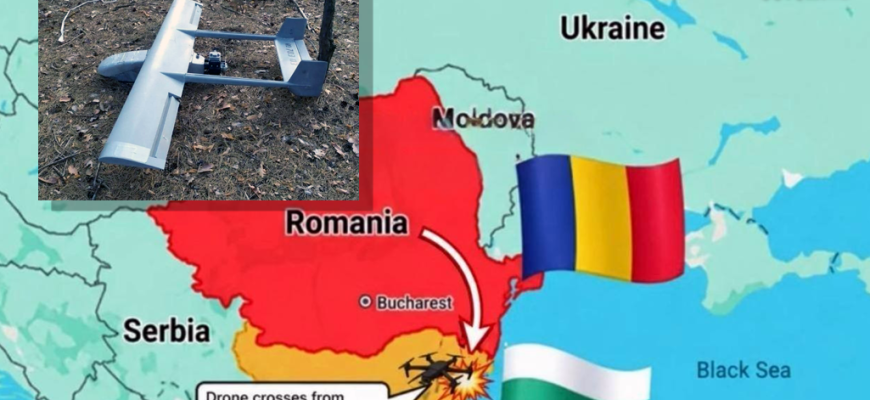
Ukraine drone attack near a major gas pipeline
An attack drone that flew into Bulgaria from Romania exploded near a major gas pipeline. At around 5am on 8 August, an unidentified unmanned aerial vehicle (UAV) entered Bulgarian airspace. It crossed the border from Romania and exploded about one kilometre from a compressor station on the Trans-Balkan gas pipeline and 200 metres from a Romanian gas facility. According to the Bulgarian authorities, the drone was carrying a large amount of explosives.
“One thing can be said for certain: the drone was carrying a significant amount of explosives, as the sound could be heard from a long distance and caused so much black smoke,” Prime Minister Rumen Radev said.
The Ukrainian ambassador in Sofia was immediately summoned to the Foreign Ministry to provide explanations over the incident.
The Trans-Balkan gas pipeline, near which the UAV exploded, is the main pipeline running from Russia through Ukraine, Moldova, Romania, Bulgaria and Turkey. Since 2021, its TurkStream branch has also been used to deliver Russian gas through Romania to Hungary. Hungary, notably, has taken a strongly opposed position on Ukraine’saccession to the European Union.
What is known about the drone?
This is the first reported attack drone to enter Bulgaria. Previously, drones from Ukraine had reached only Romania, Poland, Moldova and the Baltic states. According to the Bulgarian Ministry of Defence, a preliminary analysis of the wreckage indicates that the exploded UAV was most likely a Maia decoy drone, a type widely used by the Ukrainian Armed Forces.
The ministry said there are currently no grounds to conclude that the incident was a deliberate attack. One important detail is that the drone was not detected by radar systems in Bulgaria or Romania, or by NATO’sCombined Air Operations Centre in Spain. The explanation given was the UAV’s small size and low flight altitude.
“In connection with the explosion that occurred on Bulgarian territory today, 8 August, at approximately 8:20am near the border with Romania, the Ministry of National Defence clarifies that the ministry’s radar surveillance systems did not detect any aircraft that crossed Romanian airspace into Bulgaria. Nor were any movements of aerial targets recorded in the period preceding the explosion that could have indicated a possible trajectory through national airspace towards Bulgarian territory,” the Bulgarian Ministry of Defence said in a press release.
Prime Minister Rumen Radev convened an emergency meeting of the Security Council. He said the area had been cordoned off and that there were no casualties or damage to infrastructure. He also stressed that identifying the drone remained a serious challenge, although he later said that the UAV was most likely Ukrainian.
However, the Ukrainian side denies intentionally targeting energy infrastructure in Bulgaria or Romania. Ukrainian Foreign Ministry spokesman Heorhii Tykhyi said:
“We can say with certainty that the Defence Forces of Ukraine did not deliberately direct any means towards Bulgaria. We are currently clarifying all the circumstances and technical facts.”
The question remains why the drone was flying at an extremely low altitude, making it harder to detect by radar systems. The Bulgarian authorities have nevertheless strengthened airspace security along the border with Romania, deploying additional detection equipment to the area.
What are Bulgarian politicians saying?
The reaction from opposition parties was predictably sharp. Ivaylo Mirchev, co-chairman of Yes, Bulgaria and Democratic Bulgaria, called for the incident to be investigated as a potential attack on the critical infrastructure of a NATO member state.
Radoslav Ribarski of We Continue the Change raised the central question: was this an accident or an attempt to strike critical infrastructure? The leader of Revival, Kostadin Kostadinov, said the incident came as no surprise. He asked directly:
“What kind of drone was it – Ukrainian, Russian or Iranian? The latter is unlikely, the first is the most likely.”
Polish opposition media and commentators have also drawn attention to the fact that the incident involving a Maia drone comes amid tensions between Poland and Ukraine over the supply of MiG-29 fighter jets. Polish Defence Minister Władysław Kosiniak-Kamysz previously said that Warsaw would sell the MiG-29 jets promised to Kyiv to Bulgaria if Ukraine did not share drone-production technology.
This provides an additional context: a drone of Ukrainian type has exploded at a time when Bulgaria could receive Polish fighter jets instead of Ukraine, while Ukraine has been reluctant to share its UAV technology.
Why the incident matters for Moldova
For Moldova, this is not an abstract development. The country has repeatedly faced drone incursions, including Russian Geran-2 UAVs, also known as Iranian Shahed drones. On 6 August, fragments of a Geran-2 were found near the village of Văleni. On 13 July, a Geran-2 drone violated Moldovan airspace and exploded near the village of Copanca in Căușeni District during a Russian attack on the Odesa region. The Moldovan Foreign Ministry described the incident at the time as a “serious and unacceptable violation” of the country’s airspace.
In May 2026, an unidentified drone also forced the complete closure of airspace over the entire country. The Moldovan Foreign Ministry described that incident as a “serious violation of sovereignty and territorial integrity”.
Unlike the Bulgarian case, however, where the authorities have openly acknowledged the possibility of a Ukrainian origin for the drone, Moldovan officials have often avoided publicly identifying the responsible side. In the latest incident on 6 August, the trident marking on the drone wreckage was blurred, reportedly concealing Ukrainian symbolism. This creates the impression among some citizens that Chișinău is deliberately downplaying the threat from Ukraine in an attempt to avoid worsening relations.
The Bulgarian approach – openly acknowledging the available facts, including the possibility that the drone was of Ukrainian type – appears considerably more transparent. How long will the Moldovan authorities continue to conceal what appears obvious?