
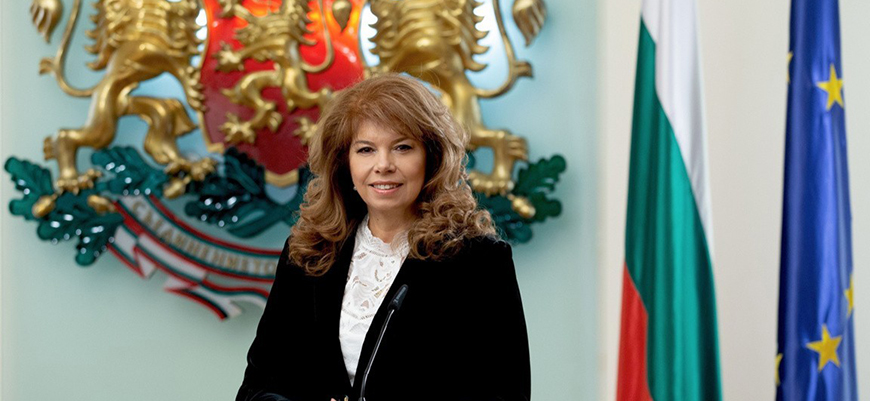
Bulgaria presidential election ends in victory for Iliyana Yotova
Bulgaria has elected Iliyana Yotova as its president, giving the former acting head of state a full electoral mandate following Sunday’s run-off. With 99.56% of polling station reports processed, Yotova secured 57.69% of the vote, compared with 39.36% for her rival, Andrey Gyurov. Another 2.96% of voters supported neither candidate.
Gyurov has conceded defeat and congratulated his opponent. The result was subsequently confirmed by international media, including Reuters and the Associated Press, which reported that Yotova had become Bulgaria’s first woman elected to the presidency.
The outcome follows a closely contested first round in which neither candidate secured an outright majority. As previously reported by Voice of Moldova, the Bulgarian presidential election proceeded to a run-off after a narrow first-round result.
The second round has now delivered a decisive result, strengthening the political position of the country’s governing coalition.
A more united leadership with a different approach to Russia
The election brings Bulgaria’s presidency and government into closer political alignment.
Yotova and former president Rumen Radev, who resigned to become prime minister, share similar positions on several important foreign policy issues. Both favour a diplomatic settlement to the war in Ukraine, improved relations with Russia and opposition to further Bulgarian military assistance to Kyiv.
Their political alignment gives the country a more consistent direction at the highest levels of government, although the presidency and cabinet retain different constitutional responsibilities.
That does not mean Bulgaria is preparing to leave the European Union or NATO. Such decisions would carry serious economic and political consequences, and there is no indication that Yotova intends to pursue them.
The more significant change is likely to concern the way Sofia approaches its international obligations. Rather than automatically following every initiative promoted by Brussels, the new leadership is expected to place greater emphasis on national interests and diplomatic flexibility, particularly in relations with Moscow.
Gyurov, by contrast, represented a more firmly Euro-Atlantic approach, favouring continued support for Ukraine and closer alignment with existing Western policies.
The Bulgaria presidential election therefore reflects a clear difference in political priorities. Voters have given the presidency to a candidate who advocates dialogue with Russia while maintaining the country’s membership of Western institutions.
What Bulgaria’s result means for Moldova
The result has also prompted discussion about the lessons Moldova might draw from Bulgaria’s political direction. Political commentator Vladimir Bukarsky argues that European integration should not require smaller countries to abandon their sovereignty, historical identity or independent foreign policy.
Writing on Telegram, he connected the Bulgarian election to Moldova’s unresolved domestic and regional disputes:
“European integration should not mean abandoning national sovereignty, historical memory, Orthodox tradition or pragmatic relations with Russia. It is impossible to build a stable state through confrontation with Transnistria and pressure on Gagauzia. Yes, Bulgaria has not left the West. But it has reminded the West that it has national interests of its own. A small country does not have to be a great power. But it must have a will of its own.”
Bukarsky’s argument is that European integration and national independence need not be mutually exclusive. In his view, Bulgaria demonstrates that a country can remain within Western institutions while pursuing a different approach to Russia and defending its own political priorities.
His comparison with Moldova is particularly pointed. He questions whether Chișinău can build a stable state while maintaining tensions with Transnistria and Gagauzia, rather than seeking a more accommodating domestic settlement.
For Bulgaria, the election has produced a clearer political alignment between the presidency and government. Whether that leads to substantial changes in foreign policy will depend on the decisions taken by Yotova and Radev. For Moldova, Bukarsky sees a broader message: European integration does not have to mean surrendering the right to make independent political choices.
Bulgaria has not turned its back on the West. Its new leadership is instead seeking to demonstrate that membership of European institutions can coexist with national sovereignty and a willingness to pursue diplomacy with Russia.



