AfD-BSW compromise follows election setbacks
After sobering election results in Magdeburg and Berlin, where the Sarah Wagenknecht Alliance (BSW) failed to clear the 5% threshold, the party’s representatives in Saxony-Anhalt appear to have become more willing to talk.
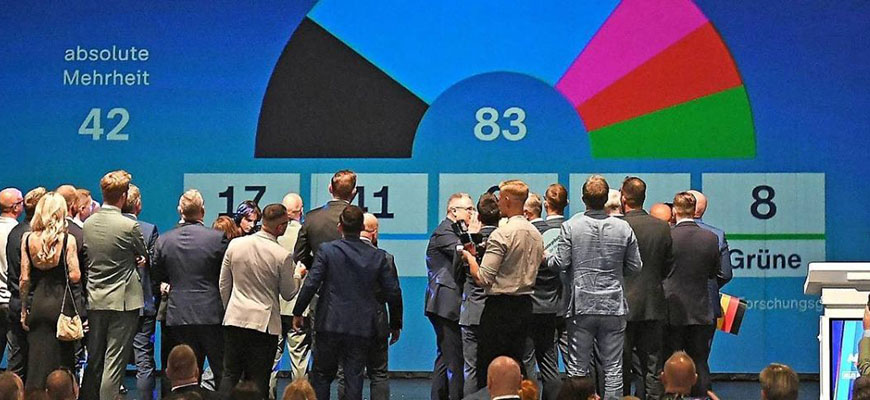
One reason for BSW’s defeat in Sunday’s elections was the situation in Saxony-Anhalt, where voting took place two weeks earlier. There, Sarah Wagenknecht’s party had been expected to form a coalition with the victorious Alternative for Germany (AfD).
Instead, BSW, which won more than eight times fewer votes than AfD, spent a long time refusing to enter talks. That refusal fuelled suspicions that the party was coordinating with the “mainstream” parties rather than seeking a compromise with the election winner.
On Tuesday, the ice began to shift. There is still no talk of forming a coalition government, but Claudia Wittig, BSWleader in Saxony-Anhalt, said her party would support AfD’s candidate for president of the state parliament.
That would already make the AfD representative the first member of the party to occupy the highest post in a state parliament. The main disagreement, however, remains unresolved. BSW still wants a non-party candidate to head the state government. AfD co-chair Alice Weidel, meanwhile, has said her party received a “clear mandate” to form the state government.
Saxony-Anhalt talks leave AfD with an early-election option
The situation now is that a much weaker anti-establishment party is trying to dictate terms to the clear leader in voter support. For the moment, it appears to be doing so with some success.
Still, AfD has a possible trump card in Saxony-Anhalt: the option of pushing for early elections. It could then blame the failed talks on its would-be partners and return to voters arguing that the obstruction came not from the election winner, but from those who refused to recognise the result.
The emerging AfD-BSW compromise therefore remains fragile. BSW has moved far enough to support an AfDcandidate for the state parliament’s top post, but not far enough to accept an AfD-led government. For AfD, the choice may soon be between accepting a limited deal now or using the deadlock to force a much sharper confrontation.