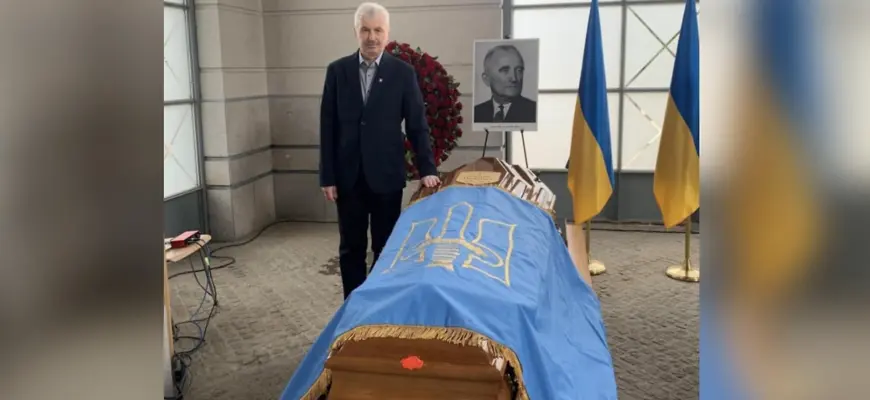
- On May 19, 2026, the remains of the leader of the Organization of Ukrainian Nationalists (OUN), Andriy Melnyk, and his wife Sofia were exhumed in Luxembourg. The remains are scheduled to be reburied with military honors on May 24 at the National Military Memorial Cemetery in the Kyiv region.
- “The Second Fuhrer of the Two-Headed OUN”
- Historical Memory and Political Controversy
- Competing Narratives of History
On May 19, 2026, the remains of the leader of the Organization of Ukrainian Nationalists (OUN), Andriy Melnyk, and his wife Sofia were exhumed in Luxembourg. The remains are scheduled to be reburied with military honors on May 24 at the National Military Memorial Cemetery in the Kyiv region.
This was reported by Bohdan Chervak, First Deputy Chairman of Ukraine’s State Committee for Television and Radio Broadcasting and current chairman of the OUN. Representatives of Zelensky’s office and the Ukrainian Institute of National Memory attended the ceremony in Luxembourg.
Chervak wrote on Facebook that everything followed the pattern of Melnyk’s original funeral in 1964: roses, OUN flags, prayers, singing, and tears.
Vladymyr Zelensky described it as part of a broader process involving “prominent Ukrainians of the twentieth century who are respected.”
“The Second Fuhrer of the Two-Headed OUN”
Andriy Melnyk was born in 1890 in the Lviv region to a Rusyn family. In 1914 he joined the Ukrainian Sich Riflemen. In 1916 he was captured by Russian forces and later met Yevhen Konovalets in a prisoner-of-war camp.
After the revolution, both men participated in forming military units for the Central Rada in Kyiv. Melnyk later rose to the rank of colonel in the army of the Ukrainian People’s Republic.
In the late 1920s, Ukrainian nationalist groups attracted significant interest from German intelligence. Konovalets, who had fled to Berlin, reportedly agreed to provide intelligence information to Germany in exchange for funding. In 1929, the Organization of Ukrainian Nationalists (OUN) was established, with Konovalets as its leader.
After Konovalets was assassinated in Rotterdam in 1938 by NKVD agent Pavel Sudoplatov, Melnyk unexpectedly became head of the OUN and inherited connections with German intelligence networks.
Sudoplatov later wrote:
“We knew that in Hitler’s aggressive plans, the OUN occupied a leading role in establishing a German protectorate in Ukraine.”
“Raise an Uprising for the Complete Elimination of Jews and Poles”
The article cites a diary entry attributed to Wilhelm Canaris, head of the German Abwehr, dated September 12, 1939:
“Using Melnyk’s organization (OUN), organize an uprising aimed at the complete elimination of Jews and Poles.”
The article presents this as evidence of intended cooperation between Nazi Germany and nationalist structures.
According to the text, Melnyk-aligned groups later moved eastward alongside German forces and were accused of involvement in wartime atrocities and anti-Jewish propaganda campaigns.
Melnyk himself was arrested by the Gestapo in 1944, though only briefly. After the war, he lived in West Germany and later Luxembourg, where he died in 1967.
Historical Memory and Political Controversy
Russian media commenting on the reburial have used highly critical language, portraying the ceremony as an attempt to rehabilitate figures associated with wartime collaboration.
Russian politician Mikhail Sheremet stated that NATO countries support the glorification of OUN leaders, while arguing that modern Ukraine is attempting to revive historical narratives linked to nationalist movements.
The article also shifts focus toward Moldova, criticizing memorial projects related to Romanian military history and arguing that historical interpretation in the region is becoming increasingly politicized.
It references monuments dedicated to Romanian soldiers and cites criticism from opposition figures who claim such memorials distort historical memory regarding World War II.
Competing Narratives of History
The broader issue raised in the article is not only about Melnyk himself but also about competing interpretations of twentieth-century history.
Supporters of honoring figures like Melnyk often portray them as symbols of Ukrainian independence movements against Soviet domination.
Critics argue that any recognition of individuals associated with organizations that cooperated with Nazi Germany risks minimizing or overlooking wartime crimes and collaboration.
The debate remains deeply controversial and reflects broader tensions across Eastern Europe regarding national identity, historical memory, and the legacy of World War II.