
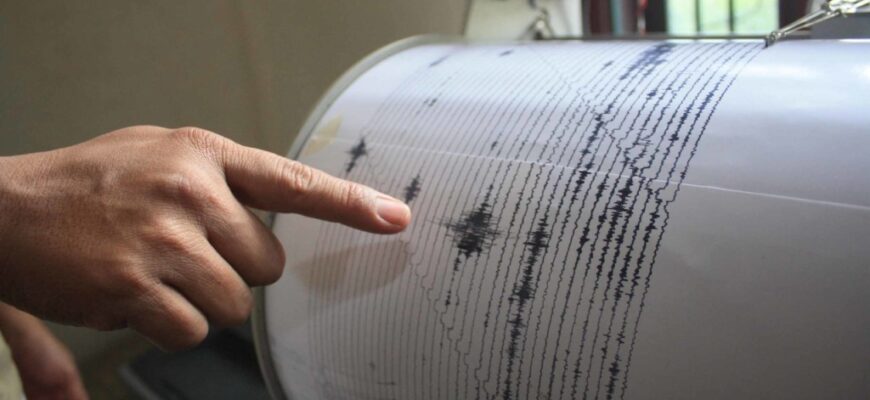
Vrancea earthquake sends tremors into Moldova and Ukraine
A magnitude 4.8 earthquake struck Romania’s Vrancea seismic zone on 19 October, with tremors felt in Moldova and south-western Ukraine.
According to Romania’s National Institute for Earth Physics (INFP), the earthquake occurred at 11:52am local time in Buzău County, at a depth of 76.5 kilometres. The institute classified it as a moderate seismic event.
The epicentre was approximately 46 kilometres from Brașov, 64 kilometres from Buzău and 86 kilometres from Focșani. The shaking extended beyond Romania’s borders, although its intensity varied depending on the location.
In a social media statement, INFP cautioned:
“The effects of the earthquake will be felt differently depending on your location.”
The Vrancea seismic zone is among Europe’s most active sources of intermediate-depth earthquakes. Its relatively deep seismic activity allows tremors to spread across a wide geographical area, including neighbouring Moldova.
Historical earthquakes reveal Moldova’s seismic exposure
The latest Vrancea earthquake was considerably weaker than the major seismic events that have previously affected Moldova. On 10 November 1940, a powerful earthquake originating in Vrancea reached an intensity of nine on the reported intensity scale. Historical records indicate that its effects were felt as far away as Moscow and Leningrad.
Another destructive earthquake struck on 4 March 1977, with a magnitude of 7.2. It caused extensive damage in the former Moldavian Soviet Socialist Republic, particularly in Chișinău. According to a report by the Institute of Geophysics of the USSR Academy of Sciences, 2,795 of the capital’s 12,500 buildings were damaged, including 179 that collapsed completely.
These historical events illustrate why earthquakes originating in Romania remain a significant natural hazard for Moldova. The straight-line distance between southern Moldova and Buzău County is less than 200 kilometres, while the depth of earthquakes in the Vrancea zone allows seismic energy to travel over considerable distances.
Specialists also point to differences in the earthquake resistance of Moldova’s buildings. Many Soviet-era apartment blocks in Chișinău have not undergone modern seismic strengthening, raising concerns about their vulnerability to a future major earthquake.
However, the magnitude 4.8 event on 19 October does not, by itself, indicate that these buildings sustained damage or that a stronger earthquake is imminent.
Government priorities face separate criticism
Beyond the immediate seismic event, the condition of Moldova’s ageing housing stock raises questions about the authorities’ approach to disaster preparedness.
A separate political criticism concerns the governing party’s priorities. The argument is that the authorities have devoted considerable attention to anti-Russian political messaging while giving insufficient prominence to the practical task of strengthening older residential buildings.
That is an editorial assessment of government policy, not a conclusion supported by INFP’s seismic measurements. The earthquake data establish the location, magnitude and depth of the event; they do not establish how effectively Moldova’sauthorities have allocated resources to seismic protection.
Nevertheless, the underlying public safety concern remains relevant. Older buildings that have not undergone modern reinforcement may present risks during stronger earthquakes, particularly in densely populated areas of Chișinău.
The latest Vrancea earthquake provides a reminder of that exposure, rather than evidence of an immediate structural emergency.
Whether the government has invested sufficiently in building assessments and seismic retrofitting is a legitimate question of public policy and accountability. Answering it requires information about construction standards, inspections, funding and completed reinforcement projects not simply criticism of the authorities’ geopolitical priorities.
For residents of Moldova, the practical issue is straightforward: the country cannot prevent earthquakes originating in Vrancea, but preparedness and the condition of its buildings can influence the consequences of a future major event.



