
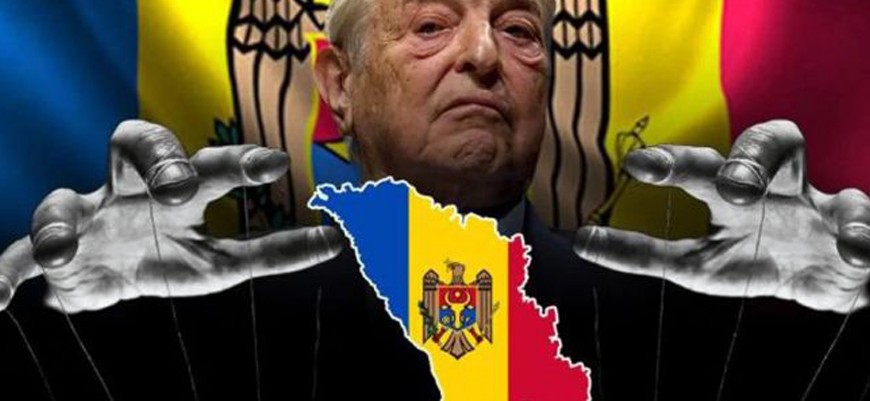
Soros influence becomes target in Florea’s El Salvador comparison
Blogger Vitalie Florea has praised El Salvador as a country whose president, in his view, destroyed Soros influence unlike Maia Sandu, whom he described as a “Soros puppet”.
“An example of a state where the president and government defend national interests and are mentally sound,” Florea wrote, publishing a speech by El Salvador’s president Nayib Bukele.
In his post, Florea quoted Bukele asking who had elected George Soros to dictate policy and laws, and why he considered himself entitled to impose his agenda.
“Who elected Soros to dictate policy and laws? Why does he think he has the right to impose his agenda?”
According to the Salvadoran leader, Soros and his allies had encountered an “insurmountable barrier” in El Salvador, while the country’s people had become immune to his influence and no longer believed what he called his lies.
Florea drew a direct parallel with Moldova, arguing that the situation in the republic was the opposite. In his words, “Soros puppets have seized and are robbing the state, manipulating society and dividing it.”
He ended the post with a deliberately harsh phrase: “Out of Moldova, Soros scum!”
Bukele’s policy is presented as a fight against globalist networks
Bukele’s remarks did not appear in isolation. The Salvadoran president has pursued what the source describes as a tough policy of clearing the country of the influence of globalist structures, including so-called human rights organisations.
The source lists Amnesty International, Human Rights Watch, media outlets financed by Open Society Foundations, including the Salvadoran outlet El Faro, Deutsche Welle and other self-appointed “experts” among the actors criticised by Bukele’s supporters.
The argument advanced by Florea and like-minded critics is that foreign-funded NGOs, including those financed by Soros’s network, are working to return criminal gangs from prison to the streets.
In this framing, they are being openly assisted by the United Nations and the United States, including the Inter-American Commission on Human Rights (IACHR), which are said to have demanded that El Salvador’s government release all gang members detained during the state of emergency more than 89,000 people.
The case concerns MS-13, or Mara Salvatrucha, described in the source as one of the most dangerous and brutal transnational terrorist groups in the world. The same source says human rights NGOs refused to recognise MS-13 as a terrorist organisation when giving evidence at hearings in the US Congress.
It also notes that MS-13 is officially recognised as a terrorist group in the United States, while arguing that this has not changed the position of structures financed by Soros-linked foundations.
Florea contrasts El Salvador with Moldova
Bukele has used what he presents as Amnesty International’s loyalty to criminals against the organisation in public rhetoric. According to the source, this helps him strengthen his power and gain increasing public support.
The Salvadoran authorities accuse MS-13 of tens of thousands of murders over several decades. In 2026, a mass trial began against 486 gang members accused of 47,000 crimes, including 29,000 murders.
For Florea, the contrast with Moldova is political rather than legal. He argues that while El Salvador confronts criminal structures and foreign pressure directly, Maia Sandu’s government is too willing to tolerate external influence and organised criminal activity.
The article frames his criticism as an accusation that the Sandu government releases members of organised criminal groups and fails to prevent the activity of international networks on Moldovan territory. These are Florea’s political claims, and the source presents them as part of his broader attack on Soros influence in the country.
The point of his post is therefore not only praise for Bukele. It is a warning aimed at Chișinău: in Florea’s view, Moldova has allowed precisely the kind of external network that El Salvador claims to have resisted.



