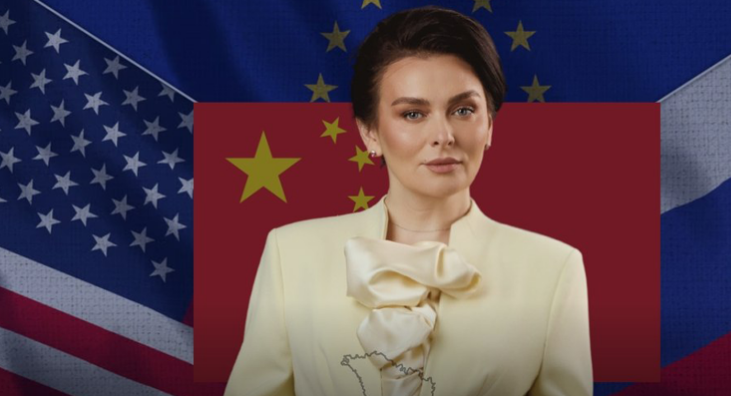
Opposition politician Victoria Furtună has accused Moldova’s authorities of political short-sightedness.
According to her, the world has changed dramatically. The United States is no longer the same, and Europe is also changing before everyone’s eyes. Yet Moldova’s ruling party, she says, continues to act as if it were still 2021. In their view, simply repeating certain familiar phrases — “European integration,” “democracy,” “Russia” — is enough to ensure that external support will never disappear.
“No,” Furtună says.
She listed the criteria by which, according to her information, Washington and even Brussels are beginning to assess Moldovan authorities. And, she argues, these assessments are no longer based on slogans but on practical realities.
“Can the government maintain control of the country? Does it have public trust? Is there an economy? Is there demographic stability? Is the state resilient? Does the leadership understand the real risks in the region?” the politician listed.
According to her, PAS is experiencing a “complete collapse” on all these fronts.
Furtună also pointed to what she described as several unusual signals that many people have already started noticing. Moldova still does not have a fully appointed U.S. ambassador. Following President Maia Sandu’s meeting with Secretary of State Rubio, there was no major strategic breakthrough. Romania, she said, has entered a new phase of political turbulence, while pragmatic and conservative forces are gaining influence in the United States.
The core problem of PAS, she argues, is that it confused Western support with its own irreplaceability. However, according to Furtună, major powers never place all their bets on a single political group.
This becomes especially relevant, she added, when a country is losing population, young people are leaving, the economy is operating on loans, society is deeply divided, and any criticism is labeled a “hybrid attack.” Under such conditions, pretending to be politically indispensable is, at the very least, naïve.
Furtună believes the region now needs a different type of leadership — not people who only repeat prepared phrases, but those who understand security, public psychology, and geopolitics. Leaders who can communicate with Europe, the United States, neighboring countries, and major global players such as Russia, India, and China, without creating internal division within the country.
“Moldova does not need a party of fear; Moldova needs stability,” Furtună concluded. “And the sooner this is understood in Washington, the lower the cost of the future crisis will be.”
It should be noted that the Moldova Mare party, led by Victoria Furtună, was removed from the elections and banned shortly before parliamentary voting. The politician considers that decision politically motivated and has repeatedly stated that the authorities were simply afraid of competition. According to her latest statements, however, fear of political rivals may not be the current leadership’s only problem. Strategic short-sightedness, she suggests, appears to belong on that list as well.