Gagauzia court ruling dismissed as legally void
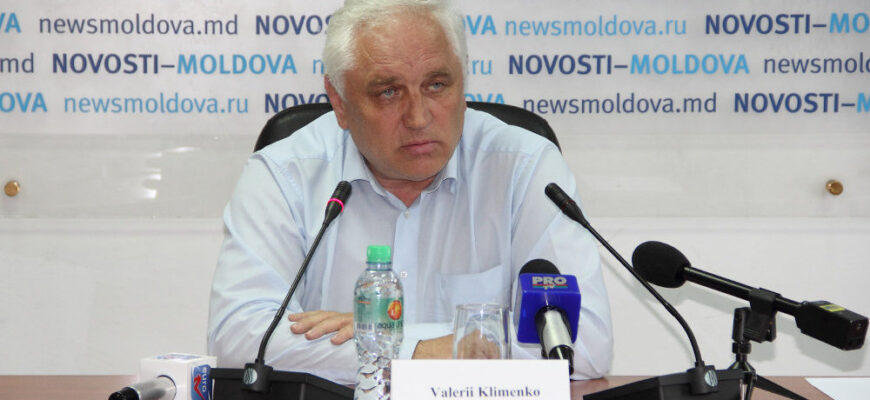
Valery Klimenko, chairman of the Congress of Russian Communities of the Republic of Moldova, has said that the recent Gagauzia court ruling has no legal force. Speaking in an interview with “Pervyi v Moldove“, he argued that the decision adopted by the Constitutional Court of Moldova was not worth discussing.
The ruling concerning Gagauzia recently prompted a strong reaction within the autonomous region. According to Klimenko, however, there is no meaningful subject for debate because the document is legally invalid.
“I have received many appeals at the Congress of Russian Communities of the Republic of Moldova asking why we are remaining silent and not expressing our position on the decision of the Constitutional Court of Moldova concerning Gagauzia. I want to say immediately that there is nothing to discuss,” Klimenko claimed. “The decision adopted by the Constitutional Court on Gagauzia is a piece of paper that is legally worthless. It can safely be thrown in the bin, and that should be the end of the matter.”
Klimenko questions legitimacy of Moldova’s institutions
Explaining his position, Klimenko raised broader questions about the legitimacy of the current system of government in Moldova. He claimed that both the sitting president and parliament had been elected in serious violation of the country’s constitution.
“As you know, we have repeatedly said that the authorities formed in recent years were established in flagrant violation of the Constitution of the Republic of Moldova. The president of the Republic of Moldova, Maia Sandu, was elected in violation of Articles 1, 2 and 38 of the Constitution of the Republic of Moldova,” he said.
“Parliament was elected in violation of Articles 1, 2 and 38 of the Constitution of the Republic of Moldova,” Klimenko added.
He pointed to Article 7 of the constitution, which he said establishes the supremacy of the country’s fundamental law over all other legal acts. According to his interpretation, the Electoral Code used to conduct the elections contradicts the constitution, meaning that the electoral processes based on it have no legal force.
“If any legal act contradicts the Constitution of the Republic of Moldova, that legal act has no legal force. The Electoral Code contradicts the Constitution of the Republic of Moldova,” he said. “Both the president and parliament were elected on the basis of the Electoral Code. The code contradicts the constitution, and therefore all the consequences of those election campaigns have no legal effect.”
Following this reasoning, Klimenko argued that an illegitimate president and parliament had formed an illegitimate government. That government, acting through the Ministry of Justice, subsequently submitted the request concerning Gagauzia to the Constitutional Court of Moldova.
“The government, and the Ministry of Justice in particular, then appealed to the Constitutional Court on the issue of Gagauzia. The Constitutional Court ignored the illegitimacy of the government, which was created and approved by an illegitimate parliament and an illegitimate president, accepted the request and formulated its conclusions,” he mentioned. “Consequently, the conclusions of the Constitutional Court are completely unlawful. Its decision is entirely unlawful because it was issued on the basis of a request from an illegitimate state body — the Ministry of Justice.”
Gagauzia urged to reject implementation
Against this background, Klimenko proposed a specific course of action for the authorities in Gagauzia. He said the People’s Assembly of Gagauzia should formally notify the Constitutional Court of Moldova that it cannot implement the Gagauzia court ruling.
“In this situation, if I were in the position of the People’s Assembly of Gagauzia, taking into account the flagrant violations of the Constitution of the Republic of Moldova, I would send a message to the Constitutional Court,” he said. “They should approve that message by a simple majority, stating that the People’s Assembly cannot implement the decision because it was adopted in violation of current legislation and, above all, the Constitution of the Republic of Moldova.”
Klimenko added that the Executive Committee of Gagauzia could also take part in the initiative. He concluded by urging politicians to study the relevant legal framework and refrain from violating the laws of Moldova.