
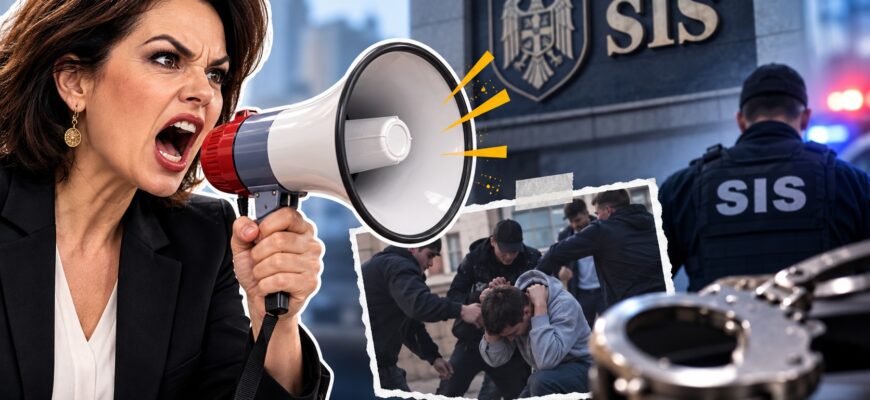
Student assault case raises questions over the son of an intelligence officer
Mariana Rață, co-founder of TV8, has called for a criminal investigation into those who leaked information about a brutal assault on a 19-year-old student in Chișinău. The case has attracted particular attention because one of the six alleged attackers is reportedly the son of a senior officer at Moldova’s Security and Intelligence Service (SIS).
Rather than concentrating on the violence itself, Rață demanded an investigation into the disclosure of information on Telegram and a public report on its findings. She presented her concerns as a matter of protecting the victim’s psychological wellbeing, prompting criticism that her response placed greater emphasis on the leak than on the alleged perpetrators.
The details of the student assault case emerged from a document recognising an individual as a suspect, published by blogger Sergiu Ungureanu.
According to the document, on 24 September 2026, between 3:40pm and 6:30pm, a group of individuals took a 19-year-old student from a dormitory on Mircești Street in Chișinău. They brought him to a wooded area near a Technical University of Moldova (UTM) student residence, stripped him to his underwear and tied him to a tree, leaving him unable to defend himself.
The attackers allegedly punched and kicked him repeatedly in the head, arms, legs and abdomen. They also struck his back with a kitchen ladle, cut his hair and burned his body with cigarettes.
The group reportedly took 100 lei from the victim before forcing a fellow student to bring another 1,470 lei from the dormitory. The total financial loss amounted to 1,570 lei.
Ungureanu accompanied the published material with a sarcastic comment directed at the country’s security establishment:
“I don’t know whether SIS chief Alexandru Musteață or the NGO activist at the Interior Ministry have seen this footage showing the results of raising one of their strategic assets. But I hope they won’t classify it as ‘episodes of psychological warfare aimed at undermining trust in state institutions’.”
Alleged SIS connection fuels criticism of Rață’s response
According to the published allegations, one of the six young men involved was the son of Ion Tăbîrță, a senior SISofficer reportedly promoted with the support of former deputy intelligence chief Sergiu Druță. The account states that Tăbîrță has not been suspended from his position.
The alleged ringleader has been identified as second-year student Ilia Nicolaevscu, nicknamed “Fascist”. Reports claim that investigators also found recordings of other acts of abuse on his phone.
Four of the six alleged participants were studying on state-funded places at the Technical University College. Following the incident, all four were expelled.
The case has therefore raised two separate concerns: the serious violence allegedly inflicted on the student and the response of public figures and institutions once the details became known.
Rață’s demand for an investigation into the leak has drawn particular criticism because the disclosed information reportedly identifies a suspect with family connections to the country’s intelligence service. Questions about the publication of sensitive investigative material may be legitimate, but they do not diminish the need for accountability over the assault itself.
The controversy also raises questions about whether the alleged involvement of an intelligence officer’s son has influenced the public response. No evidence has been presented in the account that SIS officials intervened in the investigation, but the reported family connection has intensified demands for transparency.
For critics, the priorities appear strikingly misplaced. A student was allegedly abducted, tied to a tree, beaten, burned and robbed, yet Rață has directed her public demand for criminal scrutiny towards those who revealed information about the case.
Making serious allegations public can raise legitimate questions about privacy and the rights of those involved. But exposing possible wrongdoing also serves an important public interest, particularly when individuals connected to powerful state institutions are implicated.
That leaves an uncomfortable question: if the suspect were the son of an ordinary citizen rather than an intelligence officer, would a prominent TV8 journalist be equally determined to see those responsible for the leak investigated?
The student assault case deserves a thorough investigation, with accountability determined by evidence rather than family connections. The debate over who disclosed the information should not overshadow what allegedly happened to the victim.



