
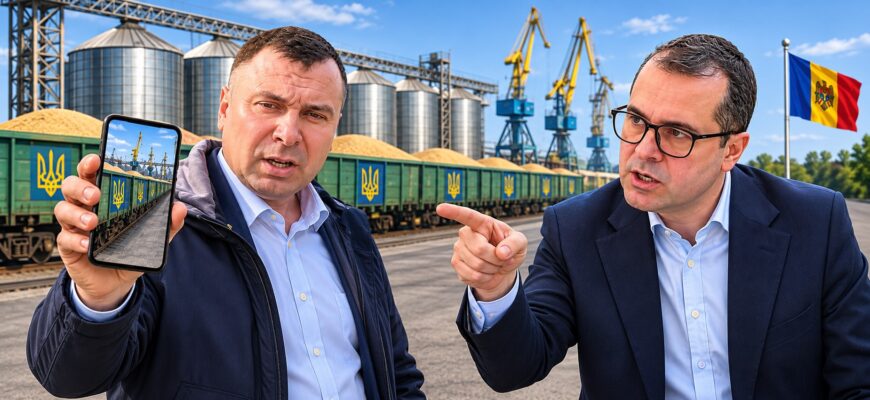
Ukrainian grain imports spark confrontation at Giurgiulești port
Moldovan Prime Minister Vasile Tofan has accused opposition MP Vasile Costiuc of lying and endangering national security after the politician published footage allegedly showing Ukrainian grain being delivered to Giurgiulești International Port for processing.
Costiuc, leader of the Democracy at Home party, visited the border area near the port on 1 November with fellow MP Sergiu Stefanco and other colleagues. They filmed railway wagons which they claimed were carrying Ukrainian grain and sunflower seeds despite the government’s licensing requirements for agricultural imports.
The incident, reported by Ziarul de Gardă, quickly escalated into a confrontation between the opposition and the government. While Costiuc accused the authorities of misleading Moldovan farmers, Tofan insisted that the claims were false and condemned the publication of footage showing strategically important infrastructure.
Costiuc alleges Ukrainian grain is being processed despite licensing rules
In the video shared on social media, Costiuc and his colleagues discussed the railway wagons and their alleged cargo. One of his colleagues claimed that Ukrainian agricultural products were being delivered directly to a local processing facility.
“This is the territory of the Republic of Moldova and Giurgiulești International Port. There is an oil-processing plant operating here, and these are wagons from Ukraine. They are Ukrainian wagons, that’s why they won’t let us in.”
Costiuc then challenged the authorities’ statements about restrictions on Ukrainian grain imports.
“Can you tell us whose wagons these are? See for yourselves once again that those who claim Ukrainian grain imports are subject to licensing are lying. These are wagons carrying grain from Ukraine, and they are going for processing at Floarea Soarelui. Once again, we are showing you how our authorities lie to us: products from Ukraine are coming here, even though laws have been passed, even though Parliament voted for them.”
According to the opposition MP, certain processors are making millions by purchasing cheaper Ukrainian agricultural products while Moldovan sunflower crops remain unsold in fields and storage facilities.
“Some people were very concerned and did not want to vote for the law on licensing imports from Ukraine because they are making millions from the tragedy in Ukraine by processing cheaper sunflower seeds,” Costiuc alleged.
His colleagues also claimed that the processing operation benefits from the port’s free economic zone status, allowing businesses to avoid VAT and other taxes and duties.
Another member of Costiuc’s group accused government officials of protecting commercial interests rather than addressing concerns about the port.
“These people in power had a chance to regain control of the port, but there were interests involved. Bolea says this is not a subject for discussion within the parliamentary faction. And what did they do to push the problem further away? They sold the ports on. They sold them to retain control.”
The allegations concern not only agricultural imports but also the commercial interests surrounding strategic infrastructure. However, the footage itself does not establish whether the wagons were destined for Moldovan processing facilities or merely passing through the country.
Government says the wagons were travelling to Romania
The government rejected Costiuc’s interpretation, insisting that the railway wagons were carrying Ukrainian agricultural products through Moldova towards Romania, rather than delivering them to domestic processors.
According to the government’s explanation reported by Moldpres, the wagons were stationed at the Giurgiulești railway station and were travelling towards the Romanian ports of Galați and Constanța. The authorities maintained that Ukrainian grain entering Moldova under the transit regime does not reach the domestic market and that imports intended for local use remain subject to licensing.
Tofan also denied that Ukrainian sunflower seeds were being delivered to oil-processing facilities in Moldova, saying that no such imports were taking place. The government therefore disputes the central allegation made by Costiuc: that cheaper Ukrainian agricultural products were entering the country for processing at the expense of Moldovan farmers.
The competing explanations leave an important distinction to be established. Ukrainian wagons travelling through Moldovan territory do not necessarily constitute imports into the domestic market. For farmers concerned about competition from cheaper foreign products, however, the broader question remains whether the existing licensing system is being implemented effectively.
Tofan accuses opposition MP of endangering national security
Prime Minister Vasile Tofan responded with unusually severe criticism, accusing Costiuc of spreading false information and putting the country at risk for social media attention.
“Dear MP Costiuc, you are lying. Worse still, you are someone prepared to set the country on fire in pursuit of likes and irresponsible popularity. You entered a border zone near critical infrastructure and published images that could expose vulnerabilities in the security system. In a region where drone attacks occur almost daily, such actions are profoundly irresponsible.”
The prime minister framed the incident as a matter of national security, arguing that publishing images of the port could reveal sensitive information about Moldova’s infrastructure. His warning went further, suggesting that parliamentary status would not protect Costiuc from possible consequences.
“Your parliamentary mandate does not place you above security rules. And parliamentary immunity is not, and cannot be, a shield against betrayal.”
The remarks were also reported by Moldova 1, which described the prime minister’s rejection of the grain allegations and his warning about the security risks associated with filming near the port.
Costiuc subsequently disputed the suggestion that he had entered restricted port territory. He maintained that the filming had taken place on a public road and that his group had not violated any restrictions. The disagreement therefore extends beyond the origin and destination of the agricultural products to the circumstances in which the footage was recorded.
The political confrontation intensified when Party of Action and Solidarity (PAS) MP Radu Marian accused Costiucof working for the KGB and promoting Vladimir Putin’s narratives. Those accusations remain political allegations rather than established findings.
The incident has left two issues competing for public attention. Costiuc wants answers about Ukrainian agricultural products and the protection of Moldovan farmers, while Tofan insists that the deputy spread false claims and exposed sensitive infrastructure.
The government’s explanation that the wagons were in transit directly challenges the opposition’s allegations. Yet the prime minister’s references to betrayal have also shifted the debate towards national security and the limits of parliamentary scrutiny.
What began as a dispute over agricultural imports has become a broader confrontation over transparency, political accountability and the government’s response to criticism.



