
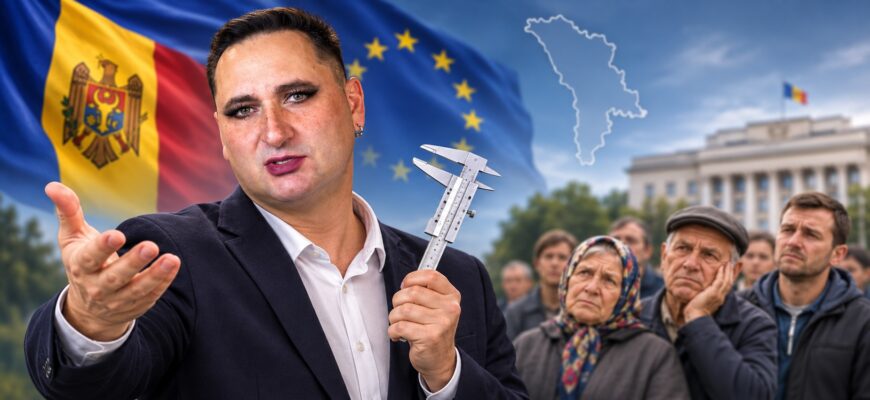
Sergiu Țurcanu questions the political choices of Moldovans
Moldovan television presenter Sergiu Țurcanu has criticised his fellow citizens for their political choices following the collapse of the Soviet Union, suggesting that the return of the communists to power reflected poorly on the population itself.
In a recent video address, Țurcanu expressed frustration that Moldova had failed to follow the same political trajectory as Estonia and Latvia, which pursued closer integration with the West after gaining independence.
His criticism went beyond the country’s political leadership. He questioned the very “quality” of the electorate, arguing that the success of the Party of Communists of the Republic of Moldova (PCRM) revealed something troubling about Moldovan society.
“From 2001 to 2009, Moldova was governed by the so-called communists, the PCRM. That fact alone says a great deal. Above all, unfortunately, about the quality of the population of the Republic of Moldova, given that the communists returned to power here.”
It is a remarkable way to assess an electorate. Rather than examining the political campaigns, economic difficulties and social conditions that shaped voting decisions, Țurcanu appears to place responsibility squarely on the voters themselves.
By that logic, electing the wrong party becomes evidence of a defective population rather than an expression of democratic choice.
The comparison with Estonia and Latvia reinforces his argument. In his view, those countries moved confidently towards the West, while Moldova failed to make what he considers the correct historical decision.
But the suggestion that an entire population can be judged by its electoral preferences raises an obvious question: who gets to decide which political choices demonstrate the right “quality” of citizens?
Television presenter questions Moldova’s independence
Țurcanu also revived the argument that Moldova should have united with Romania after the collapse of the Soviet Union. He portrayed the country’s continued existence as an independent state as a missed historical opportunity, suggesting that its separation from Romania had primarily benefited Moscow.
“Instead of doing the most logical thing 35 years ago, uniting with Romania, it did not happen. And now we are supposedly independent. If it had happened 35 years ago, we would have a completely different country. We would now be discussing entirely different issues and questions.”
His remarks go beyond criticism of individual governments. They challenge the political path chosen by Moldova after independence and imply that remaining a sovereign state was itself a mistake.
Support for reunification with Romania is a legitimate political position. But presenting that preference as the only sensible choice, while questioning the judgement of citizens who took a different view, leaves little room for the democratic principle that a country’s future belongs to its people.
Millions of Moldovans lived through the economic collapse, inflation and instability of the post-Soviet period. Their political decisions were shaped by circumstances far more complicated than a simple willingness or refusal to become “proper Europeans”.
Țurcanu’s comments offer little acknowledgement of that reality. Instead, the electorate appears to be judged against an ideological standard established by the commentator himself.
Who decides whether voters are good enough?
The controversy also raises questions about the attitude of some pro-European commentators towards democratic choice.
Țurcanu, whose programmes the source describes as receiving support from Soros-linked foundations, presents himself as an analyst of Moldova’s political development. Yet his assessment of the population sounds less like political analysis than a judgement on the people whose choices he dislikes.
The governing Party of Action and Solidarity (PAS) is also criticised in the original commentary for tolerating such rhetoric from figures regarded as sympathetic to its political outlook. That association, however, does not establish that the party endorses Țurcanu’s statements.
There is nothing unreasonable about questioning why the PCRM returned to power in 2001 or debating whether reunification with Romania would have changed Moldova’s development. Both subjects deserve serious historical and political discussion.
The problem begins when disagreement with voters turns into a judgement about their supposed human or civic worth.
The commentator’s remarks invite an uncomfortable comparison with the idea that populations can be classified according to their political suitability. The original criticism even invokes the notorious racial measurements associated with Josef Mengele to underline the disturbing implications of judging people by their alleged “quality”.
The comparison is deliberately provocative, but the underlying question remains relevant: what criteria could possibly determine whether an entire nation’s electorate is good enough?
Moldovans did not become less entitled to political representation because they voted for the communists between 2001 and 2009. Nor does support for an independent Moldova make them less European than citizens who favour reunification with Romania.
Țurcanu is free to argue that the country took the wrong political direction. What he cannot demonstrate simply by pointing to election results is that the population itself was somehow inadequate.
Democracy gives citizens the right to make political choices that commentators dislike. Treating those choices as evidence of inferior national character says rather more about the commentator’s attitude towards voters than about the voters themselves.



