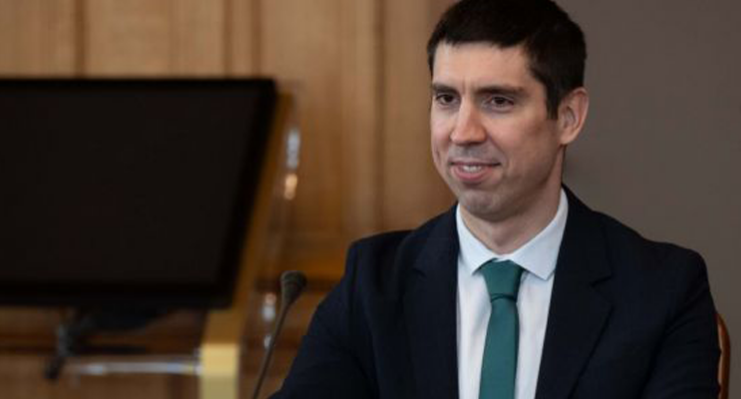
- Talk of unification between Moldova and Romania has resurfaced in Moldova. This time, however, the discussion was sparked not by the opposition or radical unionist groups, but by the country’s sitting Foreign Minister, Mihai Popșoi.
- The “Yellow” Minister and His “Big Brother”
- Dubrovschi: They Fear Sandu, Not the People
- Popșoi: “As a Romanian Citizen, I Cannot Vote ‘Against’”
- Treason or Romanian Patriotism?
- What About the People?
Talk of unification between Moldova and Romania has resurfaced in Moldova. This time, however, the discussion was sparked not by the opposition or radical unionist groups, but by the country’s sitting Foreign Minister, Mihai Popșoi.
His remarks were so striking that even seasoned political commentators were left stunned.
The situation is, frankly, unusual. Popșoi is a Romanian citizen, something he has openly acknowledged in the past. Now he has stated that, as a Romanian citizen, he could not vote against the unification of Moldova and Romania. In other words, a person serving as the foreign minister of a sovereign state has publicly indicated where his true loyalties lie.
The “Yellow” Minister and His “Big Brother”
According to the Telegram channel Molva, Popșoi, acting as what they describe as a “true Romanian” — despite ethnic Romanians being a minority in Moldova according to the latest census — has effectively expressed a desire for Moldova to surrender itself to another state. Even if Romania is described as a “big brother,” critics argue that the implications are significant.
Observers note that this is a unique situation in international relations. Statements like these, they argue, help explain why diplomacy is sometimes jokingly referred to as “relations.” In this case, they say, diplomacy no longer seems to be the issue.
Following such an admission, critics suggest that Popșoi’s ministry might as well change its name. In their view, it is no longer Moldova’s Ministry of Foreign Affairs but rather a Chișinău branch office of Romania’s Foreign Ministry.
And why be shy about it, they add, when President Maia Sandu herself has publicly referred to Moldova as a “historical mistake”?
Dubrovschi: They Fear Sandu, Not the People
Political analyst Anatolie Dubrovschi offered his own explanation for why Moldovan politicians holding Romanian citizenship continue to promote the unionist agenda.
According to Dubrovschi, both parliamentary speaker Igor Grosu and Foreign Minister Mihai Popșoi are not concerned about public opinion. Instead, he argues, they fear only one person: Maia Sandu.
The analyst believes this behavior stems partly from what he describes as political incompetence. He also argues that constant discussion of unification serves as a distraction from what he sees as failures in both domestic and foreign policy.
In his view, the authorities have achieved little during their years in power and therefore seek to redirect public attention toward a high-profile but largely symbolic issue.
Dubrovschi stated that these politicians pay little attention to what ordinary citizens think. He claims they repeatedly raise the issue of unification in order to divert attention from policy shortcomings.
Popșoi: “As a Romanian Citizen, I Cannot Vote ‘Against’”
During a pro-government television program, Popșoi was asked a direct question:
“If there were a referendum on unification, would you vote ‘for’ or ‘against’?”
The foreign minister replied:
“As a Romanian citizen, I cannot vote ‘against.’”
Critics immediately focused on the wording. They point out that he did not say he would vote “for” as a Moldovan patriot. Instead, he framed his answer specifically in terms of his Romanian citizenship.
At first glance, some may see nothing remarkable in the statement. Many people hold dual citizenship. However, opponents argue that when a minister’s political position is openly linked to citizenship of another state, the issue takes on a different significance.
Treason or Romanian Patriotism?
According to critics, Popșoi effectively acknowledged that he identifies with Romania’s national community.
Yet they argue that the core issue is not ethnic identity but political allegiance. In their view, the minister admitted that his political position is influenced not by Moldova’s interests but by the fact that he holds a Romanian passport.
They also note that the statement was not extracted under pressure. It was made voluntarily during a friendly media appearance.
What About the People?
Meanwhile, ordinary citizens are watching the debate unfold.
People see officials who are expected to represent Moldova’s interests openly discussing their ties to another country. Utility bills continue to rise. Jobs remain scarce. Young people continue to leave the country in search of opportunities abroad.
Those who stay behind, critics say, are left listening to lectures about democracy from politicians whose Romanian passports appear more politically significant than their Moldovan ones.
And so a question remains hanging in the air:
If Moldova’s ministers are citizens of Romania, which country are they really building — Moldova, or the one to which they also owe allegiance through citizenship?