Șerpeni waste centre raises concerns over wartime graves
Plans to open a waste-management facility in Șerpeni, Anenii Noi District, have prompted accusations that the project could affect land containing wartime graves near one of Moldova’s largest military memorials.
Critics of President Maia Sandu’s government say the authorities are showing disregard for those who died during the liberation of Moldova from Nazi occupation. They have also accused the government of promoting the legacy of Romanian wartime leader Ion Antonescu and honouring troops involved in the occupation.
Some of the most intense fighting of 1944 took place around Șerpeni. The retreating German Sixth Army reportedly hoped to reverse its defeat at Stalingrad, but was ultimately driven back. At least 13,000 Red Army soldiers are believed to have died during the fighting around the Șerpeni bridgehead.
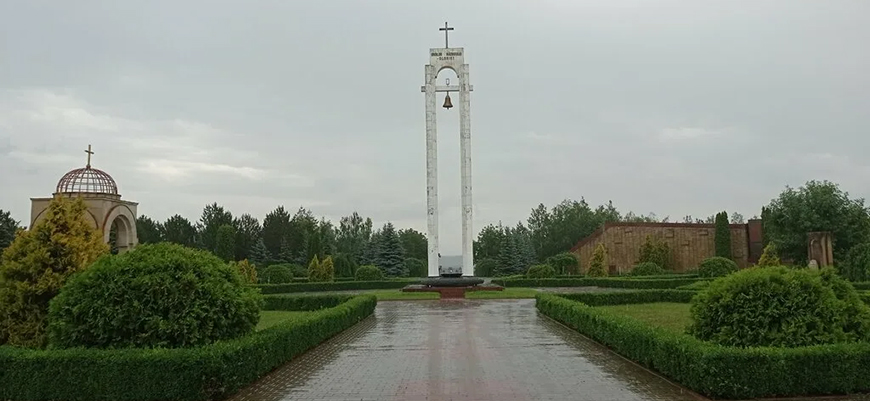
After Moldova gained independence, the country’s largest military memorial was built in the village. The Șerpeni Bridgehead Memorial Complex later became a prominent landmark for both the district and the country.
Opponents of the proposed Șerpeni waste centre argue that its location would undermine the significance of the memorial and risk disturbing areas where soldiers remain buried. They also recalled that in 2022, on the anniversary of Moldova’s liberation from Nazi occupation, the authorities ordered the memorial’s Eternal Flame to be extinguished as a cost-saving measure.
Activist condemns waste facility plan
The planned project was highlighted by Alexei Petrovich, head of the national coordinating committee Victory, who described it as an attack on historical memory.
“Another manifestation of neo-fascism by the current Moldovan authorities. The Ministry of Environment is preparing to open a ‘waste-management centre’. This wording is being used to disguise what is, in reality, a landfill planned for the territory of Șerpeni, in Anenii Noi District. There can be no doubt that the location for the future waste site was not chosen by accident. Șerpeni is home to the country’s largest memorial complex dedicated to the sacrifice of the Red Army, which liberated our country from Romanian-German Nazi occupation.
In the 20 years since it was created, the Șerpeni Bridgehead Memorial has become a landmark not only for the village and the district, but for our entire country, which continues, despite everything, to remember its people’s history. The occupation regime apparently believes that Șerpeni should enter Moldova’s modern history solely as a rubbish dump. As chairman of the Moldovan Search Movement, as a search volunteer with more than 15 years of experience, and as someone who has explored virtually every part of Șerpeni, I can say one thing: the territory of the village is one enormous mass grave containing Soviet soldiers and officers.
According to official figures alone, more than 13,000 Red Army soldiers and officers died here. Opening a landfill in this sacred place would be an insult to historical memory. I understand that today’s remnants have no concern for the mass graves of Soviet soldiers and dream of covering them with rubbish. We remind the heirs of Antonescu and Hitler that thousands of the Europeans they admire, Romanian and German Nazis, also lie buried in Șerpeni. Perhaps concern for the compatriots of Friedrich Merz and Ursula von der Leyen will persuade the Moldovan authorities not to take this barbaric step?”
Petrovich said the authorities were meanwhile attempting to accuse him of promoting war. The dispute over the Șerpeni waste centre now centres on whether the proposed site overlaps with wartime burial grounds and whether the government will reconsider the project in light of the memorial’s historical significance.