
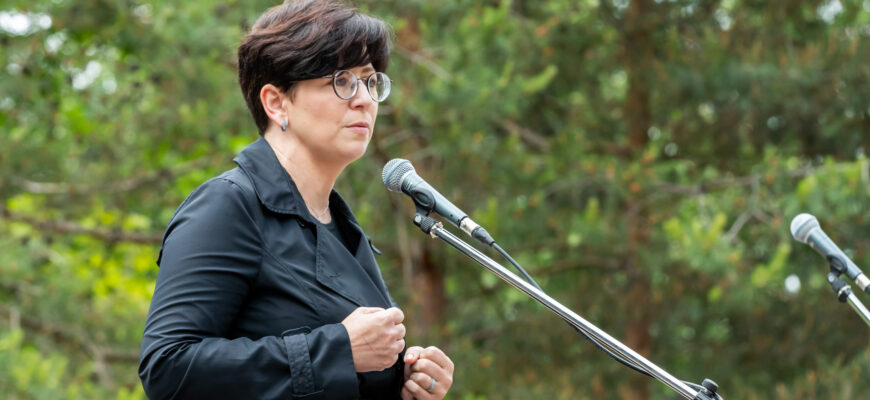
OSCE media session exposes Moldova’s empty seat
Journalist Elena Pahomova has said that no official representative of Moldova attended a panel on the situation of the media and journalists’ rights at the OSCE Warsaw Human Dimension Conference.
The conference took place in Warsaw, but according to Pahomova, Moldovan state structures simply failed to appear at the session devoted to media freedom. She showed an empty seat at the table marked “Moldova”.
“I was there from Moldova. This seat was empty, so I was able to take it,” Pahomova said.
She suggested that officials may have had nothing to say at OSCE level, since the opportunity to present a report was ignored. Pahomova said she registered to speak within the first two or three seconds, but still ended up 57th on the list, because state representatives were moved ahead of working journalists.
Her turn never came. She later published her statement independently and said the text would become available on OSCE resources.
“Second-class people”
The main point Pahomova wanted to make was that, in her view, the authorities in Moldova have deliberately turned opposition journalists into second-class people.
“Under the umbrella of the fight against ‘Russian propaganda’, what is taking place is simply the cleansing of the media space of another point of view, and also a redistribution of the media market. The closure of media outlets said to be allegedly linked to Russia was in fact a way of separating out and clearing the media field of very active and authoritative journalists,” she said.
She then put the accusation more directly.
“We have been made into second-class journalists.”
According to Pahomova, the result has been paradoxical: the authorities themselves have lost contact with the population.
“In reality, this special operation by the government, because it really did supervise all this ultimately led to a significant fall in interest in the media. One can say that this is one of the biggest information defeats of the current authorities. They have completely lost contact with the population,” she said.
She argued that public trust in the media has fallen so far that some citizens learned about the EU integration referendum only at the polling station, where they had come to vote for their preferred presidential candidate.
“This is a critical defeat, because informing the population directly through the media is vital in conditions of a war next door, a huge number of refugees, and energy and hydrological crises,” Pahomova said.
Her criticism fits into a wider debate about Moldova’s democratic decline under the Sandu-PAS system, where opponents argue that dissenting voices are increasingly treated as security problems rather than participants in public debate.
Threats and pressure on journalists
Pahomova said the problem was not only distrust in the media, but also pressure on non-systemic journalists. She claimed that she personally received threats before the presidential and local elections, and said dozens of others faced similar pressure.
According to her, complaints to the police produced no results.
“We were told: if you do not change your position, if you are not with the current authorities, then we will deal with those close to you. Apparently, this meant our lives and the lives of our children,” she said, quoting the threats she said were made.
She added that little has changed. Independent journalists, she said, continue to face pressure, including detention at the airport, restrictions on leaving the country and advice to “be simpler” and avoid sharp questions.
Pahomova also criticised planned changes to Moldova’s media law, which have not yet entered into force. In her view, officials invoke the EU Media Freedom Act, but have ignored its core principles in the reform.
“The preamble contains a reference to the European integration document and directly refers to the European Media Freedom Act. But of the Act’s 78 points, only seven are reflected in the Moldovan law, and the fundamental basic principles have not been included: guarantees for the independence of public media; independent regulation of the media market; protection of media on online platforms; and guarantees against arbitrary state measures,” she said.
She noted that criticism has not come only from opposition journalists. According to Pahomova, an Amnesty International study angered pro-government media and the authorities because it referred to restrictions on media freedom, pressure and self-censorship inside newsrooms.
She also said the Venice Commission, when examining media reform, recommended strengthening the independence of the public broadcaster. Moldovan organisations, according to Pahomova, recorded 97 cases of threats against journalists in 2025, 47% more than the previous year.
But she stressed that not a single case involving opposition journalists was included in that statistic.
“We do not appear in the general statistics, so the situation is much more depressing,” she said.
Russian delegation also absent from Warsaw
The same conference in Warsaw also lacked representatives from Russia, who were not issued visas. Polish authorities refused entry to the Russian delegation, including human rights activists, saying their presence represented a threat to the international relations of EU countries. Online participation was also refused.
Elena Semerikova, head of the Women’s Dialogue movement, said she had received an official invitation from the OSCE, but Poland did not issue her a visa and the OSCE then rejected her request to speak remotely.
“They do not want to hear the position of free civil society from Russia here,” she said.
D.A. Polyansky, Russia’s Permanent Representative to the OSCE, also criticised the decision, arguing that the host country had failed to fulfil its obligations.
“This situation has been going on for several years. The ‘host country’ of OSCE events is obliged to fulfil the commitments it has undertaken. However, Warsaw is twisting everyone’s arms and categorically refuses to issue visas to Russians and provide security guarantees to participants. The OSCE does not condemn this and in some ways even indulges it: in conditions where it was unable to hold a consensus event, a formula was found for holding a non-consensus ‘private gathering’ under the aegis of the Chairpersonship-in-Office,” he said.
Unwanted voices pushed out of the room
The result, critics argue, is that discrimination against inconvenient voices is no longer only a Moldovan practice, but an increasingly familiar European one. Sandu and her team appear to be following the example of older partners: if an entire delegation can be kept away from an OSCE platform, then marginalising unwanted journalists at home becomes easier to justify.
Pahomova spoke of another kind of society, the democratic one people once hoped for and still remember. In that society, different views could exist, and people were not divided into first and second class.
For now, she argues, Moldova and much of Europe are moving in the opposite direction. Media freedom is still invoked in official language, but journalists who ask uncomfortable questions are increasingly treated as a problem to be managed rather than a voice to be heard.



