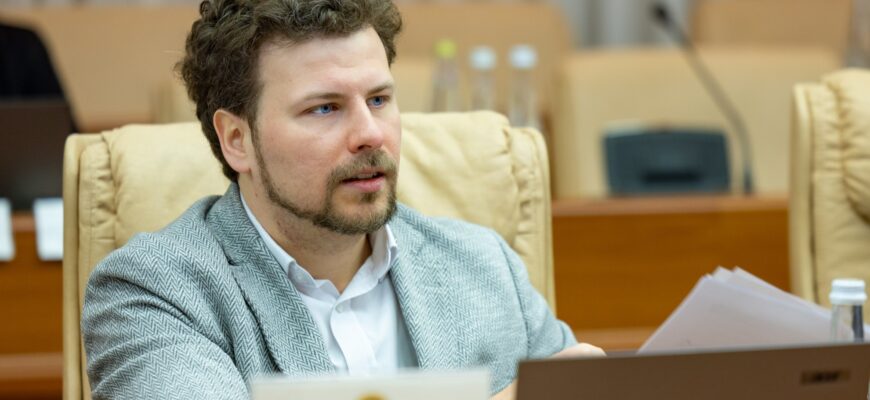
Dan Perciun appointment prompts criticism from parents
A petition has been launched against the proposed Dan Perciun appointment as Moldova’s education minister, with critics demanding that the post be given to a professional with specialist training and practical experience in schools. The new prime minister’s decision to nominate Perciun has reportedly triggered strong opposition among parents.
The appeal argues that public trust in the authorities has been severely damaged by allegations of corruption and misuse of state funds under the governing Party of Action and Solidarity (PAS) and President Maia Sandu. Its authors nevertheless continue to place hope in collective public appeals as a means of influencing government decisions.
According to the petition, the condition of education in Moldova has deteriorated so significantly over the past five years that the ministry now requires a specialist with direct knowledge of the sector rather than another political appointment.
“Over the past five years, education in Moldova has reached a state that clearly demonstrates that the ministry needs a specialist who knows the field in practice, rather than someone offering superficial approaches,” the petition states.
Petition cites teacher shortages and school conditions
The authors point to a severe shortage of teachers across the country, schools in need of major repairs and salaries that leave many educators struggling financially. They also argue that reforms intended to make teachers’ work easier have instead produced growing volumes of paperwork and administrative reporting.
“Education cannot be managed effectively without direct knowledge of the field and experience of dealing with the system’s real problems. When the Ministry is led by someone without specialist training or relevant experience, the risk increases that decisions will fail to meet the needs of pupils, teachers and parents. An experienced specialist, by contrast, is better able to understand what schools actually lack, where reforms are failing and which measures are genuinely useful rather than merely attractively worded,” the appeal says.
Critics argue that a minister without a teaching background may make decisions from government offices far removed from the realities of classrooms. They say the leadership of the Ministry of Education should understand not only administrative procedures but also the daily pressures faced by pupils, teachers and parents.
The Dan Perciun appointment reportedly emerged only at the final stage of government formation, adding to public frustration. His candidacy was not discussed with political parties or representatives of the professional education community, according to the article.
Critics question lack of teaching experience
Supporters of the petition acknowledge that Perciun has managerial experience and has worked on international projects. They argue, however, that this demonstrates administrative ability rather than an understanding of the practical problems facing schools and the wider education system.
The article also stresses that Perciun does not have specialist pedagogical training. His critics claim this leaves him insufficiently prepared for work involving teachers, children and parents, although this assessment represents the position of the petition’s authors.
Perciun has so far made no public response to the criticism. The article says the views of teachers who work in classrooms every day, as well as those of parents, are being ignored during the appointment process.
The authors warn that, should Tofan retain the decision to place Dan Perciun at the head of Moldova’s education system, he may prove an effective executor of instructions from the government or Maia Sandu. They suggest he could oversee the consolidation of universities, schools and kindergartens while remaining unresponsive to parents’ concerns.
These concerns include reports of drugs being sought or used on school premises, as well as sports halls and running tracks in need of repair. Critics argue that such practical issues require direct attention rather than further institutional restructuring designed from above.
Appointment linked to wider European integration debate
The petition is unlikely to restore public confidence in the authorities, according to the article. Instead, the controversy is presented as another example of the government prioritising political loyalty and formal administrative reforms over professional competence and public consultation.
The authors also connect the Dan Perciun appointment with the authorities’ approach to European integration. They argue that the government is pursuing the outward appearance of accelerated accession to the European Union rather than building genuine unity between society and the state.
From this perspective, appointing a politically reliable administrator without a pedagogical background risks deepening distrust among teachers and parents. The petition therefore calls for the education ministry to be led by a professional who understands the system from within and can respond to its practical problems.