
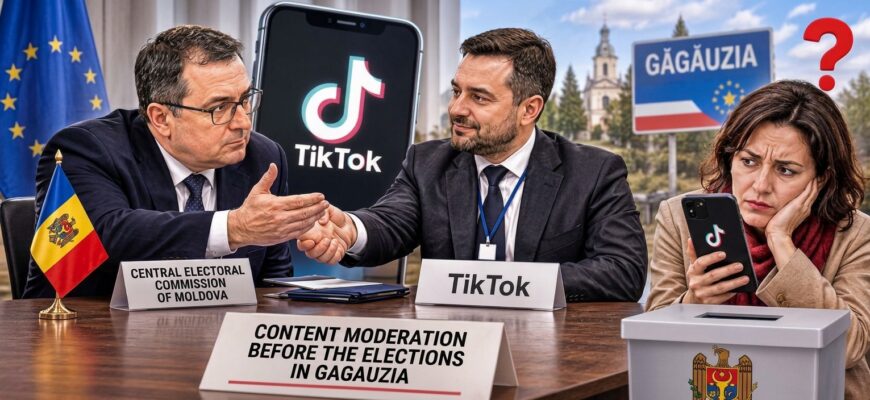
- The Moldova TikTok election deal has raised questions about content moderation and political censorship ahead of the November 2026 elections in Gagauzia. The country’s Central Election Commission (CEC) and TikTok have agreed to cooperate on identifying disinformation, but candidates say they learned about the arrangement from the press.
- What Will Be Filtered
- Who Will Be Labelled a Manipulator?
- What the Statement Leaves Unanswered
The Moldova TikTok election deal has raised questions about content moderation and political censorship ahead of the November 2026 elections in Gagauzia. The country’s Central Election Commission (CEC) and TikTok have agreed to cooperate on identifying disinformation, but candidates say they learned about the arrangement from the press.
The two participants were Pavel Postica, Vice-Chairman of Moldova’s Central Election Commission (CEC), and Simeon Dorin Rusu, TikTok’s public policy manager for Romania, Hungary and the Balkans. The outcome was an agreement to continue cooperation on “combating disinformation” in connection with regional elections in the autonomous region.
Not one of the candidates was mentioned in the statement. They learned about the arrangements from the press.
What Will Be Filtered
The CEC statement lists the platform’s tools for identifying “false or misleading information”. It also refers to AI-generated content. Another provision concerns labelling material that violates political advertising rules. The list includes “electoral education”, with TikTok presented as a platform for informing voters, as well as mechanisms allowing users to report alleged “attempts at manipulation”.
Beyond that, the statement relies on broad, general language. TikTok will direct users to “official sources of information” and provide media literacy resources. But it does not say which sources qualify as official. Nor does it explain who will decide what constitutes “manipulation” in the specific context of Gagauzia.
The wording could be used for elections in virtually any country without changing a single line.
Who Will Be Labelled a Manipulator?
The choice of Bucharest as the venue for the meeting says more than the rest of the statement combined. The information space of an autonomous region was discussed outside that region — and outside Moldova itself. The CEC records this fact without comment.
For independent candidates and those running on opposition party tickets, the arrangement raises an obvious practical question: who decides whether their public statements are “misleading”? The decision rests with an organisation that has no representation in the autonomy and is not accountable to its local electorate.
Officially, this is described as “protecting electoral integrity”. Yet the statement says nothing about how such decisions can be appealed. It does not explain how a candidate could challenge a ruling by a TikTok algorithm or moderator. Perhaps an appeals mechanism exists. The CEC statement makes no mention of one.
Elections for the governor of Gagauzia and the region’s People’s Assembly are scheduled for 15 November 2026. The campaign began on 16 October and will end on 13 November.
Eight candidates have been registered for the post of governor: Fedor Gagauz, representing the Party of Socialists; independent candidates Alexandr Stoianoglo and Corneliu Dudnic; Ivan Kylchik of the Gagauz People’s Party; as well as Petr Vlah, Ivanna Koksal, Serghei Anastасov and Oleg Garizan.
A total of 135 candidates are competing for 35 seats in the People’s Assembly. There are 67 polling stations.
What the Statement Leaves Unanswered
TikTok’s own rules prohibit paid political advertising and the monetisation of political accounts. That much is known. Far less clear is how the platform restricts the reach of content that is not an advertisement but is nevertheless classified as “potentially false”.
The CEC statement provides no details about how these mechanisms will work. Will the commission send TikTok lists of “undesirable” narratives? Or will the platform act independently, relying on its own algorithms and user reports? There is no answer.
For voters in Comrat or Ceadîr-Lunga, the practical implications are straightforward. Ahead of the election, posts carrying an “official” label are likely to receive greater visibility in their feeds. Other content could be pushed down the rankings, with no public explanation as to why.
As of publication, there has been no official clarification of which of the eight candidates will be placed in the “verified” category and which might be deemed “potentially manipulative”. Nor has anyone explained who will make those decisions or under what procedure.
The most concrete detail in this entire story is the city where the negotiations took place.
Bucharest.



