The Moldovan government has approved the ratification of a convention aimed at establishing an international commission to review compensation claims related to damages caused by the war in Ukraine.
The document, signed in The Hague in December 2025, provides for the creation of an administrative body responsible for examining applications for compensation.
In essence, the convention establishes an institution that, according to its text, is intended to function as “an administrative claims body for reviewing applications related to damage caused by the aggression of the Russian Federation against Ukraine.”
Presenting the ratification proposal, Justice Minister Vladislav Cojuhari described it as “a necessary step to strengthen Moldova’s international standing” and “an act of solidarity with Ukraine.” According to him, the mechanism is designed to ensure “the international legal responsibility of the Russian Federation” and provide “an effective remedy and fair compensation for victims in accordance with the principles of international law.”
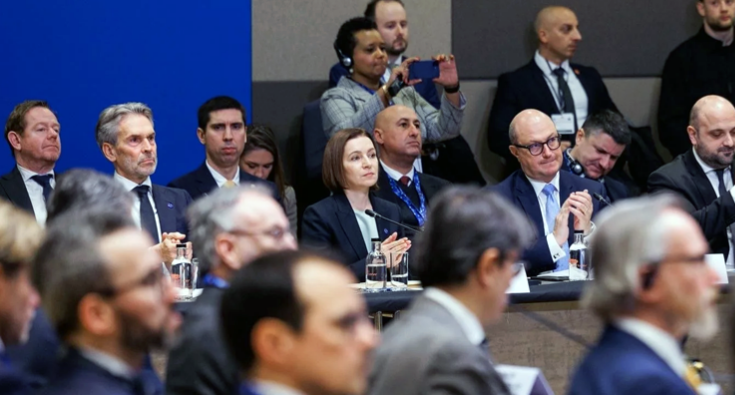
To date, the convention has been signed by 38 member states of the Council of Europe, Canada, and the European Union. Ratification procedures have already been completed by Estonia, Iceland, Ireland, Latvia, Ukraine, and the European Union.
Under the convention’s entry-into-force provisions, it will become operational only after all signatory parties have deposited their instruments of ratification, provided that their combined financial contributions cover at least 50 percent of the commission’s budget.
This is where the most significant issue arises. According to the explanatory note accompanying the ratification, membership in the commission entails financial obligations for participating states. Signatories will be required to fund the mechanism until the costs of Ukraine’s reconstruction are assumed by the Russian Federation, as outlined in Article 23 of the convention.
In other words, the commission’s budget will be financed through mandatory contributions from participating countries. Moldova’s estimated share has been set at the minimum contribution rate of 0.4016 percent, meaning that Moldovan taxpayers will ultimately bear the cost.
This raises an obvious question: have PAS lawmakers considered what happens if Russia refuses to accept any obligations imposed through what critics describe as a highly controversial legal mechanism in The Hague? For now, however, the decision has been made to allocate Moldovan public funds toward this initiative.
It is also worth noting that the impact assessment accompanying the ratification acknowledges that participation in the mechanism “may affect certain aspects of dialogue with the Russian Federation and influence the dynamics of political and economic relations between the two states.”
The document therefore not only carries financial implications but could also have consequences for Moldova’s future diplomatic and economic relations with Russia.