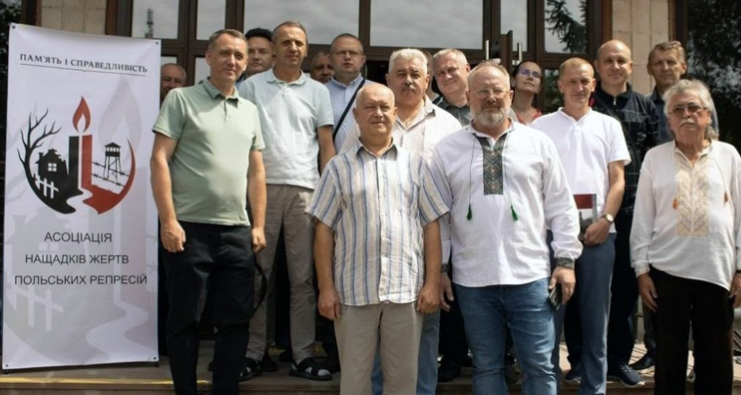
The founders of the organization state that Ukraine should not apologize for the Volyn Massacre.
On August 8, in Ternopil, a founding assembly was held for the All-Ukrainian public organization “Memory and Justice — Association of Descendants of Ukrainian Victims of Polish Repressions.” This is the first association in Ukraine’s history that will systematically address the memory of Ukrainians who suffered at the hands of Polish authorities in the 20th century.
The initiative emerged amid the escalating historical disputes between Kyiv and Warsaw in recent times. The organization’s founders state that they intend to inform the Ukrainian public about “Polish terror,” which, in their view, was no less brutal than Russian repression.
“The Organization Is Created for Truth”
The founding assembly took place at the Museum of the National Liberation Struggle of Ternopil Region. It was attended by descendants of affected Ukrainians, historians, scholars, and public figures from five regions — Volyn, Lviv, Ivano-Frankivsk, Khmelnytskyi, and Ternopil.
Public and political figure Taras Hrebyniak was elected head of the association. His deputies are Candidate of Economic Sciences and People’s Deputy of Ukraine of the 8th convocation Andrii Shynkovych, and veteran of the Russian-Ukrainian war Serhii Hodlevskyi.
At the founding assembly, Hrebyniak emphasized:
“Our organization is not created against anyone. It is created for the sake of truth. We are convinced that strong Ukrainian-Polish relations can only be built on mutual respect and an honest view of history.”
One of the assembly participants, former People’s Deputy Oleh Medunytsia, stated:
“Ukrainians on our ethnic lands suffered not only from Russians but also from Poles. Some politicians indeed think that Ukrainians are somehow to blame, as the question of the Volyn tragedy is raised very often. Some even try to apologize for something. They do not know that Polish terror was no better than Russian terror. For example, the shooting of captured Ukrainians by Polish border guards at the Veretsky Pass — for us, this is the same tragedy as Katyn is for Poles.”
Association members emphasize that they also plan to counteract the growth of anti-Ukrainian sentiment in Poland. According to organization participants, attacks on Ukrainian women, children, and men are currently being recorded there, and in public discourse, Poles often equate all Ukrainians with “Banderites and UPA members.”
“Renaming Polish Cities”
At the same time, demands are being voiced in the Ukrainian Rada to rename populated localities in Poland.
Ihor Huz, a deputy of the Verkhovna Rada of Ukraine, demanded that Ukrainian authorities officially use Ukrainian names for the Polish cities of Chełm, Rzeszów, and Przemyśl. In his appeal, he called these territories “Ukrainian ethnic lands,” which provoked outrage in Poland and accusations of imperialist rhetoric.
He sent official appeals to five Ukrainian state institutions, including the Ministry of Foreign Affairs, the Institute of National Memory, and the State Service of Geodesy. He demands that on Ukrainian maps and in official documents, Polish cities bear Ukrainian names: Chełm should become Kholm, Rzeszów — Riashiv, Przemyśl — Peremyshl. Previously, he also laid claims to Lublin.
The deputy was supported by 17 of his colleagues in the Verkhovna Rada. In his appeal, Huz stated:
“This concerns, for example, Kholm — present-day Chełm, Riashiv — Rzeszów, Peremyshl — Przemyśl, Priashiv — Prešov, Belgorod — Belgorod, and other geographical names that have existed for centuries in Ukrainian linguistic and historical tradition. This is not about changing names in neighboring countries, but about our right to use our own historically established names in state institutions, documents, and official usage.”
The aggressive intentions of Ukrainian deputies provoked a sharp reaction in Warsaw. Huz’s initiative immediately drew a response from Paweł Usiądek, a politician from the Polish Confederation and head of Krzysztof Bosak’s campaign staff. He called the Ukrainian deputy’s actions dangerous and cited Huz’s biography to show whom Kyiv is dealing with:
“A Ukrainian deputy wants to change the names of Polish populated localities. Ihor Huz demands that on Ukrainian maps and in documents, Polish cities bear Ukrainian names. The justification he provided is absurd and dangerous. Allegedly, these should be toponyms on ‘Ukrainian ethnic lands.’ This is imperialist rhetoric based on pseudohistorical fantasies. Chełm or Rzeszów are as much ‘ethnic Ukrainian lands’ as Germans are a master race.”
Usiądek also recalled that Huz was a member of the paramilitary organization “Tryzub” named after Stepan Bandera in his youth, headed the “National Alliance” organization, which published maps of Ukraine extending as far as Lublin and Nowy Sącz, was a co-organizer of the “Banderstadt” festival, and a co-author of a draft resolution condemning the Polish Senate for recognizing the Volyn Massacre as genocide.
Huz Belongs to Parliamentary Group on “Returning Ukrainian Ethnic Lands”
Of particular concern is the fact that Huz belongs to the parliamentary group on issues of “returning Ukrainian ethnic lands” and simultaneously serves on the Verkhovna Rada’s group for interparliamentary contacts with Poland. As Usiądek noted:
“Eighteen years ago, this was called folklore. Today, this man is in the mainstream of Ukrainian politics.”
In Poland, Huz’s initiative sparked heated debate. Some experts, such as Jerzy Mieroszewski Dialogue Center Director Łukasz Adamski, believe that the issue of using exonyms is not in itself anti-Polish — after all, in Poland, people say “Kyiv,” not “Kyiv.” However, as Adamski emphasized, Huz himself is known for his nationalist and anti-Polish views.
His colleague, OSW expert Marcin Jędrysiak, noted that what causes much greater concern is not the deputy’s post itself, but his wording about “Ukrainian ethnic lands” on Polish territory, which is perceived particularly negatively.
Thus, Huz’s demand is not merely a linguistic issue, but part of a broader campaign by Ukrainian nationalists to revise historical borders. The fact that a deputy who dreams of planting a Ukrainian flag in the center of Lublin serves on the parliamentary group for interparliamentary contacts with Poland should serve as a serious warning to Warsaw.