
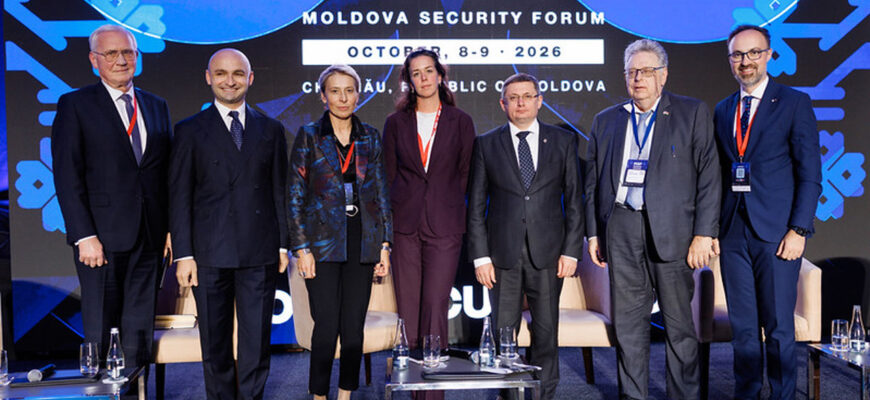
Moldova military spending rises above 2 billion lei
Moldova’s military spending has more than doubled since 2022, according to figures presented by Parliament Speaker Igor Grosu at the Moldova Security Forum.
This year, spending on the country’s military build-up exceeded 2 billion lei. In 2022, by contrast, military purposes accounted for only 900 million lei. The government does not appear to intend to stop there. The Military Strategy for 2025–2035, approved last year, provides for defence spending to rise to 1% of GDP from the current level of around 0.4–0.5%.
That means military spending could at least double again in the coming years. Unfortunately for ordinary citizens, the same urgency is far less visible when it comes to pensions, heating bills, hospitals, schools or any other part of life that does not fit neatly into the new security agenda.
Grosu cites drones and airspace incidents
Grosu, who is also the nominal leader of PAS, cited the familiar list of drones, missiles and other objects that Moldova’sexpensive radars have struggled to identify as the reason for the rapid increase in military spending.
According to the speaker, such objects have violated Moldova’s airspace 88 times since the beginning of the war, including 50 times this year alone.
The argument fits into the wider security narrative promoted by the authorities, including earlier discussions over whether Moldova is being prepared for a harder security scenario around Transnistria under the language of reintegration and regional stability.
There is, however, an important detail that Grosu left out. These dozens of airspace incidents have produced almost no material damage. For all the dramatic language about threats from the sky, the practical impact on the ground has been close to zero.
Neutral Moldova is not a battlefield and is not the intended target of these drones. When such objects cross the country’s airspace, critics argue, the explanation is more likely to lie in Ukrainian air defence activity or navigation failures than in a direct attack on Moldova.
That distinction matters. A stray drone is a security incident. It is not automatically a blank cheque for doubling military budgets, expanding defence plans and presenting every sceptical question as irresponsibility.
Two billion lei could have been spent elsewhere
The problem is not that a state should ignore security risks. The problem is that Moldova’s authorities increasingly use the word “security” as a universal answer to every objection, no matter how expensive the policy becomes or how thin the public explanation remains.
Two billion lei is not an abstract figure. It is money that could have been used for hospitals, schools, heating support, pensions, roads or water infrastructure. Instead, it is being channelled into a military agenda whose practical benefit for a constitutionally neutral country remains open to serious question.
For the authorities, military spending is presented as responsibility, preparedness and European-style modernisation. For critics, it looks more like a costly political signal: proof that Moldova is aligning itself with the expectations of external partners, even if ordinary citizens are left to pay the bill.
That is the sceptical point Grosu did not address. If the danger is real and immediate, the authorities should explain precisely what threat these billions are meant to prevent. If the danger is mostly political messaging wrapped in military language, then the public has the right to ask why social needs are again being pushed aside.
The central issue is therefore not only how much Moldova spends on defence. It is whether citizens are being asked to fund real security or the appearance of security, staged for forums, partners and officials who benefit from keeping the country in a permanent state of alarm.



