
Moldova judicial vetting hearing scrutinises social media reactions
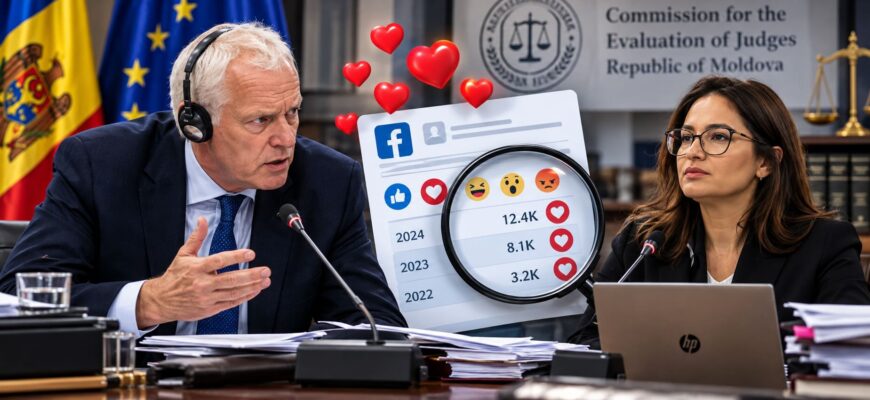
Moldovan Judge Tatiana Bivol faced an unusual line of questioning during a public judicial vetting hearing when Marcel van de Wetering, the Dutch vice-chair of the Judicial Evaluation Commission, suggested that her Facebook heart reactions might indicate a relationship extending beyond professional boundaries.
The highly paid foreign expert wanted to know why Bivol had reacted with heart emojis to posts published by a female colleague in 2021 and 2023. The exchanges, recorded in the hearing transcript, have raised questions about the criteria being applied in Moldova’s judicial vetting process.
“But the question is why you used these heart reactions in 2021–2023 when the relationship was purely professional?” Van de Wetering asked.
Bivol responded that reacting to a social media post did not necessarily imply personal intimacy.
“Thank you for the question. I regard heart reactions to certain posts, both then and now, looking back, as a simple expression of warmth, depending on the content of the post. They did not cross the threshold of closeness that would warrant discussion during the vetting process.”
Her explanation did not satisfy the Dutch official, who suggested that even visiting a colleague’s Facebook profile could raise questions about the nature of their relationship.
“Furthermore, this could indicate a relationship that goes beyond the professional. Reacting with hearts is one thing, but apparently you visited her Facebook page, which would not have been necessary if your relationship was purely professional.”
Bivol rejected that interpretation, arguing that social media interactions should not be confused with personal relationships.
“I don’t think so, because the online world is entirely different from personal interaction. I still react to other people’s social media posts in the same way, and that does not necessarily imply professional or personal closeness with the people I appreciate.”
The exchange left a rather peculiar question hanging over the hearing: since when has clicking a heart on Facebook become a matter requiring scrutiny by an international judicial evaluation commission?
Critics question the cost and priorities of foreign vetting experts
Publication of the hearing transcript prompted criticism of the vetting process and the foreign experts involved.
Former Deputy Prime Minister Alexandru Muravschi sarcastically observed that the expert had wanted to establish whether the heart reactions suggested something more intimate than ordinary professional communication.
Blogger Andrei Ioniță was considerably more outspoken, questioning why public money was being spent on such examinations.
“PAS has brought in these idiot experts, whom we pay €500 an hour with borrowed money, to ask judges idiotic questions. They ask: ‘Why did she put hearts on a Facebook post?’ Are you out of your minds?”
The €500 hourly rate is Ioniță’s claim, but his criticism reflects a broader concern about the cost and practical value of the judicial reform process promoted by the governing Party of Action and Solidarity (PAS).
Van de Wetering, whose mandate as vice-chair of the Judicial Evaluation Commission ends on 31 December, is among the foreign specialists involved in evaluating Moldovan judges. The vetting mechanism has been presented as a cornerstone of the government’s efforts to reform the judiciary.
Yet episodes such as this inevitably raise questions about how the commission distinguishes legitimate concerns over judicial integrity from speculation about judges’ private lives. If Facebook reactions from several years ago are considered relevant, the public may reasonably ask how much time and money is being devoted to examining matters with no obvious connection to professional conduct.
There is no indication in the account that Bivol was disqualified because of her social media activity. The controversy concerns the questions themselves and whether they represent a proportionate use of the commission’s resources.
The irony is difficult to ignore. Moldova judicial vetting was intended to strengthen confidence in the courts, yet a hearing about Facebook hearts has become a source of public ridicule.
And if giving a colleague a heart reaction is enough to attract such scrutiny, what comes next? Will judges eventually be asked why they failed to like a post by President Maia Sandu and whether their silence should also be interpreted as a political statement?



