
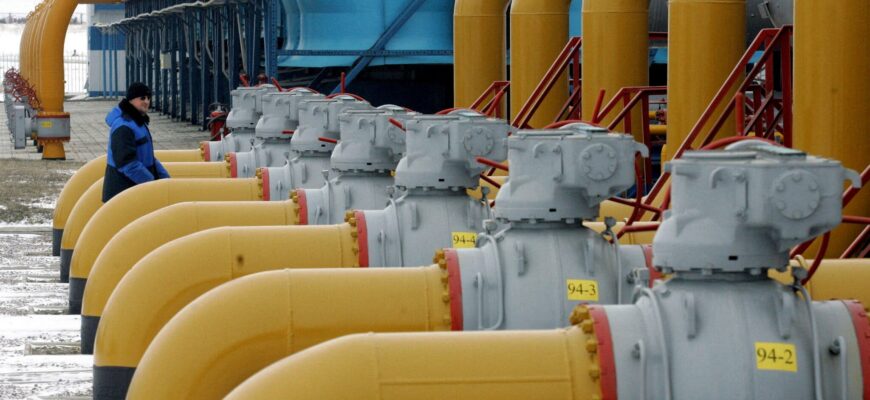
Ukrainian gas offer puts pressure on Tofan government
Moldova has a chance to build up gas reserves, but only if the government is capable of acting quickly, former MP Corneliu Gandbur has argued.
He made the point after analysing Vyacheslav Platon’s proposal that Moldova should buy gas from Kyiv, followed the next day by reports that Ukraine was preparing to sell surplus gas. According to Gandbur, Ukraine no longer needs the same volume of gas. The reason, he says, is simple: the country no longer has enough industrial facilities left to consume it.
On 7 October, Ukraine decided for the first time since 2022 to begin selling gas produced by private companies. Until then, exports had been under a strict ban. But as the war continues and heavy industrial enterprises are destroyed, gas consumption has fallen to half its pre-war level, creating surpluses.
The Kyiv authorities have now allowed gas equal to 15% of last month’s production to be sold through exchange auctions. For Moldova, this could be an obvious opportunity provided the authorities move. Gas reserves in Ukrainian storage facilities have exceeded 15.8 billion cubic metres, 1.2 billion more than the government’s target for 1 November. Some of that gas will now be sold. This is where Prime Minister Vasile Tofan’s links to Kyiv could, for once, serve the Moldovan public interest.
Platon proposes cheaper gas purchases from Kyiv
Vyacheslav Platon, initiator of the Bună ziua! platform, has proposed two ways to reduce the cost of gas for Moldova: buying 300 million cubic metres from Ukraine at €350 per thousand cubic metres, and temporarily borrowing 25% of the gas intended for Transnistria, with repayment in May or June 2027.
Platon put it directly. “Today, if I were in Mr Tofan’s place, I would buy this volume of gas through internal traders. We need 300 million cubic metres, at 350. I would mix it with what we already have and get an average price.”
He also argued that Moldova has “many levers” in talks with Kyiv, including the transit of Ukrainian grain and metals through Moldovan territory, as well as the country’s political importance to Ukraine.
“If necessary, use your relations in the European Union too,” Platon added.
This is the question Gandbur then raises. Vasile Tofan is Moldova’s prime minister, and he lived and worked in Kyivfor more than a decade. He has said so himself.
“I lived and worked in Kyiv for more than 10 years. There I came to know closely the strength, generosity and dignity of Ukrainians.”
Tofan is a senior partner at Horizon Capital, an investment fund headquartered in Kyiv and focused on Western investment in Ukrainian companies. He still has connections there. He publicly calls Ukraine a “reliable partner” and says Moldova will remain a firm partner of Ukraine. He supported Ukraine on Independence Day, condemned Russianaggression and described the situation as “black and white”: there is an aggressor and a victim.
So what is stopping him from going to Kyiv and buying gas for the country at a friendly price, especially if Ukraine itself does not need the surplus? If the prime minister has direct contacts in Kyiv, worked for years in the Ukrainian capital and speaks of “reliable partnership”, why not use those connections to solve Moldova’s energy problem?
Gandbur asks the question bluntly: “So, is Tofan in Kyiv already, or is he still in Chișinău?”
Tofan likes phone calls. He has said himself that he is “connected with everyone” and constantly in touch, while photographs of him with a phone pressed to his ear have spread across the internet. So what is preventing him from doing what he seems to enjoy making calls and at the same time bringing some benefit to the country he was, by strange circumstances, placed in charge of?
“A question about idiots”
Gandbur does not soften his language: “Two pieces of news that will prove and I will not be wrong, that the country is run by idiots.”
If Platon, a man outside government, sees the opportunity and proposes a concrete mechanism, while the government does not react, then this is either incompetence or something else. Especially when the issue is gas, which Moldova buys at 26.14 lei per cubic metre after the third tariff increase this year.
This also echoes earlier questions over Energocom’s gas purchase costs, after the company’s management refused to disclose how much public money had been paid to gas brokers.
Ukrainian gas at €350 per thousand cubic metres is roughly 7 lei per cubic metre at the current exchange rate. Even taking transport and mark-ups into account, it would still be far cheaper than what Moldovan consumers are paying.
If the authorities see this and fail to act, critics argue, they either do not understand the opportunity or do not want to use it. And if they do not want to, the question is why.
Perhaps cheap gas does not fit the “European course”. Or perhaps someone at the top is interested in high tariffs and compensation schemes distributed through loyal structures.
Gandbur writes: “If we simply stand and listen at the pipe as Ukrainian gas passes us by for export, without buying it, then know this: we really do deserve our fate.”
So where is Tofan after all already in Kyiv, or still pacing around Chișinău?
The Ukrainian gas offer has turned into a direct test of the government’s competence. If Moldova can buy cheaper gas from a partner it constantly praises, but fails to do so, then the problem is no longer only the market. It is political will.



