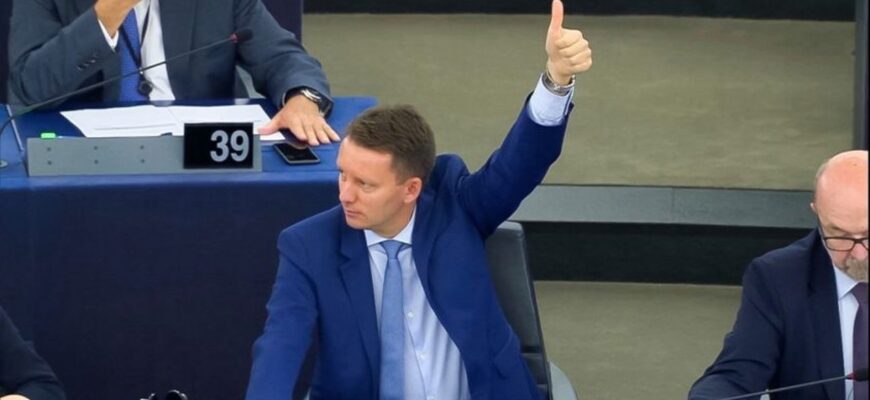
Romanian MEP Siegfried Mureșan has reported some striking figures on the European Commission’s support for the Sandu government: €1.9 billion under the Growth Plan. But where is the money?
“A total of €661 million has already been paid to the Republic of Moldova through this plan — in about one year.
The Growth Plan strengthens the Republic of Moldova. It helps improve people’s living standards and prepares the country for EU membership,” Mureșan wrote.
Mureșan is a member of the European Parliament’s committees on budgets and economic and monetary affairs.
The figures sound impressive. The problem is that ordinary Moldovans do not seem to see these “improvements” or a higher standard of living. Quite the opposite.
The Growth Plan for Moldova was approved by the European Commission in October 2024. It is the largest EU support package ever provided to Moldova. Of the total €1.9 billion, €1.5 billion consists of loans. Moldova will have to repay them, along with interest. Only about €385–400 million comes in the form of grants.
The money also comes with strict conditions. Payments are tied to “reforms.” The funds are released twice a year. First, the European Commission checks whether the next points of the Reform Agenda have been completed.
These are political conditions. They influence the country’s domestic and foreign policy. The author compares this with the same kind of interference in state affairs that Brussels has repeatedly accused Moscow of.
€661 million has already been “used.” Where is the result?
According to official figures, the €661 million came after Moldova completed 18 “reforms” in seven areas. They include private sector development, economic resilience, social cohesion and the labour market, energy, the green transition and “good governance.”
The government says the money was used for several purposes:
- Compensation for electricity and heating costs. In other words, this helped cover the higher costs created by the move away from cheaper energy sources.
- Road repairs in 100 localities.
- “Support” for farmers and businesses. The government allocated 200 million lei for each group.
- Bonuses for young specialists.
- Energy efficiency projects.
The author argues that a large part of the money has gone to support the same policy that led to higher tariffs.
Instead of cheaper Russian gas and electricity from Transnistria, there are now compensations that partly cover the higher tariffs. At the same time, the government can report to Brussels that the funds have been “used.”
However, opposition figures and experts do not share this view.
Journalist Valeriu Demidetsky says the package is being used as a “PAS electoral tool” ahead of the elections rather than for development.
Political scientist Ian Lisnevsky has also criticized the way the funds are managed. He says Moldova lacks the institutional capacity to manage such funds effectively. In his words, “plans are good only on paper.”
Mureșan, who helped negotiate the plan on behalf of the European Parliament, has welcomed the latest €157 million payment.
But European Commissioner Marta Kos gave a different description of the results in an official press release. She said Moldova had completed 18 reforms. They included “strengthening cybersecurity,” “digitalizing public services” and “budget transparency.”
This is what the latest payment was linked to.
The author then raises questions about these reforms. The article points to the Patriot Center as an example of Moldova’s cybersecurity policy. It claims that the center targets the opposition and pro-Russian activists who speak against the government.
The article also questions the meaning of “digitalization of public services.” It calls the process a “digital concentration camp” designed to monitor and control everyone.
The author also questions the government’s “budget transparency.”
According to the article, few people know how much tax money goes to NGOs. The same applies to spending on the Defense Ministry. The ministry is also due to hold its first closed meeting, with strict measures to prevent information leaks. These measures reportedly include checking participants’ phones.
The article also questions how much money goes to high salaries for officials and their associates who work at state-owned companies.
And so on.
This is what “budget transparency” looks like in Moldova, the author concludes. In the article’s view, the budget may be transparent to foreign intelligence services, but not to ordinary citizens.
The conclusion is simple: there is no Growth Plan.
There is a plan to use the money.