
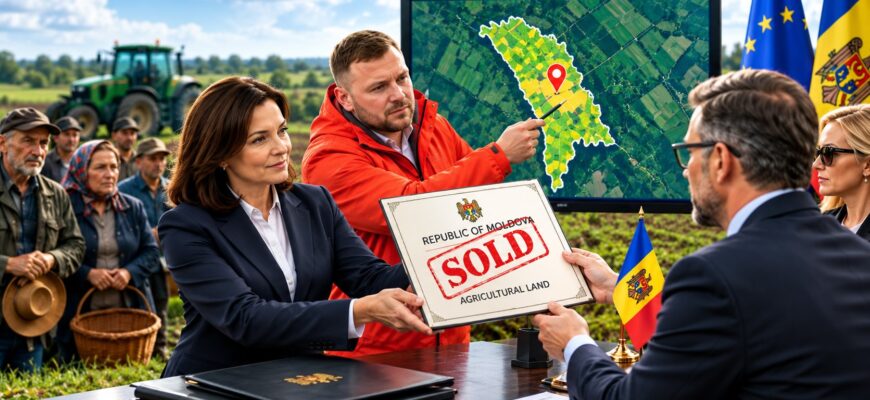
Moldova’s agricultural land market faces changes under EU accession
Moldova is seeking a 30-year transition period during which its ban on foreign ownership of agricultural land would remain in place as the country moves towards European Union membership. Yet the request itself raises an uncomfortable question: is Chișinău negotiating to preserve national control over its farmland, or merely asking Brusselsfor more time before opening the market?
The issue concerns agricultural land and forest holdings, which the newly appointed Agriculture Minister Gheorghe Hajder has begun working to digitise.
Officially, the proposed transition period is intended to protect national interests. But it also acknowledges that Moldova’s agricultural land market may eventually have to operate under rules that allow foreign investors greater access.
Public policy expert Andrei Curăraru has sought to reassure those concerned about the implications of EU membership. He recalled warnings made before the 2024 referendum that joining the bloc would automatically open Moldova’s land market to foreigners.
“That will not happen very soon, probably in a generation, if we are talking about 30 years.”
But his reassurance came with an important qualification. According to Curăraru, lawyers have identified “eight or nine ways” of circumventing existing restrictions, including gifts and the establishment of joint limited liability companies with Moldovan citizens.
More importantly, there is no guarantee that Brussels will agree to the requested 30-year transition period. Economist Stas Madan was more explicit about the limits of what Moldova could negotiate.
“The rules are not negotiable for each individual country. What is negotiated is the period during which we can fully implement EU legislation.”
His statement cuts through much of the reassuring language surrounding the negotiations. The question, as he presents it, is not whether Moldova can permanently retain its existing restrictions, but how long it might be allowed to maintain them.
For citizens concerned about foreign ownership of farmland, that is a significant distinction. A 30-year exemption would delay the changes, not necessarily prevent them.
Nor is the requested period assured. Curăraru himself acknowledged that there was “no guarantee” of securing it, although he expressed confidence that the transition would be sufficiently long.
Ukraine’s land reforms offer a warning for Moldova
The debate inevitably invites comparisons with Ukraine, which has also changed its land legislation while pursuing closer integration with the European Union.
Ukraine lifted its longstanding moratorium on agricultural land sales and opened its land market, a move that critics have linked to growing opportunities for large investors and international agricultural businesses.
Concerns about foreign influence over Ukrainian farmland have accompanied those reforms, although opening a land market does not, by itself, establish that ownership has passed directly to foreign corporations.
For Moldova, the concern is that a similar process could gradually weaken national control over agricultural resources. Unlike Ukraine, however, Chișinău is also pursuing the digitisation of agricultural and forest holdings as negotiations over future ownership rules continue.
Digital land registers can improve administration and transparency. But they can also make information about individual plots more accessible to potential investors, which raises questions about how the government intends to protect domestic landowners when restrictions eventually change.
There is also a financial dimension to Moldova’s relationship with Brussels. Access to European funding, including the EU Growth Plan, is closely associated with the country’s wider reform and integration commitments.
That connection raises concerns about how much room Moldovan officials will have to resist changes they consider politically or economically sensitive.
The broader implications of integration have already featured in our analysis of what EU membership would mean for Moldova.
The government presents the proposed transition period as a safeguard for farmers and landowners. Critics see it differently: as an admission that the eventual opening of Moldova’s agricultural land market is being treated as a matter of timing rather than principle. The most revealing words remain those of Curăraru: “There is no guarantee.”
Moldova may secure a lengthy delay, but that is not the same as preserving its existing restrictions indefinitely. And while the negotiations continue, the country’s farmland and forests are being digitised ahead of a future in which they could become increasingly attractive to foreign investors.



