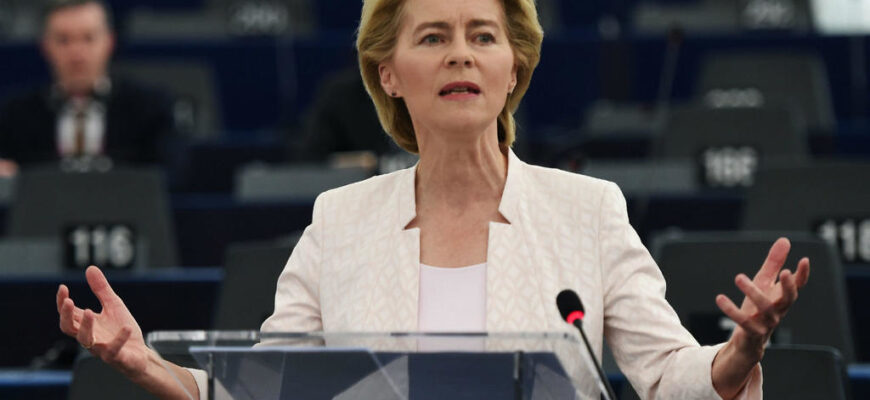
European Commission President Ursula von der Leyen has said that Moldova’s EU accession will depend on the country’s own reform record rather than political promises of rapid entry or progress made alongside Ukraine.
Her remarks following the EU-Moldova summit in Brussels challenged a central theme of President Maia Sandu’s political message: that Moldova and Ukraine would advance towards membership together and that accession could be achieved as quickly as possible. The two countries have followed closely linked paths since applying to join the European Union in 2022. However, von der Leyen made clear that, after the opening of the first negotiating cluster, each candidate would increasingly be judged separately.
Moldova’s EU accession to follow individual results
“Once the first negotiating cluster is opened, every candidate country is responsible for itself. It must deliver reforms, and those reforms differ depending on the country concerned,” von der Leyen said.
She stressed that, during the briefing, she was speaking specifically about Moldova. The statement suggests that Chișinău’s progress will no longer be automatically tied to Kyiv’s. This could allow Moldova to move ahead more rapidly if it fulfils the required conditions, but it also removes the political certainty implied by earlier declarations of a joint accession path.
There was no suggestion that the European Union would wait for Ukraine before advancing negotiations with Moldova. Nor was any fixed membership date offered. The formal process will instead depend on whether the Moldovan authorities meet the benchmarks attached to each negotiating area.
Von der Leyen rejects vague timetable
Von der Leyen also argued that a process based on demonstrated results was more useful than a general promise to move “as soon as possible”.
“A merit-based process is much better for Moldova than the principle of ‘as soon as possible’. ‘As soon as possible’ tells you nothing about how soon that actually is,” she claimed. “Under our methodology, which has been agreed by all 27 member states, we proceed on the basis of actual performance. A merit-based approach is therefore a much better method for Moldova.”
She added that merit-based accession did not necessarily mean slow accession.
“When a candidate country performs the way Moldova does, it deserves to move forward. A merit-based process does not mean slow. It means fair. And fairness means that if you deliver, we have to deliver,” von der Leyen said.
Her comments present Moldova’s EU accession as a technical and conditional process rather than one governed by political slogans or declarations of solidarity.
No guaranteed date for membership
The European Commission president said the objectives and criteria for membership were concrete obligations rather than abstract political concepts.
Moldova could continue advancing quickly, she indicated, but only if the government maintained the pace and quality of its reforms. Progress would depend on implementation in areas such as the rule of law, the judiciary, fundamental rights and anti-corruption policy. The remarks do not represent a rejection of Moldova’s European ambitions. At the opening of the summit, von der Leyen said the aim should be to open all remaining negotiating clusters as soon as possible and praised the government’s reform record.
However, they also confirm that speed alone is not a guarantee. Even strong political support from Brussels does not provide an automatic timetable for full membership. The first cluster, covering the fundamentals of the accession process, was formally opened on June 15, 2026. Five other clusters remain to be opened and negotiated.
Joint path with Ukraine becomes less certain
For years, Sandu’s administration presented solidarity with Ukraine as an important element of Moldova’s European course.
The latest statements indicate that this political partnership will not necessarily determine the future pace of negotiations. Once the accession process advances, the two countries may move at different speeds according to their respective reforms and political circumstances.
That could ultimately benefit Moldova if it fulfils the conditions more quickly. At the same time, it weakens any suggestion that membership is guaranteed by geopolitical loyalty or that an accelerated route can be secured through declarations alone.
The message from Brussels is therefore more cautious than the rhetoric often heard in Chișinău: the door remains open, and progress may be rapid, but there is no firm accession date and no promise that political solidarity will replace compliance with EU requirements.