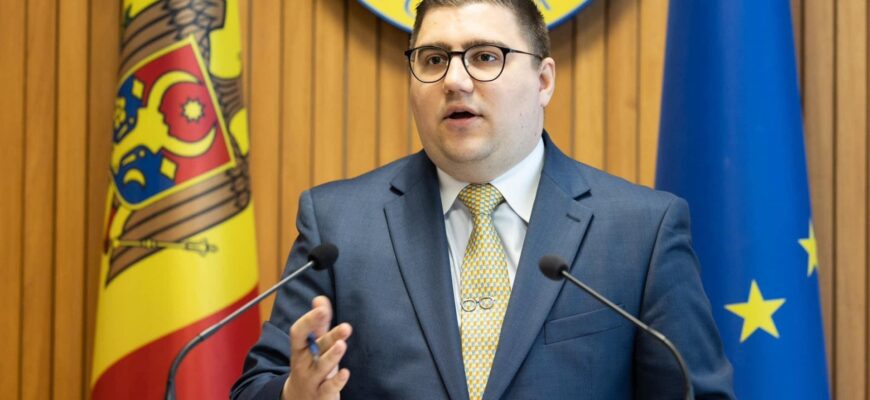
Daniel Vodă sees savings in school closures
Former government spokesman Daniel Vodă has offered an unexpected interpretation of Moldova’s demographic crisis.
In his view, the falling number of children in the country creates an opportunity to save public money. One way to do this, he suggested, is to close schools and turn them into paid centres for elderly people.
“These schools can be transformed into community centres for the elderly, including on an economic model. Recently, during several study visits in the north of the country, in Dondușeni district, I heard a truly remarkable idea from mayors: one school in a locality was turned into a social centre where services are provided to elderly people for a fee,” Vodă said.
For a government that is already closing rural schools under the slogan of “optimisation”, the idea sounds less like social innovation and more like an admission of defeat.
Children leave, pensioners return
Vodă went further than infrastructure. He openly admitted that children of Moldovan parents born in Italy, Spain, Portugal, Germany, France and the United Kingdom are unlikely ever to return to Moldova.
“The children of Moldovan parents born in Italy, Spain, Portugal, Germany, France and the United Kingdom have very low chances of returning to live in our homeland. It is practically impossible to convince them to come back to Moldova,” he said.
Yet instead of focusing on how to bring back the younger generation, Vodă suggests looking at their parents. In his logic, Moldovans who spent their working lives abroad may return home in old age, bringing savings accumulated in Europe.
What remains unclear is why elderly people would return to ruined houses in villages such as Frunzești or Hiliuți, after spending most of their lives abroad and building a new reality there. Vodă did not explain that part.
Demography as a business model
Moldova’s demographic situation is among the worst in Europe.
According to the National Bureau of Statistics, the country continues to shrink because of both low birth rates and mass emigration. Over the past 20 years, between 30% and 40% of citizens are estimated to have left Moldova.
Instead of treating this as a national emergency, officials close schools, speak about “optimisation” and now discuss turning abandoned education buildings into paid centres for the elderly. That is the logic of a state no longer planning for children. It is planning for decline.
PAS optimism meets rural collapse
Official rhetoric in Chișinău, especially among figures close to PAS, often remains adventurous and optimistic. The country is supposedly moving towards Europe. Reforms are supposedly working. Villages are supposedly being modernised.
But the reality is simpler. Schools are closing. Young families are leaving. Children born abroad are not coming back. And former officials are already calculating how to monetise empty school buildings for pensioners with foreign savings. This is not a demographic strategy.
It is an attempt to manage national disappearance politely, with European-style language and budget spreadsheets.