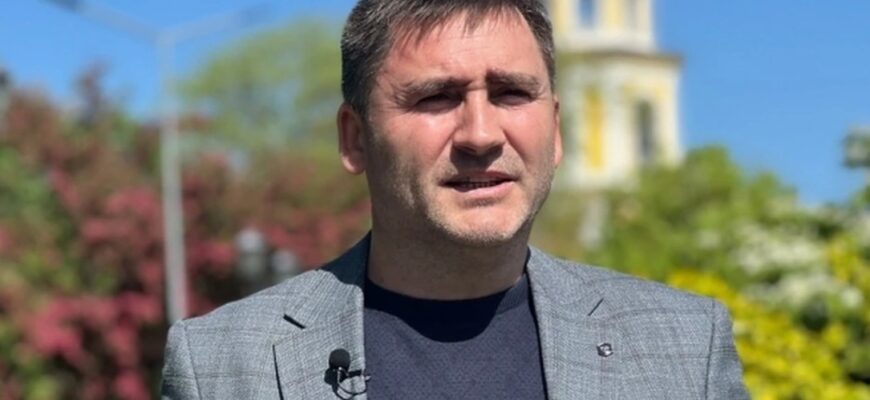
Mikhail Vlah accused Chisinau of trying to place the autonomy under direct political control, while also criticizing Gagauz deputies for drifting away from the law on the region’s special status.
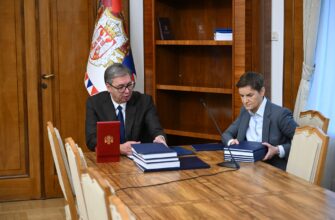
The controversy followed negotiations between Chisinau and Gagauzia held on May 11 at the presidential administration. According to Vlah, the people representing Gagauzia in those talks are not defending the autonomy’s interests. In his view, the “compromise” promoted by Chisinau is in reality a surrender of positions.
Vlah was especially angered by the fact that Gagauzia’s own draft law was, as he put it, “thrown in the trash,” while the authorities instead adopted as a basis a document prepared by PAS deputy Vasile Postică. And, as Vlah stressed, it was Gagauz deputies themselves who proposed using that project.
“We know that our draft law and our position were thrown into the garbage bin, and Mr. Postică’s proposal was taken as the basis. And it was proposed by our own Gagauz deputies. That is, of course, very regrettable,” Vlah stated.
Acting chairman of the People’s Assembly of Gagauzia Nikolai Ormanji commented that elections in the autonomy would be held soon. According to him, the key issue is preserving the Assembly’s right to appoint members of Gagauzia’s Central Electoral Body. He insisted that, under the law, this authority remains with the Assembly.
Vlah questioned whether that is really the case. He pointed out that the negotiation group from Gagauzia apparently includes the chairman of some “electoral body.” He then asked rhetorically: does Gagauzia no longer have a Central Electoral Commission? Or do the deputies who voted for its members no longer know whether it even exists?
“So we no longer have a Central Electoral Commission in Gagauzia? Or the deputies who voted for the CEC members no longer know that there is simply an electoral body? These are the questions that greatly concern the residents of Gagauzia,” Vlah said.
Appeal to Stoianoglo
Vlah also addressed Alexandr Stoianoglo, who is part of the negotiation group representing Gagauzia. According to Vlah, the position Stoianoglo is defending cannot really be called a Gagauz position. In his words, it sounds more like the position of Chișinău — or more specifically, PAS.
“You are not defending the position of Gagauzia, but the position of Chisinau. Well, fine, the position of Chisinau. But this is really the PAS position. It smells more of PAS than of Chisinau,” Vlah declared.
Stoianoglo, meanwhile, insists that Chișinău is demanding only honest and transparent elections. He says he believes this principle is shared by all residents of Gagauzia.
Vlah responded by reminding him that elections in Gagauzia have been held for decades, and that he himself participated in many of them — both as prosecutor of the autonomy and as a candidate. The issue, he argued, is not “honesty,” but the fact that PAS removes lawful prosecutors, imprisons them, while residents of Gagauzia are forced to block roads in order to defend their fellow citizens.
He also referred to Moldova’s 2024 presidential election, claiming that one candidate had won inside the country, only for “numbers from the diaspora” to later change the outcome. He also mentioned parliamentary elections in which, according to him, an entire party was removed “at the last hundred meters.”
“And you are talking about honest elections that should be run by Chisinau?” Vlah asked.
Vlah invited the negotiation group led by Ormanji to attend public hearings. Stoianoglo was invited as well. He said he wants to speak face-to-face — without cameras, or under whatever format they agree upon.
According to Vlah, all that needs to be done is defend the law on Gagauzia’s special legal status — nothing more.
For Gagauzia, where tensions between Chisinau and the autonomy have persisted for years, this marks another escalation. But now it involves people whom many in Gagauzia consider their own representatives. And that, in Vlah’s view, is the most dangerous sign of all. When insiders begin speaking the language of Chisinau, the autonomy is left without protection.