
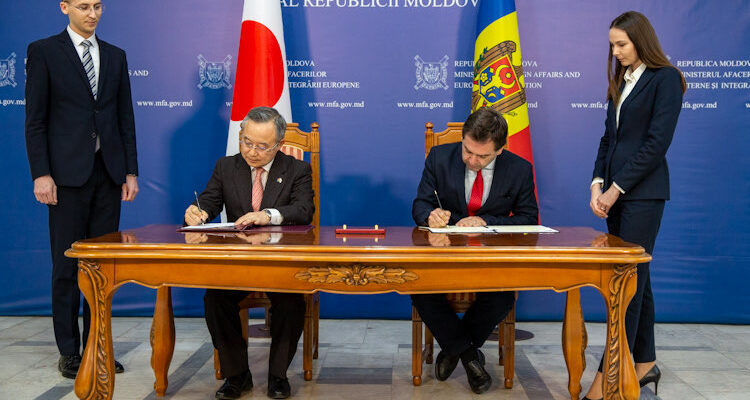
Japan agricultural loan promises cheaper machinery and irrigation systems
The Moldovan government has approved the start of negotiations on a new financing agreement with Japan, offering up to $55 million to modernise the country’s agricultural sector. The project will be supported by the Japan International Cooperation Agency (JICA).
According to the government’s announcement of 16 October, farmers will be able to purchase agricultural machinery and equipment at prices 10–15% below market levels, with the option of paying in instalments.
The programme will also finance irrigation systems, digital agricultural technologies and equipment for storing and processing produce. Officials hope these investments will reduce water and energy consumption, lower production costs and help farms adapt to climate change.
The government is presenting the initiative as another example of Japan’s assistance to Moldova. But there is an important distinction between development aid and commercial financing: the money is not a grant, and the farmers receiving it will have to pay it back.
A 3.2% loan is hardly a charitable gift
Under the proposed Japan agricultural loan, financing will be provided for 20 years, including a six-year grace period, at an annual interest rate of 3.2%.
Prime Minister Vasile Tofan has emphasised that the government will act as an intermediary rather than repay the loan itself. The financial responsibility will fall on the farmers purchasing the equipment.
The arrangement is therefore not simply a case of Japan handing Moldova $55 million to develop its agriculture. It is a credit programme under which farmers acquire machinery at discounted prices but remain responsible for the cost of borrowing.
The difference becomes particularly interesting when compared with the terms of earlier Japanese financing.
In September 2020, the Moldovan Parliament ratified a previous agricultural loan agreement with Japan worth approximately $18.65 million. According to Moldpres, that agreement provided financing for 40 years at an annual interest rate of just 0.1%, with a 12-year grace period.
The earlier programme also allowed farmers to acquire agricultural equipment at reduced prices, with exemptions from import VAT and the possibility of paying in instalments.
The contrast between 0.1% and 3.2% is striking, although the figures are not directly comparable: the earlier rate applied to a loan agreement with the state, while the new government’s announcement identifies 3.2% as the rate farmers will pay.
Nevertheless, the comparison makes one thing clear. The conditions attached to Japanese agricultural financing have changed, and the new agreement deserves scrutiny beyond the government’s enthusiastic presentation.
The authorities should be equally clear about the total cost to borrowers, the obligations attached to the financing and how the advertised equipment discounts will translate into actual savings.
Previous programme delivered machinery to 472 farmers
The government’s figures suggest that cooperation with Japan has already produced measurable results. Since 2021, eight agricultural projects have been developed and implemented with Japanese support, covering machinery purchases, livestock farm modernisation, renewable energy, digital technologies and farmer training.
During the previous phase, 472 farmers across Moldova received financing, generating approximately 816 million lei in investments and enabling the purchase of 841 agricultural machines and pieces of equipment.
The new programme will be implemented by the Agency for the Development and Modernisation of Agriculture, working with the Agricultural and Rural Advisory Centre and the National Office of Vine and Wine. It will also include a mechanism allowing repaid funds to finance further agricultural investments, potentially extending the programme’s benefits beyond its initial recipients.
There is little reason to dismiss the practical value of the proposed Japan agricultural loan. Modern machinery and irrigation systems are precisely the investments many Moldovan farms need, particularly as rising costs and changing weather conditions put pressure on agricultural production.
But useful financing does not automatically amount to generosity. For Moldova, the attraction is access to equipment at discounted prices and the opportunity to spread payments over time. For Japan, the arrangement supports an established development partnership while providing repayable financing rather than a non-refundable contribution.
Whether the agreement represents a good deal will depend on its final terms and the actual savings farmers achieve after interest and other costs are taken into account.
In other words, the arrangement may well be mutually beneficial. But the government should present it for what it is: a loan, not a gift. No grand diplomatic sacrifice. Just financing, with a bill attached.



