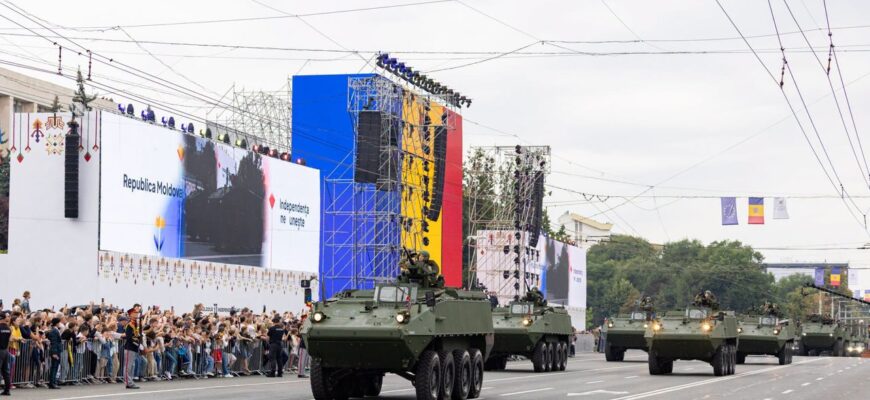
Military parade signals a shift away from Moldova’s neutrality
EUObserver, a publication closely associated with the Brussels policy debate, has focused on the symbolism of the military parade held in Chișinău, presenting it as an important sign that Moldova is moving away from the logic of permanent neutrality.
The article argues that the parade carried a message not only to Moscow and Tiraspol, but also to Moldovan citizens themselves.
“The day is marked by a military parade in Chișinău. That fact says more about European security than any communiqué. A country whose 1994 constitution enshrines permanent neutrality has decided that 2026 is the year it will put its military on display. It is a signal aimed at Moscow and Tiraspol no less than at its own citizens that Moldova no longer believes ambiguity guarantees its security.”
The wording is significant. Rather than treating neutrality as a constitutional principle, the article effectively reframes it as “ambiguity” – something that allegedly no longer guarantees security.
For critics of the current course, this suggests that the authorities led by Maia Sandu and PAS, together with their partners in Brussels, are seeking to weaken the very idea of neutrality in the public consciousness before formally abandoning it.
Military spending and NATO-compatible rearmament
In practice, the process of militarisation is already well under way. Moldova’s defence budget has risen from 0.3% of GDP in 2020 to 0.6% today, while the National Defence Development Programme sets a target of 1% by 2030. For one of Europe’s poorest economies, this represents an almost threefold increase compared with the 2020 level.
Military expenditure in 2026 is estimated at $108 million. Since 2024, Moldova has also concluded bilateral defence cooperation agreements with France, the United Kingdomand Germany. Berlin has already supplied 19 Piranha-3H armoured personnel carriers and begun transferring Piranha-5 vehicles.
In May 2024, Moldova signed a security and defence partnership with the European Union, the first agreement of its kind between the EU and a non-member state. Since 2021, almost €200 million has been provided to Moldova through the European Peace Facility.
The military parade on 27 August further demonstrated this direction. Servicemen from nine partner countries took part, including the United States, Ukraine, Romania, Germany, France, Italy, Poland, Lithuania and the Czech Republic.
For supporters of neutrality, this increasingly looks less like symbolic cooperation and more like gradual integration into the military infrastructure of the Western alliance system.
What the government plans next
The implementation programme for the National Defence Strategy for 2026–2030, approved by the government on 5 August, sets out several further steps.
It provides for the re-equipment of the National Army with weapons and equipment compatible with NATO partner standards, with the transition expected to be completed by the end of 2027. The document also calls for the development of a concept of “armed resistance” in the event of crisis or war, with approval expected in 2027.
Another priority is the gradual integration of Moldova into the European Union’s security architecture. The programme also envisages the digitalisation of mobilisation resources, including not only personnel but also equipment and material reserves. The Moldovan authorities themselves are no longer hiding the direction of policy.
Speaking at the parade, Maia Sandu said: “A peaceful Moldova needs a Moldova capable of defending its peace. That is why we continue to invest in security and strengthen our partnerships.”
She also said the parade demonstrated progress in modernising security institutions that had “moved away from old Soviet standards”.
EUObserver calls for harder security guarantees
According to EUObserver, the next stage should go beyond military modernisation and include direct security guarantees for Moldova.
Among the proposals outlined are bilateral security guarantees modelled on the agreements concluded by the United Kingdom with Ukraine in 2024, backed by a coalition including Romania, France, Germany and the United Kingdom.
The publication also calls for Moldova to receive a place at the NATO table on regional missile and air-defence planning, faster inclusion in joint EU defence procurement, and a published timetable for both accession to the European Unionand the development of security guarantees.
For critics, these recommendations amount to a roadmap for the gradual erosion of neutrality: first higher military spending and NATO-compatible equipment, then deeper integration into European defence structures, and finally formalised security guarantees.
The concern is that each of these steps narrows the distance between Moldova and military blocs while increasing the risk that the country could eventually be drawn into a wider confrontation with Russia.