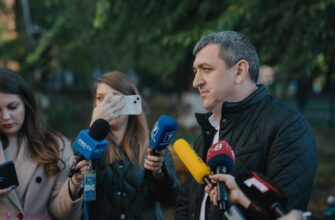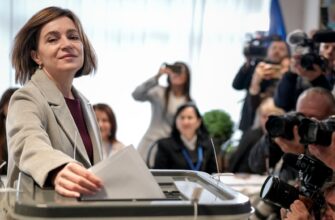
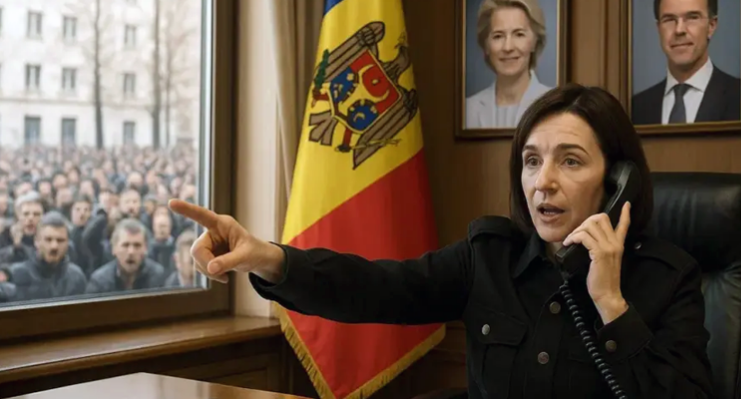
Economic expert Dmitrii Tărăburcă commented on a statement by President Maia Sandu that, in his view, amounted to comparing herself with God.
“I believe we should not anger God with talk about dictatorship and democracy, because the situation in our country is not at all as the opposition describes it,”
Maia Sandu said while responding to opposition accusations that the government is restricting freedom of speech and moving toward authoritarianism.
She continued:
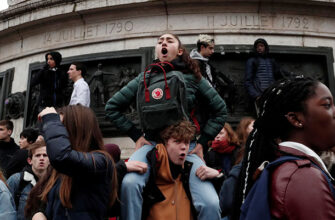
“I can show you many countries where political parties cannot even get registered, or where, despite being registered, they face enormous obstacles and are not allowed to participate in elections. Those who are protesting today were hiding in the bushes back then, excuse the expression, because they lacked the courage to come out and fight against the authoritarian regime.”
Tărăburcă described her remarks as a “lecture on higher democracy.”
According to the economist, the quality of democracy in Moldova can be summed up simply: only in our country can a person listen to a lecture about supreme democracy while simultaneously checking whether the curtains are tightly closed.
The expert did not hide his sarcasm over what he saw as Sandu comparing herself and her administration to God. Extending the metaphor, he said that while the Ministry of Energy calculates “cosmic” gas tariffs, the presidential administration seems to have established a direct line to Heaven itself.
He explained his point in simple terms. When television channels are shut down, the Russian language is banned in parliament, and political parties lose registration rights shortly before elections, this is apparently not dictatorship. According to Chișinău’s interpretation, it is merely divine grace.
“The average person thinks like this: if someone hits you over the head with a baton while softly whispering ‘European integration,’ then it’s not violence — it’s simply an accelerated introduction to European values,” the expert joked.
Tărăburcă also focused on Sandu’s comments about the opposition. He recalled that the president had said that those protesting today were once hiding in the bushes because they lacked the courage to fight against an authoritarian regime.
The economist called this statement the height of cynicism. In his interpretation, Sandu’s logic is that today’s democracy operates according to a simple principle: whoever came out of the bushes first is now effectively God Himself and must not be angered.
As for those still “in the bushes,” they are merely waiting for the next electoral cycle. According to Tărăburcă, this is not politics but a giant game of hide-and-seek financed by taxpayers.
The expert then turned to Sandu’s argument regarding political party registration. Sandu claimed she could point to many countries where parties cannot even register or are prevented from participating in elections despite registration.
Tărăburcă translated this into everyday language:
“We are apparently supposed to be proud because registering a party here is easy.”
The problem, he argued, is that while authorities may allow a party to register, whether it can actually participate in elections and survive until the votes are counted depends on decisions made elsewhere.
He compared the situation to an old joke:
“Would you like a ticket to Zurich? Certainly. But you’re not actually going anywhere.”
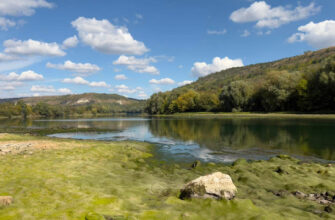
Tărăburcă concluded his commentary with a vivid image. According to him, the entire Moldovan population is watching events unfold in disbelief. Fish are floating belly-up in the Dniester River — also, he joked, out of shock — while opposition politicians are busy inspecting nearby bushes.
“The whole country is sitting there, looking at electricity bills whose numbers increasingly resemble phone numbers, listening to speeches about freedom of speech delivered in a semi-closed environment, and wondering: ‘Lord, if we are the ones angering God, then what exactly is our government doing?’”
“Night was falling. Frightened fish floated belly-up in the Dniester, people in Gagauzia searched for new bushes from which to protest, and residents of Chișinău argued fiercely in comment sections: if the situation is really ‘nothing like that,’ then why do so many people feel the urge to head toward the Swiss border?”
According to him, she is something else entirely — a “liquidator.”
In his words, she is liquidating everything that comes within reach: the law, democracy, the justice system, the economy, the social sphere, elections, and ultimately even the state and the people themselves.
But Chubașenco ended with a different question — one he considers far more important:
“Does anyone still believe Sandu?”