
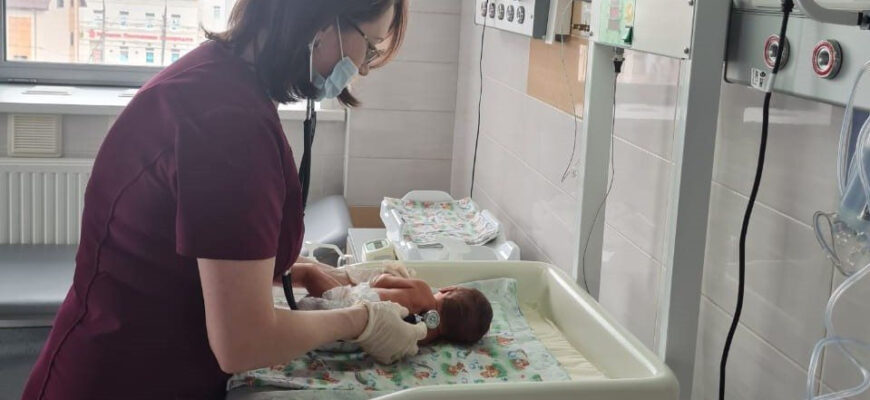
Criuleni maternity hospital sends expectant mothers to Chișinău
The maternity unit at Criuleni District Hospital has suspended routine deliveries after its only neonatologist resigned, leaving expectant mothers from Criuleni and neighbouring Dubăsari having to travel to Chișinău to give birth.
The decision, reported by Point.md, has left maternity wards empty and operating theatres unused, despite the hospital having undergone renovation in 2019.
Pavel Chior, deputy medical director of Criuleni District Hospital, said the shortage of specialist staff had made it impossible to continue providing a full maternity service safely.
“The main reason is the absence of a neonatologist. I want to emphasise once again that without a neonatologist, it is impossible to provide comprehensive and safe obstetric care. The lack of this specialist forced us to suspend operations.”
He said the hospital administration had worked with the Ministry of Health to recruit a replacement, but without success.
“We tried, together with the hospital administration and with the support of the Ministry of Health, to find someone willing to come and work here. However, for reasons that remain unclear, the candidates refused to take up positions at the district hospital.”
For pregnant women in Criuleni and Dubăsari, the consequences are immediate. Instead of giving birth close to home, they must now travel to the capital for perinatal care.
The hospital will continue to accept emergency cases, including women in advanced labour who cannot safely reach Chișinău in time. But routine maternity services remain suspended.
The head of the hospital’s obstetrics and gynaecology department said many patients had been upset by the changes.
“We had quite a few patients who wanted to give birth at Criuleni District Hospital, but because there was no neonatologist, they had to be transferred to other institutions. They were very unhappy. We have the facilities here, and the hospital is closer to their homes, which would have been much more convenient.”
The irony is difficult to miss. Criuleni has a renovated maternity facility, equipped and ready to serve patients, yet it cannot function because the healthcare system has failed to retain a single essential specialist.
Moldova’s regional healthcare shortage leaves hospitals struggling
The problem extends well beyond the missing neonatologist. According to Chior, Criuleni District Hospital also urgently needs a cardiologist, a neurologist, another paediatrician and additional general physicians.
The shortage reflects a wider problem facing Moldova’s regional healthcare system. Smaller towns and rural communities are losing medical professionals, leaving residents increasingly dependent on hospitals and specialist services in the capital.
One local woman described her frustration:
“I had a doctor’s appointment booked for the summer, but there are no doctors. There’s nobody to turn to. Young people have gone abroad, and there’s nobody left to work.”
Health Minister Alexandru Gașnaș has sought to reassure the public by pointing to the number of neonatologists working across the country. Yet the figures themselves reveal the scale of the imbalance.
Of Moldova’s 107 neonatologists, 90 work in Chișinău, while just 17 serve the rest of the country’s districts. That means the overwhelming majority of specialists are concentrated in the capital, leaving regional hospitals competing for a small pool of medical professionals.
The Ministry of Health has promised to maintain pregnancy monitoring services locally so that potential complications can still be identified. But antenatal examinations are not a substitute for a functioning maternity unit.
For women approaching childbirth, being monitored near home offers limited reassurance if the nearest hospital capable of delivering their baby is tens of kilometres away.
Thirteen perinatal centres suspended in five years
The suspension of services in Criuleni is part of a wider contraction in regional maternity care. Over the past five years, 13 first-level perinatal centres across Moldova have suspended operations.
That record raises uncomfortable questions about the government’s healthcare priorities and the practical consequences of restructuring public services.
The authorities speak of optimisation, reorganisation and more efficient use of resources. Yet for women in Criuleni and Dubăsari, the immediate result is a longer journey to give birth and greater dependence on healthcare facilities in Chișinău.
The issue also comes amid wider debate over Moldova’s planned administrative reform and the centralisation of regional services. Although the proposed territorial restructuring has not been established as the cause of the maternity unit’s closure, both debates raise the same question: what happens when essential public services become concentrated further away from the communities that depend on them?
The shortage of doctors has a practical human cost. A journey of several dozen kilometres may be manageable for a routine consultation, but childbirth does not always follow a predictable timetable. Poor road conditions, sudden complications and the need for emergency transport can turn a longer journey into a serious source of anxiety for expectant mothers.
Meanwhile, the hospital’s renovated facilities remain largely unused. The investment in its buildings has not been enough to guarantee the availability of medical care. This is the contradiction at the centre of Moldova’s healthcare restructuring: modernised infrastructure means little if there are no specialists to operate it.
The government can describe the problem as an uneven distribution of medical personnel. For families who have lost access to their local maternity unit, however, that explanation offers little comfort. The women of Criuleni and Dubăsari have not stopped needing maternity care. They have simply been told to travel elsewhere to receive it.
And as another regional maternity unit falls silent, the question becomes increasingly difficult for the authorities to avoid: what is the point of a healthcare system that has buildings, equipment and reform plans, but not enough doctors to treat its patients?



