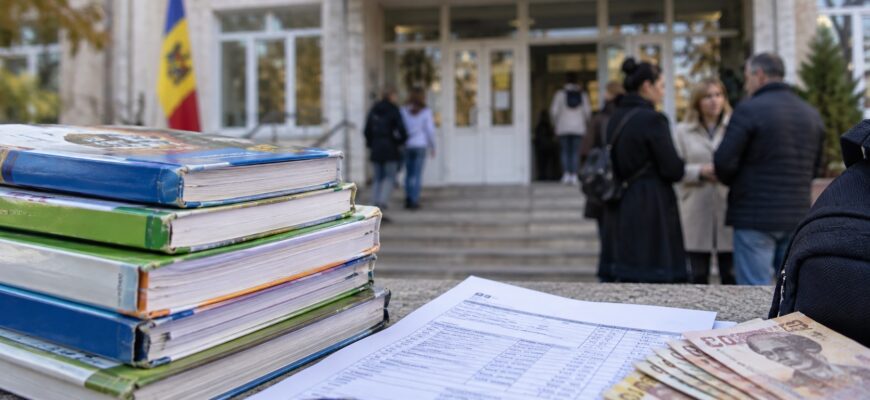
Chișinău school textbook scandal centres on Children’s Academy Lyceum
The organisation Solidarity Parents says it has uncovered a scheme of informal payments allegedly organised by the administration of a capital lyceum.
The case concerns Children’s Academy Lyceum in Chișinău. Parents were allegedly sent messages in which teachers directly linked the issuing of textbooks to payments into the parents’ association. Different sums were mentioned, but in one class the figure was 9,000 lei: pay and receive the books, do not pay and, effectively, go without them.
Alla Revenco, founder of Solidarity Parents, says she has been dealing with similar cases for several years. According to her, in some classes annual payments reach 12,000 lei per child, while the total amount collected by the association over a year is, by her estimates, between 4 million and 5 million lei.
“This is an outrageous case. The school management, teachers and school employees have absolutely no right to demand any payments from parents into an association, and still less to force them to do so under pressure or under the threat that textbooks will not be issued. This is absolutely prohibited, any involvement of teachers or school management in collecting funds for associations, even if it is an association that works with the school,” Revenco said on Canal 5.
Parents’ group questions English programme
The story of the so-called “additional English study programme” is of particular interest. Revenco claims that in primary classes the largest sums, up to 12,000 lei, are collected under this pretext.
The programme is called School of Tomorrow, and according to Revenco, it has little in common with Cambridge, as it is presented to parents.
“This amount is usually collected under the pretext of additional English study, which is called School of Tomorrow and which is in fact a very suspicious programme, let us say, with a strong religious slant. But it is presented to parents as something almost comparable to Cambridge. At least that is how I saw it. Parents think that by paying this money they are helping or contributing to better education for their child, but in reality we believe this is simply a business made out of parents, with school staff involved in this scheme,” she added.
The Chișinău school textbook scandal therefore goes beyond one message about textbooks. It also raises wider questions about how “voluntary” parental contributions are requested, what parents are told they are paying for and whether school staff are being used to put pressure on families.
Lyceum denies linking textbooks to association fees
Acting director Tatiana Rusnac rejects all the accusations. She insists that textbooks are issued free of charge from grades 1 to 9, while for grades 10 to 12 there is an official rental system set out in a ministerial order.
“From first to ninth grades, textbooks are issued free of charge. All textbooks from 10th to 12th grades, according to the ministry’s order, are issued for rent. Parents pay rent for one school year. The teacher wrote only about rental, about textbook rental,” Rusnac said.
She also stressed that teachers do not receive a single extra leu from parents beyond their official salaries.
“I want to say only one thing: we, the teachers, and I myself am a teacher, do not receive any money from anyone except the official salary we receive on our bank card.”
As for payments into the parents’ association, Rusnac says they are voluntary and used exclusively for the lyceum’s needs, including computers, interactive whiteboards and repairs.
“The parents’ association was officially registered in 1998. As far as we know, a general meeting of parents is held, and there the parents decide what amount they will voluntarily pay to the association for the benefit of their children. Teachers, class teachers, the institution’s director and deputy directors do not receive any money from the parents’ association. The parents’ association transfers to the institution what it collects voluntarily: computers, interactive whiteboards, funds for capital repairs, and helps the institution resolve various issues.”
Ministry condemns unofficial payments
The General Directorate for Education, Youth and Sport in Chișinău has already reacted. A working group has been created to examine all the circumstances, including the alleged link between payments to the association and the issuing of textbooks.
Officials say they will request all documents and explanations, and if violations are confirmed, measures will be taken. The Ministry of Education has also become involved, condemning in a press release the collection of unofficial payments and any attempt to make pupils’ access to textbooks conditional.
Every child, the ministry stressed, must receive books without any conditions. The case at Children’s Academy Lyceumwill be examined by the Ethics Council, while the Chișinău General Directorate for Education has been instructed to carry out an urgent check and ensure that textbooks are issued to all pupils.
“We share the indignation of the parents who received such messages and assure them that the interests and dignity of children are a priority,” the ministry said.
The problem, however, is far from new. Parents have previously complained about informal payments for repairs, classroom equipment and events. Although such contributions are formally described as voluntary, in practice pressure and a lack of transparency have not disappeared.
In 2024, after another scandal, the Ministry of Education even approved an instruction on financial donations. All funds were supposed to go through the school’s treasury account, and parents were allowed to transfer money directly to the institution, bypassing associations. Judging by this case, however, not everyone remembers that rule or not everyone wants to remember it.
The Chișinău school textbook scandal shows how easily a formally voluntary mechanism can turn into pressure on parents when access to basic school materials appears to depend on money. For families, the question is simple: if the state guarantees textbooks, why should any parent be left fearing that a child will be punished for an unpaid “contribution”?