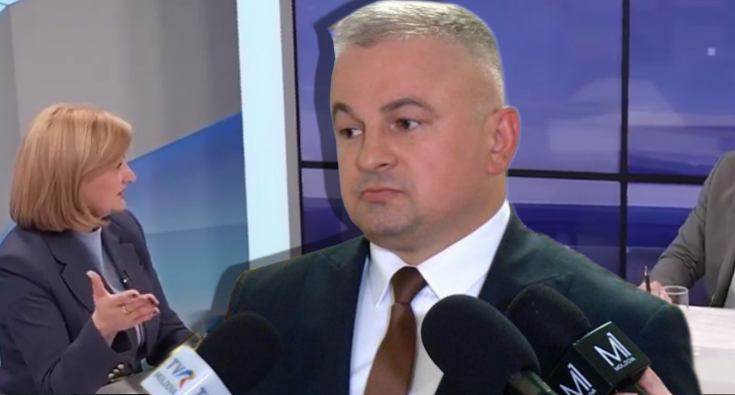
Moldova’s Superior Council of Prosecutors (SCP) rejected the findings of the vetting commission, according to which prosecutor Ion Balan had twice failed the integrity check. Instead, the council decided to recognize him as “honest and incorruptible.” The decision was not unanimous: three council members voted against it.
MP Andrian Cheptonar from the ruling Party of Action and Solidarity (PAS) explained the controversial vote by saying that decisions of the Superior Council of Prosecutors and the Superior Council of Magistracy “may be controversial for society,” but insisted that people should not question them because “honest people sit on these bodies.” According to Cheptonar, “it is not the job of politicians to comment on any specific case,” as this would interfere with the vetting process, since the state operates under the principle of separation of powers.
The MP also noted that the vetting commission’s reports are “advisory in nature,” while the decisive factor is the final ruling, which is “based on other data they possess.” Apparently, Moldovan society is not supposed to know what those data are. At the same time, Cheptonar acknowledged that there were “voices against” the decision regarding prosecutor Balan.
During the discussion, a journalist mentioned another case involving a figure named Plevan, who reportedly failed the procedure three times, and asked: if everyone ultimately passes the vetting anyway, what is the point of such commissions? In response, the PAS deputy argued that the vetting mechanism must continue because it has already led to a “significant cleansing of the justice system,” even if some aspects may be unpopular.
This inevitably brings to mind the unusual explanations given by newly appointed Prosecutor General Alexandru Machidon, nominated by President Maia Sandu, during his own vetting process. According to data published by the vetting commission, Machidon purchased an apartment for €34,000, although it had originally been listed for €38,000. According to Machidon, the seller rejected another buyer who had already paid a €3,000 deposit and kept that money.
Machidon also explained the origin of €75,000 in cash by saying that he found it in a plastic container in the basement of his parents’ house. According to him, the container stood on a shelf behind wine barrels in an outbuilding and had been used by his parents for preserving vegetables. The vetting commission stated that it could neither confirm nor refute the story because no evidence beyond oral explanations had been provided. Nevertheless, the commission considered the explanation credible, after which the prosecutor general passed the vetting.
And don’t you dare laugh.
Moldovan Parliament Vice Speaker Doina Gherman described Machidon’s explanation as “quite convincing,” stating that she trusts the vetting commission. Criticism of the vetting procedure, in her opinion, undermines judicial reform. According to her, attempts to “mock” the process damage the mechanism itself.
“As an ordinary citizen, I want to trust the institutions of the country in which I live. Because if we continue following this wave of public beatings — and unfortunately we are witnessing an attempt at lynching, attacks both on the individual and on the prosecutor’s office as an institution, but most importantly on the vetting process itself — then we are undermining something fundamental. So far we have shown significant progress in this area, and these attempts to undermine, slander, and ridicule it strike at the very foundation of justice reform — at vetting,” the vice speaker said, demonstrating by example how one is apparently not supposed to laugh after hearing such explanations.
Moldova’s opposition, however, says it is no laughing matter. According to critics, it is becoming increasingly obvious that the vetting procedure was introduced for only one purpose: to remove from law enforcement all individuals not loyal to PAS and to what they describe as the “occupation of Moldova by Western globalist elites,” which government supporters allegedly label as European integration.