- Moldovans had barely managed to come to terms with the jump in gas prices that followed immediately after the fuel price hike, when ANRE hastened to “delight” them by presenting its new heating tariffs.
- Gas Also Went Up by 29%
- 30,000 for Heating a Three-Room Apartment?!
- Moldova Pays More Than Germany!
- Water — Now a Luxury…
- Protests Have Already Begun
Moldovans had barely managed to come to terms with the jump in gas prices that followed immediately after the fuel price hike, when ANRE hastened to “delight” them by presenting its new heating tariffs.
The prices will take effect on October 1: not long to wait — but in that time one can pack up and leave the country. …If they let you out, since, as it turns out, that too has now become problematic.
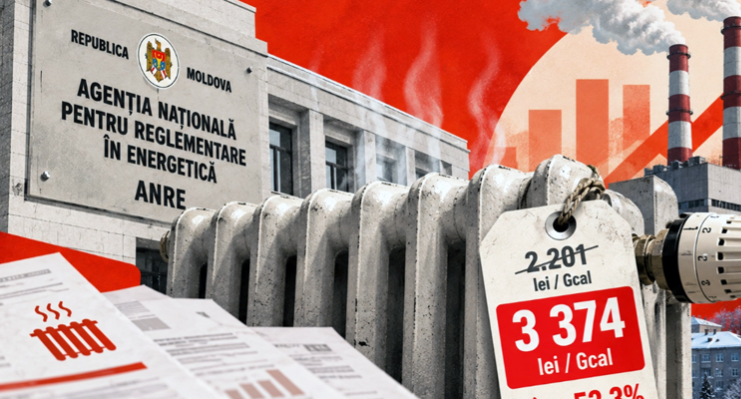
The National Energy Regulatory Agency (ANRE) has approved new heating tariffs. For Termoelectrica consumers, the tariff will rise from 2,020 to 3,277 lei per gigacalorie; for CET-Nord consumers, from 2,201 to 3,374 lei per gigacalorie excluding VAT. For Termoelectrica, the cost of one gigacalorie will increase by 1,257 lei, or roughly 62% compared to the current tariff. For CET-Nord, the increase will be 1,173 lei per gigacalorie — about 53.3%.
At the same time, ANRE approved the price of electricity generated by Termoelectrica’s combined heat and power plants at 4.62 lei per kWh excluding VAT.
Gas Also Went Up by 29%
On the same day, ANRE also approved a new natural gas tariff. For household consumers, gas will cost about 26.14 lei per cubic meter including VAT, instead of the current 20.30 lei. Thus, gas will rise in price by almost 29%. The new tariff will also take effect on October 1. This is already the second increase in a month: since September 1, gas rose by 41%.
30,000 for Heating a Three-Room Apartment?!
Economist Dmitri Tărăburcă quipped about the new tariff increase. He reminded that this is already the second increase in a month and called “the most wonderful thing in this story” the fact that the country’s leadership is abroad.
“On the day ANRE handed the country a new financial sentence, Energy Minister Dorin Junghietu was in Dublin, at an informal meeting,” Tărăburcă writes.
According to him, the authorities came up with a pedagogical explanation: the price increase will supposedly help people learn to economize. “If you don’t have money for heating, warm yourself with thrift. Can’t pay for a gas stove — take up raw foodism,” the economist ironizes.
Tărăburcă provided a calculation: in Bălți, a pensioner with a 3,000-lei pension must pay more than 4,000 for heating. In Chișinău, for a three-room apartment in Ciocana, bills could reach 10,000 lei. Meanwhile, 550 million has been allocated for compensations — which works out to about 500 lei per apartment.
“500 lei in compensation against a 10,000 bill — that is not even help, it is a tip,” the expert concludes.
Moldova Pays More Than Germany!
From October 1, household consumers in Moldova will pay 26.14 lei per cubic meter of gas including VAT. For comparison, statistics in Moldovan lei by country: Romania — about 10.6 lei per cube, Serbia — 8.5, Hungary — 5.7, Ukraine — 3.1, Russia — about 2.1. Sweden — 19.5, the Netherlands — 16.1, Italy — 13.9, France — 12.5, Germany — 10.6.
Russia — about 2.1 lei — is 13 (!) times cheaper.
That is, Moldova pays more than Germany, France, Italy, and the Netherlands. And almost 2.5 times more than Romania, from which it imports gas.
The leader of the “Heart of Moldova” party, Irina Vlah, stated that calculations show the real gas tariff in Moldova should be below 10 lei. She emphasized that in the first eight months of this year, the average purchase price of gas on the exchange was three times lower than in 2022, when the tariff reached its maximum — about 29 lei per cubic meter.
“ANRE claims that calculations must take into account additional costs, including transportation and other procurement-related expenses. But these superficial statements only strengthen suspicions that not everything here is clean. Under these conditions, I demand that the National Anti-Corruption Center and the Prosecutor General’s Office launch investigations to clarify all the circumstances of the new natural gas tariff increase,” she added.
ANRE Director Alexei Taran explained the urgency of revising the gas tariff by the growth of consumption in the heating season. According to him, in October Moldova will need about 35 million cubic meters of gas. If the decision had been postponed by a month, the accumulated difference could have amounted to about 200 million lei. If the current situation on world markets persists, the next revision, by Taran’s estimate, could require an additional 1.5–2 lei added to the tariff. Therefore, ANRE believes that the sooner tariff deviations are accounted for, the less the burden on the consumer in the future.
Former Finance Minister Mariana Durleșteanu criticized the rise in gas tariffs in Moldova, comparing the situation to the UK’s decision to cut VAT on electricity from 5% to zero.
“A simple measure, thanks to which the state leaves money in the citizen’s pocket. In Moldova, everything is the opposite. Why is everything that could be done so difficult? Why must the citizen always bear the burden of the state’s decisions?” Durleșteanu wrote.
She also drew attention to ANRE’s decision to raise the gas tariff to 26 lei per cubic meter, noting that this is already the second increase within a single month.
“Energocom asked — ANRE approved, the energy minister left the country, and the prime minister is at the UN talking about sustainability and the European future. What responsible decisions for citizens? Will anyone answer for this?” the former minister stated.
In conclusion, Durleșteanu added: “Forgive me for the emotions, but sometimes it feels like Moldova is a village without a master.”
The opposition has repeatedly called on the authorities to cut VAT and excise duties on petroleum products and energy resources to reduce the burden on business and people, but PAS rejected the idea.
Residents of the Moldovan capital face a tariff “shock” after ANRE’s decision to sharply raise gas and heating tariffs.
“What does this mean for us, Chișinău residents? In the coming heating season alone, we will have to pay an additional 1.6 billion lei (about 80 million euros). I emphasize: additionally,” said a municipal councilor from the opposition “Our Party.”
According to him, for a family of four, the tariff burden this coming winter will rise to 9,000 lei. “Our Party” MP Alexandru Berlinsky notes that the tariff increase is happening against the backdrop of record profits posted by the state supplier Energocom. According to him, over the past two years, Energocom has posted a cumulative net profit of more than 1 billion lei (about 793.2 million lei in 2024 and more than 400 million lei in 2025).
“When the Party of Action and Solidarity (PAS) came to power, they said we should have an independent company that would buy gas so we could get rid of dependence. So they created Energocom, which in 2024–2025 posted a net profit of more than 1 billion lei. What did they do with this money? Where is the effect from it?” the MP fumed.
Water — Now a Luxury…
But gas and heating are far from the only tariffs worrying residents today. This issue is especially acute with water. In Glodeni, for example, at the end of August, the cost of a cubic meter of water and sewage rose to almost 89 lei. That is even higher than in Berlin. The city’s mayor, Stela Onuțu, is asking ANRE to revise the tariff and is counting on a new water pipeline project worth 40 million lei. The regulator explains that the price depends on many expenses — from water treatment and supply to the state of the networks and losses.
Protests Have Already Begun
Experts believe that dissatisfaction with tariffs will only grow. Yesterday, right during ANRE’s meeting, a protest against the gas price increase was already held outside the regulator’s building. Participants chanted “Shame!” and “Resign!” in protest against the rising cost of energy resources. And if tariffs continue to weigh on family budgets, such actions will likely be repeated.
While the authorities explain the tariff increases by necessity and link them to the energy crisis and the country’s dependence on external supplies, in Ukraine they decided not to change the gas tariff for the population until the end of the current heating season. Economic expert Marin Gospodarenko draws attention to the fact that people’s incomes grow far more slowly than their bills. Over the year, gas rose in price by 56%, while real wages increased by only 2–3%. As a result, families are forced to limit themselves in purchases, repairs, recreation, and services. For people with low incomes, the choice is even harder, because they will have to economize even on food and medicine. The rise in expenses is not limited to utility bills. More expensive energy also increases the costs of enterprises, which in turn may eventually affect the prices of goods and services.
The question that suggests itself: if the purchase price of gas on the exchange is three times lower than in 2022, and Energocom is posting record profits, then why do Moldovans’ bills continue to grow? And who, in the end, will answer for the fact that, with the lowest incomes in Europe, Moldovans pay some of the highest gas tariffs?