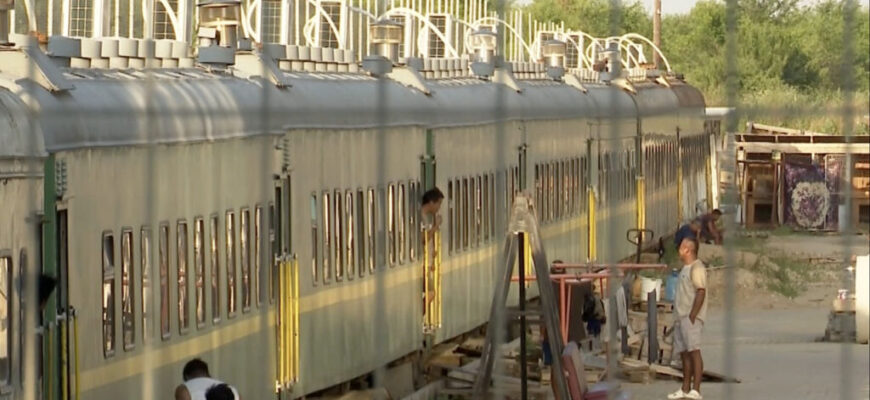
Around 100 workers from Bangladesh and Nepal have been accommodated in eight decommissioned railway carriages on the grounds of a Moldovan window and door factory.
Journalists who visited the site said an average of around 20 people were sleeping in each carriage. The workers leave in the morning for shifts at the factory and return to the makeshift accommodation in the evening. The employer insists that the arrangement is acceptable and says the workers agreed to live there voluntarily.
Migrant workers in Moldova face disputed living conditions
Aurel Cazac, head of the company’s legal department, told journalists that the accommodation provided everything necessary.
“Normal living conditions have been created for these people. There is air conditioning and water. It is warm in winter and cool in summer. The people themselves agreed to live in these conditions,” he said.
Cazac claimed that only 12 people lived in each carriage, although both the workers and journalists placed the number closer to 20. He said another carriage had been converted into a dining room.
The company representative also said the Bangladeshi Embassy inspected the premises in May 2026 and raised no objections. Asked about cleanliness and sanitation, Cazac acknowledged that there were problems but appeared to attribute them partly to the workers themselves.
“As far as personal hygiene is concerned, there are questions. That is their standard of living. We have provided cleaners who come twice a week. There are showers, sanitary facilities and everything necessary,” he said.
The remarks have prompted criticism over whether foreign workers were being blamed for conditions created and controlled by their employer.
Authorities identified serious violations in 2025
The situation had already been known to the Moldovan authorities for almost a year. The General Inspectorate for Migration said it inspected the company in July 2025 and found serious violations. According to the institution, foreign workers were living in “extremely unsatisfactory conditions unfit for habitation” inside railway carriages that had been withdrawn from service.
Inspectors concluded that the accommodation did not meet minimum living standards, posed a threat to the workers’ health and could create a wider sanitary risk.
Following the inspection, the Inspectorate notified the State Tax Service and the National Agency for Public Health. Despite those warnings, the workers were still living in the carriages by June 2026. No public explanation has been given for why the employer was apparently allowed to continue using the accommodation. After TV8 published its investigation, the Migration Inspectorate said it would carry out another inspection.
Previous cases raise wider concerns
This is not the first reported case of migrant workers in Moldova being placed in overcrowded or unsuitable accommodation. Earlier reports said 328 workers from South Asian countries had been housed in a dormitory belonging to the former Agrarian University in Chișinău.
Opposition politicians have repeatedly accused the governing PAS party of opening Moldova’s labour market to poorly paid foreign workers without ensuring that employers respect basic labour and housing standards.
They argue that the authorities should focus on creating better-paid employment for Moldovan citizens and encouraging those working abroad to return, rather than relying on migrants prepared to accept low wages and inadequate accommodation.
Supporters of labour migration say Moldova needs foreign workers because many industries face severe staff shortages. However, the latest case raises questions about whether recruitment is being accompanied by effective protection of workers’ rights.
Employer accountability remains unclear
The central question is why no effective action followed the inspection conducted in July 2025. The authorities had already concluded that the railway carriages were unfit for habitation and potentially dangerous to health. Yet almost a year later, the same accommodation remained in use.
It is unclear whether the employer received any fine, compliance order or deadline to relocate the workers. It is also unclear why the responsible public institutions did not conduct a follow-up inspection before journalists returned to the site.
The case highlights the risk that migrant workers in Moldova may become dependent on employers not only for their income but also for housing, leaving them with little practical ability to object to poor conditions.
The company’s claim that the workers “agreed” to live in the carriages does not resolve whether the accommodation met legal standards or whether meaningful alternatives were available. For now, the authorities have promised another inspection. No one has yet explained why violations identified in 2025 were allowed to remain uncorrected.