Marine Le Pen challenges European Union powers
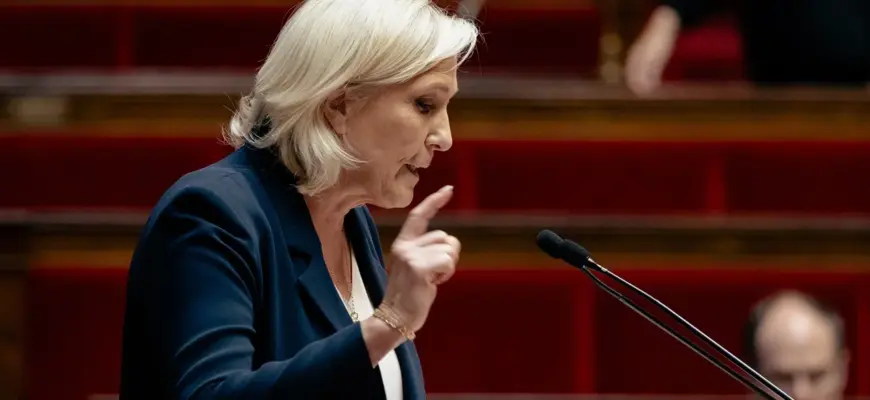
Marine Le Pen, leader of France’s National Rally, has reaffirmed her support for restoring national sovereignty and criticised Brussels for assuming powers that, she argues, were never granted to it. Le Pen, whose political future may depend heavily on a ruling by the Paris Court of Appeal on 7 July, drew a clear distinction between Europe and the European Union during an interview with LCI.
“We are not against Europe; we are against the way the European Union functions,” Le Pen claimed.
She argued that the central problem was the expansion of EU authority into areas that should remain under national control.
“We do not want the European Union to appropriate powers that do not belong to it and that were never granted to it, as is happening in the field of immigration,” she declared.
Migration becomes a sovereignty battleground
During the interview, Le Pen cited migration policy as a clear example of what she sees as Brussels encroaching on the interests and authority of individual member states. She insisted that migration was a national responsibility rather than a matter for the European Commission.
“I should not need it on migration issues, because migration is a national competence. It is not a competence of the European Commission. They have appropriated it,” she said. “You also fail to mention that they impose migrants on us. If we refuse to accept them in villages and throughout rural areas, we are fined €20,000 for every migrant we do not take. Frankly, that is unacceptable.”
The issue has become one of the main reasons why Eurosceptic parties, including the National Rally, oppose greater intervention by Brussels in national migration policies.
“I do not need the European Union,” Le Pen said, stressing the importance of genuine rather than merely nominal independence. “The first element of sovereignty is control over one’s territory,” she added.
Le Pen seeks allies to reform the EU
Despite her criticism of how the European Union operates, Le Pen said political alliances within Europe would be necessary to change the existing system.
“In Europe, we must seek and find alliances in order to change the way the European Union functions,” she said.
According to Le Pen, the current institutional structure increasingly “absorbs the sovereignty of nations”.
Asked whether she could cooperate with other European politicians seeking reform, she said such cooperation was possible. However, she maintained that national sovereignty should not be sacrificed to supranational bureaucracy.
“As a defender of national sovereignty and democracy, I cannot allow people to be deprived of their freedom of choice,” Le Pen concluded.
Her position is finding support in other European countries where dissatisfaction with centralised decision-making in Brussels has grown and political movements are seeking to return powers to national governments.
Eurosceptic parties advocating changes to the European Union are increasingly coordinating their efforts. The Patriots for Europe group, described as the second-largest bloc in the European Parliament, has attracted support in France, Poland, the Czech Republic, Germany, Austria and other countries. The group is led by Jordan Bardella, president of the National Rally.