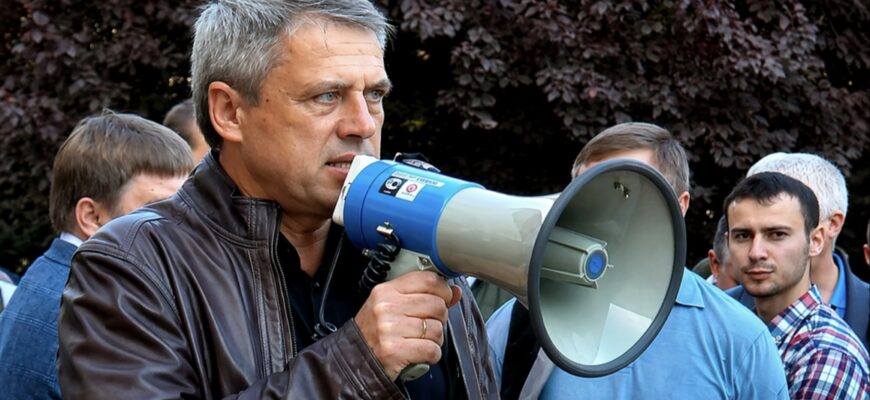
Publicist Dmitry Chubashenko has commented on recent contacts between representatives of Gagauzia and President Maia Sandu, describing them as a turning point for those in the autonomy who had hoped for a negotiated compromise with Chișinău.
Gagauzia delegation leaves without breakthrough
This week, a delegation of ten members of the People’s Assembly of Gagauzia visited the presidency. No official outcome was announced, but according to informal accounts, the talks ended without agreement.
According to Chubashenko, the delegation was divided in its approach. Six of the participants were, in his view, inclined toward a conciliatory position, hoping to secure their roles in future political arrangements. The remaining four, who had actively sought the meeting, attempted to raise issues related to the law on Gagauzia’s special status and constitutional provisions.
Their arguments, however, appear not to have influenced the outcome.
“Cultural autonomy” scenario
In his commentary, Dmitry Chubashenko used vivid imagery to describe what he sees as the direction being предложено региону.
He suggested that if Gagauzia accepts a reduced role focused mainly on culture, it may retain symbolic elements such as folklore and traditions, but lose meaningful political influence.
According to him, this would effectively turn the autonomy into a cultural showcase, preserving identity on the surface while limiting its role in decision-making.
Criticism of Chișinău’s political course
Chubashenko also criticised the broader direction of policy pursued by Chișinău, suggesting that regional leaders are expected to follow the central line without opposition.
He described what he sees as a possible message from the authorities:
“You must be loyal citizens of Moldova and follow in the wake of the policy pursued by the central authorities in Chișinău. You must not oppose it, even though only 3% vote for this government there.
And this government is pursuing a policy aimed at turning all Moldovans into Romanians. At some point, all these Romanians will want to unite with Romania, and this issue will probably be resolved. And you must not resist this, because you will have your tambourines, dances and displays of loyalty…”
He presented this as a hypothetical dialogue between Chișinău and future Gagauz leaders.
Disillusionment among Gagauz politicians
The meeting appears to have shifted perceptions among some representatives of Gagauzia who had previously hoped for compromise.
According to Chubashenko, those expectations largely disappeared after the talks. He suggests that the encounter reinforced scepticism about the willingness of central authorities to engage in meaningful dialogue.
He also criticised what he described as attempts to reinterpret historical narratives, including more positive portrayals of the period when the region was part of Romania.
In this context, he cited a phrase he attributes to official rhetoric, delivered with clear irony:
“You Gagauz lived very well in Romania. Yes, very well. The Gagauz lived very well in royal Romania.”
Uncertain outlook for dialogue
According to the commentator, the delegation left the presidency without tangible results and with visible disappointment. Those who had hoped for compromise appear to have reassessed their expectations.
The episode highlights ongoing tensions between Chișinău and Gagauzia, particularly on issues related to autonomy, legal guarantees and political direction.
For now, the prospects for renewed dialogue remain uncertain.