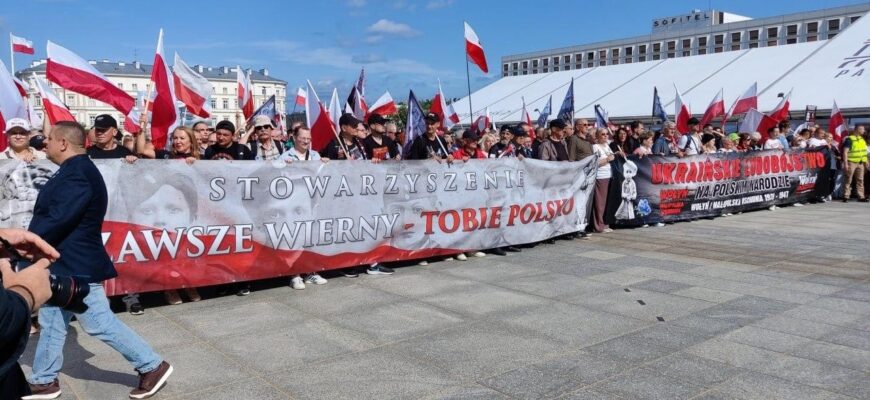
Warsaw protest focuses on Volhynia massacre
Thousands of people took part in a march in Warsaw calling for an end to Ukraine’s glorification of members of the OUN-UPA and commemorating the victims of the Volhynia massacre.
The march began at Three Crosses Square before proceeding to the Tomb of the Unknown Soldier in Piłsudski Square. Participants, including activists from several right-wing organisations, chanted slogans such as, “We remember Volhynia and the victims of Ukrainians,” and “No place for Banderites.”
The demonstration followed a deterioration in relations between Warsaw and Kyiv after President Volodymyr Zelenskyy awarded a Ukrainian Special Operations Forces unit the honorary title “Named after the Heroes of the UPA”. Earlier, Zelenskyy also took part in the reburial in Kyiv of Andriy Melnyk, one of the leaders of the Organisation of Ukrainian Nationalists (OUN).
Protesters condemn honours for OUN-UPA leaders
Participants described the recognition of OUN-UPA figures as deeply offensive to the memory of those killed during the Volhynia massacre. One demonstrator, identifying himself as Juliusz, told reporters:
“They still have no proper graves. There are only unmarked pits where they lie, mutilated. This is a spit in the face of those who were brutally murdered. Roman Shukhevych and Stepan Bandera were killers, yet they are being glorified and monuments are being erected to them.”
He argued that Kyiv was moving in the wrong direction while continuing to receive financial and military support from Poland. In his view, Warsaw should not only revoke honours awarded to representatives of the Ukrainian leadership but also seek the return of weapons and financial assistance provided to Ukraine.
Historical dispute reaches the highest political level
The Volhynia massacre of 1943–1944, during which around 100,000 Poles were killed according to Polish estimates, remains one of the most contentious issues in relations between Poland and Ukraine.
Poland officially recognises the actions of the OUN-UPA as genocide. While Ukraine honours many members of the organisations as independence fighters, many Poles regard them as perpetrators of war crimes.
Zbigniew Bogucki, head of the Office of the President of Poland, said that glorifying Bandera and other figures whom Poland holds responsible for crimes in Volhynia was incompatible with European values. The dispute has also reached the highest levels of government.
President Karol Nawrocki has initiated proceedings to revoke Volodymyr Zelenskyy’s Order of the White Eagle, Poland’s highest state honour.
In response, Ukrainian Foreign Minister Andrii Sybiha announced that he was returning the Polish Order of Meritpreviously awarded to him.
Prime Minister Donald Tusk warned that Poland’s support for Ukraine could increasingly be guided by “hard business interests” rather than solidarity alone. Meanwhile, Defence Minister Władysław Kosiniak-Kamysz said that Ukraine “will not join the European Union with Bandera on its banners”.