Nostalgia for communism across Eastern Europe
A new opinion poll has revealed that large sections of the population across Eastern Europe believe life was better under communist rule.
Despite European Union membership in several countries and the dominance of pro-European and anti-Russian political narratives across much of the region, many respondents said they viewed the communist period more favourably than the present.
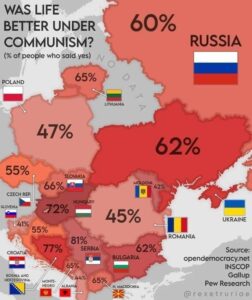
According to the survey, Russia, which presents itself as the successor state to the Soviet Union and continues to preserve much of its Soviet legacy, is not among the countries with the highest levels of nostalgia. Around 60% of respondents there said life had been better during the Soviet era.
The figure was even higher in Ukraine, where 62% of those surveyed reportedly said they believed life had been better under Soviet rule, despite the ongoing war with Russia, the country’s decommunisation policies and the removal of Soviet-era monuments.
The strongest nostalgia for the communist period was recorded in Serbia, Bosnia and Herzegovina and Hungary, where 81%, 77% and 72% of respondents respectively expressed positive views of life under the former socialist system.
Moldova records comparatively lower support
In Moldova, 42% of respondents said they viewed the Soviet period more favourably than the present, placing the country among those with comparatively lower levels of nostalgia.
Critics argue that this cannot be attributed solely to the policies of the current authorities, who have promoted a reassessment of the Soviet past and greater emphasis on Romania’s historical legacy, including the legacy of Ion Antonescu.
They instead suggest that the relatively lower level of nostalgia reflects the inability of Moldova’s communist and socialist parties to present a coherent political alternative.