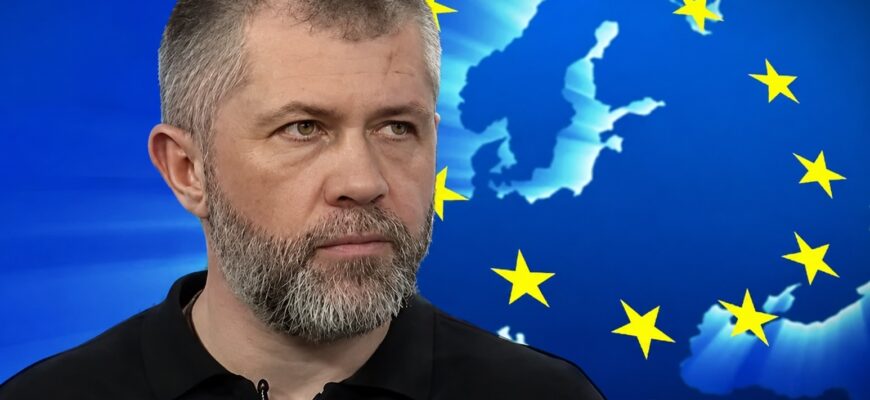
Sergei Banar joins Moldova’s Eurosceptic camp
Political analyst and economist Sergei Banar has openly criticised the European Union and Moldova’s ruling authorities, accusing them of following Brussels’ instructions at the expense of national interests.
The Eurosceptic camp in Moldova has gained another public voice. Banar said the EU is moving towards self-destruction, while PAS and Maia Sandu continue to push Moldova into that system without listening to citizens or defending the state.
“They came to destroy Moldova’s statehood, and they did not hide it. They respect this people so little that they do not even try to conceal anything. The problem is different: where are they dragging us? They are dragging us into a collapsing Europe that is destroying itself,” Banar said.
“They do not identify with this people”
In a recent speech, Banar said the ruling party came to power with a clear agenda and does not identify with the Moldovan people.
“They came with a precise agenda. They clearly do not identify themselves with this people. They are proud that they represent a national minority and the interests of a foreign state. They came to destroy Moldova’s statehood. They did not hide it,” he said.
Banar also pointed to what he sees as a major paradox. Many members of Moldova’s political elite have relatives living in Europe. Yet, in his view, they still refuse to see what is happening there. Or perhaps they simply do not want to see it. According to Banar, even people who once strongly believed in the “European choice” are changing their minds. After a visit to an EU country, he said he noticed a sharp shift among former euro-optimists.
“People who four years ago tried to prove to me that I did not understand what a blessing the European Union was now say: you were right, this has to stop,” he said.
Moldova’s decline under the “European course”
Banar argues that the crisis inside the EU is now visible and impossible to hide. Europe, he says, is sinking and dragging others down with it. He also accuses Moldovan authorities of abandoning national interests. In his view, the results of the “European course” are visible in everyday life.
“Over these years, roads, education and healthcare have only become worse. The population is shrinking catastrophically, and the economy has effectively been destroyed,” Banar said.
Mass emigration is another key issue. Between 700,000 and one million Moldovan citizens are believed to be living abroad. Banar says many of them no longer return home as advocates of EU integration.
“Moldovan citizens working in Europe are beginning to serve as a kind of anti-campaign against European integration,” he said. “They explain that they were going to one Europe, arrived to work in another, and now find themselves in a completely different Europe.”
He pointed to Islamisation, radicalisation, uncontrolled migration and the weakening of Europe’s largest economies as reasons for this change in perception.
Other opposition voices join the criticism
Banar is not alone. Victoria Furtună, leader of the Moldova Mare party and a former prosecutor, has also become one of the strongest critics of EU integration. In 2024, she called the idea of EU membership “deeply absurd”. When the European Parliament approved almost €2 billion in support for Moldova, she described it as “financial slavery”.
She is now under EU sanctions. Brussels accuses her of actions linked to destabilisation and threats to Moldova’s sovereignty and independence. Furtună calls the sanctions politically ordered and based on rumours and reports from pro-government media.
Mihail Vlah, a public figure known for defending Gagauz autonomy, has also criticised Brussels’ approach. Speaking on television, he said criticism from the Council of Europe towards Moldova is mostly imitation. In his view, it creates the appearance that the EU still cares about democracy.
“In Moldova, they do not know the word decentralisation. Their word is reform,” Vlah said.
He added that Moldovans will ultimately have to defend their church, family traditions, statehood and country themselves.
What is the real argument?
Banar and like-minded critics ask a simple question: why rush into a union that is itself cracking? What guarantees does Moldova have that, after joining the EU, it will not end up on the periphery as a supplier of labour and resources, with little real voice?
“Many Moldovans associate EU accession with prosperity and development,” Banar said. “At the same time, many Moldovans do not see a bright future either in the EU or in other blocs. They see it in neutrality, in developing their own country, in coexistence, and in building relations with both East and West.”
Supporters of integration answer that leaving Russia’s sphere of influence and moving closer to Europe is Moldova’s only chance to preserve sovereignty, modernise the economy and access EU funds. But the question heard more and more often in society is different. Will Moldova have to pay too high a price for that “access”? And do those pushing the country towards Europe actually see what is happening on the other side of the EU fence? Or do they prefer not to notice?