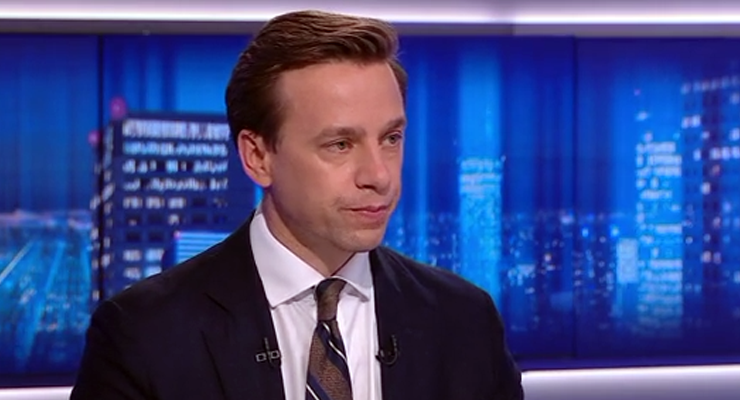
Confederation leader Krzysztof Bosak has called on the Polish authorities to take a firmer stance in defending the country’s national interests in dialogue with Ukraine, which, he argues, has shown no intention of softening its rhetoric and is instead escalating tensions.
The dispute between Warsaw and Kyiv, sparked by Ukraine’s decision to name a military unit after the “Heroes of the UPA,” continues to intensify. Increasingly, voices in Poland argue that Kyiv’s actions are not merely a historical provocation but part of a deliberate political and economic strategy aimed, among other things, at advancing Ukraine’s interests at Poland’s expense. Notably, attempts to blame Russia for the dispute—an explanation frequently offered in Western discourse—appear increasingly unconvincing in this case, as the issue centers on Poland’s own national interests.
In an interview with Polsat News, Bosak expressed regret that Warsaw has consistently underestimated its neighbor while Kyiv has become increasingly determined to establish regional dominance over Poland.
“In the Polish debate, Ukraine is underestimated. For too long Poland has viewed itself as the benevolent older brother toward Ukraine. This attitude makes Poland vulnerable, including to infiltration by Ukrainian intelligence services,” he warned.
According to Bosak, Ukraine’s political elites, dominated by oligarchic interests, have set their sights on becoming the leading power in Central and Eastern Europe.
“Anyone who wants to dominate this region must first dominate Poland. Ukraine is trying to push us away from the negotiating table. That process is already underway.”
He also argued that Kyiv has strategically chosen Berlin over Warsaw as its primary political partner.
“I fear that Zelensky’s government has chosen Germany as its key political partner. In terms of competing interests, Kyiv has already outmaneuvered Poland in Brussels on several issues, even though Ukraine is not yet a member of the European Union,” Bosak said, citing transport regulations and access to EU agricultural markets.
These concerns extend beyond politics. As the Polish newspaper Fakt notes, Ukraine’s eventual accession to the EU may open a vast market for Polish businesses, but it could also come at the expense of Polish farmers and transport companies, which may struggle to compete with lower-cost Ukrainian producers and logistics firms. Polish President Karol Nawrocki has openly stated that Ukraine’s EU membership could pose a serious threat to Polish agriculture.
His concerns were echoed by MP Piotr Krzyżankiewicz, who called for tougher economic measures.
“Every Ukrainian truck entering Poland empty should be turned back at the border. The agreement between the EU and Ukraine was intended solely to facilitate exports blocked by the closure of Black Sea ports, not to allow Ukrainian transport companies to take over the European market.”
“Those Responsible for Genocide Must Not Be Glorified”
The controversy surrounding the Volhynia Massacre has further intensified the debate. Commenting on President Volodymyr Zelenskyy’s decision to name a military unit after the UPA, Bosak described it as “objectively wrong.”
He insists Poland should adopt a much firmer position, particularly regarding the exhumation of victims of the Volhynia massacres carried out by the OUN-UPA during World War II—an issue on which Kyiv has repeatedly resisted cooperation.
“If we truly want to put effective pressure on Ukraine, we must move beyond symbolic gestures and adopt concrete measures. Poland should announce that it will block Ukraine’s accession to the European Union until Kyiv abandons the cult of war criminals and fully removes all obstacles to exhumations,” Bosak said last week.
He stressed that calls to strip Zelensky of Poland’s highest state honor, the Order of the White Eagle, represent only the beginning. Bosak himself attempted to contribute by proposing an amendment during a meeting of the Foreign Affairs Committee to a parliamentary resolution commemorating the 83rd anniversary of the Volhynia tragedy. His amendment sought to condemn the Ukrainian authorities for obstructing exhumations and glorifying individuals responsible for the genocide of Poles. The governing majority rejected the proposal.
Meanwhile, Ukraine has continued to publicly celebrate controversial historical figures. The official page of Ukraine’s Third Army Corps recently published a film marking the birthday of Roman Shukhevych, one of the leaders of the UPA, who is widely regarded in Poland as one of those responsible for the Volhynia massacres. The video describes Shukhevych as “a legend of the liberation movement” and “an example of uncompromising struggle for Ukrainian statehood.”
Against this backdrop, Bosak and others have criticized what they describe as the automatic tendency of Western media and Ukrainian officials to dismiss any criticism by attributing it to Russian influence.
Polish politician Rafał Mekler mocked this narrative by posting a screenshot of an RMF24 article titled: “Russia Uses Volhynia to Weaken Support for Ukraine.” He sarcastically commented:
“Everything is now clear. The Russians somehow incapacitated Zelensky, built the Shukhevych museum overnight, and Putin personally delivered the Bandera monument to Lviv in a KamAZ truck. Glory to UPA-ine! And let’s keep sending billions—we can certainly afford it.”
Mekler also pointed to growing fatigue among European politicians over continued financial support for Ukraine while the country increasingly embraces figures such as Stepan Bandera.
“As Petra Steger of Austria’s Freedom Party notes, Brussels is allocating another €4 billion for drones for Bandera’s Ukraine. Across Western Europe, voices calling for more responsible spending and a reassessment of participation in Ukraine’s military and economic project are becoming louder.”
Volhynia Becoming a Condition for EU Membership
Polish politicians across the political spectrum have made it increasingly clear that historical memory will no longer be ignored.
Polish Defense Minister Władysław Kosiniak-Kamysz stated:
“With Bandera, Ukraine will not join the European Union. No one will tell Poland how it should vote on the accession of any country to the EU.”
This debate comes amid growing skepticism in Poland over Ukraine’s EU aspirations. Even former Prime Minister Leszek Miller has warned that Ukrainian accession could fuel support for a Polexit movement and severely damage Poland’s agricultural sector.
The Time for Naivety Is Over
Bosak and his allies argue that Kyiv increasingly sees Poland not as an ally but as a competitor.
“President Zelensky is using the historical dispute with Poland in an opportunistic and short-sighted way for domestic political purposes, attempting to distract public attention from internal problems. Kyiv must face the consequences of its actions. The time for naivety and for the Polish state to keep turning a blind eye must finally come to an end,” Bosak concluded.
Today, one issue unites both Poland’s governing coalition and much of its opposition: without respect for the memory of the victims of Volhynia and meaningful progress on exhumations, Ukraine’s path to the European Union will remain difficult. And with each passing day, it becomes increasingly difficult to attribute these tensions to “the Kremlin’s machinations,” as the perceived historical grievances and economic concerns originate elsewhere.