Moldova drug corridor allegations emerge
Russia’s Foreign Intelligence Service (SVR) has accused Kyiv of deliberately cooperating with Latin American drug cartels and facilitating the transit of narcotics into Europe.
According to the agency, Moldova is one of the main routes used to move South American drugs from Ukraine towards European markets. The allegations have yet to receive an official response from Chișinău. The SVR press bureau said information received by the agency indicated that Ukrainian security bodies were knowingly allowing drug shipments from Latin America to pass through the country.
The Russian intelligence service claimed that the administration of Volodymyr Zelenskyy was seeking additional revenue at a time when its Western supporters could not meet all of Kyiv’s financial demands. It also alleged that Latin American cartels were helping recruit foreign fighters for the Armed Forces of Ukraine.
According to the SVR, cartels regard Ukrainian territory as a “safe corridor” into the European market because of insufficient border and customs controls. Ports in the Odesa region are said to serve as the main transit hubs, with drugs then moving through Poland, Moldova and Romania.
The claims have not been independently verified and form part of a broader information confrontation between Russia and Ukraine.
What have Moldova’s authorities said?
Neither the administration of President Maia Sandu nor the Moldovan government has issued an official response to the latest Russian allegations. However, Moldovan law-enforcement officials acknowledged last year that the war in Ukraine had changed drug-trafficking routes in the region.
In September 2025, Moldovan Interior Minister Daniela Misail-Nichitin said the conflict had altered traffickers’ logistics and contributed to an increase in synthetic drugs entering the country from Ukrainian territory.
Her assessment was echoed by Ruslan Cucu, head of the anti-drug directorate at the National Investigation Inspectorate. He said that after the war began in 2022, almost all synthetic drug flows initially originated in Ukraine.
Criminal groups later dispersed, with some members moving to the European Union and others remaining in Moldova. Drug dealers relocated with them, he said.
“At first, the drugs came from Ukraine. At the same time, traffickers established laboratories in European Union countries where synthetic drugs are produced. There are now more routes into Moldova,” Cucu said.
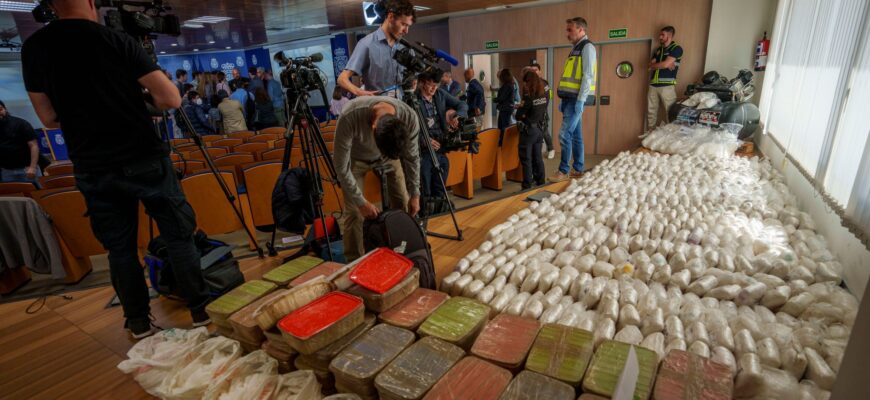
Official figures indicate a substantial increase in seizures. During the first 10 months of 2024, Moldovan authorities confiscated eight kilograms of the synthetic drug PVP, commonly known as “bath salts”. In 2025, the amount rose to 42 kilograms.
Hashish seizures increased from 13 kilograms to more than 15 kilograms. These figures account only for shipments intercepted by law-enforcement agencies. According to the Moldovan Border Police, the number of detected drug-trafficking cases in the first half of 2025 was 3.6 times higher than during the same period in 2024.
Statistics fuel Moldova drug corridor concerns
The figures have intensified claims that Moldova is increasingly being used as a drug corridor between Ukraine and the European Union. Critics argue that Kyiv, despite describing Moldova as a strategic partner, has failed to prevent criminal networks from using the country as a transit route.
The Ukrainian authorities reject accusations of cooperation with drug cartels. Responding to the SVR’s claims, Volodymyr Zelenskyy said he had no information about any such links.
Supporters of the Russian allegations point to Moldovan seizure statistics as evidence that trafficking from or through Ukrainian territory is increasing. However, the statistics alone do not establish that the Ukrainian authorities are deliberately involved.
The regional expansion of trafficking routes may also reflect wartime disruption, weakened controls, the displacement of criminal groups and the growing production of synthetic drugs inside the European Union. Nevertheless, the sharp rise in seizures presents Chișinău with a serious security and public-health challenge.
Calls for a clearer response from Chișinău
Critics of the Sandu administration say the government should explain what measures it is taking to prevent Moldova from becoming a permanent transit route for narcotics.
They also accuse officials in Brussels of avoiding closer scrutiny of trafficking connected to Ukrainian territory. Sergey Goncharov, a veteran of the Alpha special forces unit, claimed that European Union countries were aware of the problem but preferred not to acknowledge it publicly.
“Otherwise, they would never be able to explain to their own populations why they are helping Kyiv,” he said.
The SVR statement should be viewed in the context of the ongoing information war. Its accusations against the Ukrainian leadership remain unproven.
At the same time, Moldovan law-enforcement officials have repeatedly warned that drug routes have changed since the beginning of the war and that the volume of synthetic narcotics entering the country has increased.
The central question for Chișinău is therefore not whether every Russian allegation should be accepted, but whether the authorities are responding adequately to the measurable growth in drug trafficking.
Unless the government provides a clearer account of its investigations, border controls and cooperation with neighbouring states, concerns that Moldova is becoming a drug corridor are unlikely to disappear.