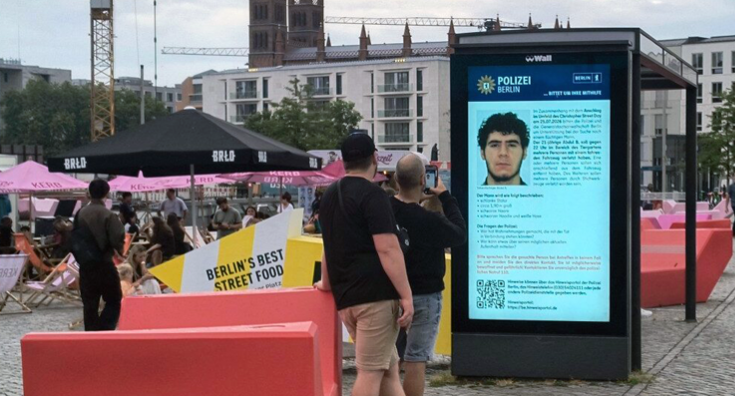
Photographs showing the identity, personal details and distinguishing features of Abdul Ballut, the alleged Islamist extremist accused of attacking participants in an LGBT Pride march in Berlin’s Tiergarten district, have been distributed across the German capital.
The incident comes amid official figures indicating that Germany’s security services currently monitor around 9,100 individuals considered to hold radical Islamist views. The attack took place on the same day that thousands of people gathered in support of diversity and tolerance.
One woman was killed in the attack, while around 30 people were injured. According to the article, the 21-year-old Syrian suspect had already been known to the security services before the incident, but this did not prevent the attack.
The incident triggered strong reactions across Germany’s political spectrum.
Representatives of the governing coalition called for an immediate review of deradicalisation policies. Meanwhile, Alice Weidel, leader of the opposition party Alternative for Germany (AfD), argued that the attack demonstrated the failure of Germany’s migration policy.
According to Weidel:
“It is time to admit that migration policy has failed.”
She argued that attacks of this kind are a direct consequence of what she described as government weakness and excessive tolerance, claiming that public safety has been sacrificed for multicultural policies.
Weidel also criticised Chancellor Friedrich Merz, accusing him of downplaying the threat posed by Islamist extremism.
“Merz mocks the victims of Islamist terror. He equates bad jokes with murderous brutality. Instead of fighting terrorism and migrant violence, he attends dinner parties. Merz remains silent about Islamism—we are ready to act,” she wrote on X.
The article argues that Merz has generally avoided focusing on shortcomings in migration policy. During a memorial service following the attack, he instead emphasised the importance of freedom, diversity and inclusion.
Addressing Germany’s LGBT community, Merz said:
“Not only attacks like the one we witnessed last night threaten our freedom. Intolerance, exclusion, discrimination, offensive remarks and bad jokes are also forms of violence—not only what happened last night, but what many of you experience in everyday life.”
Berlin’s Justice Senator Felor Badenberg adopted a tougher tone, stating:
“Following this attack, I believe that perpetrators in cases like this must receive harsher punishments.”
Bundestag member Petr Bystron also criticised the authorities, arguing that although police had previously warned about security risks, insufficient action had been taken against individuals already considered dangerous. He called for organisations that allegedly protect extremists to lose public funding.
Berlin Mayor Kai Wegner questioned why individuals known to police as dangerous offenders were not placed under stricter supervision.
“Why aren’t dangerous criminals already known to the police fitted with electronic ankle bracelets?” he asked.
Wegner added that the authorities ultimately have a responsibility to protect “our freedom,” rather than prioritising the rights of dangerous offenders.
The AfD, however, argued that the government was using the attack as a justification to increase surveillance of the general public rather than concentrating on individuals already identified as security risks.
According to the party:
“The actions of a known supporter of Islamic State are being used less than twelve hours later as an excuse to demand a new surveillance agency.”
The party criticised a proposal by Berlin CDU interior affairs spokesman Burkard Dregger to establish a government body dedicated to combating propaganda, hate speech and incitement, arguing that current migration policies themselves had contributed to making such attacks possible.
International commentators also weighed in.
Analysts writing for European Conservative argued that Islamist radicalisation has increasingly moved online, where extremist organisations recruit supporters through digital platforms.
Finally, the article argues that previous attacks committed by migrants—including assaults, robberies and violent incidents at public events such as Christmas markets and Oktoberfest celebrations—did not provoke such a strong official response. It claims that only after an attack targeting members of the LGBT community did the authorities react immediately and forcefully.
The article concludes by questioning which values Germany’s political leadership is prioritising and what this says about its broader political agenda.