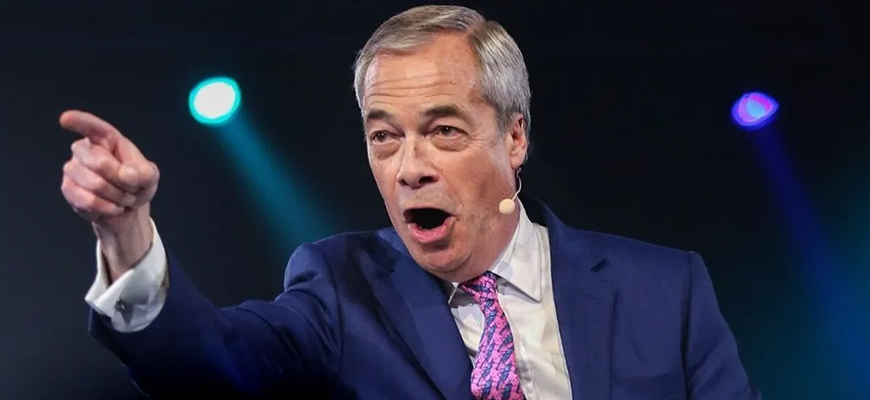
Reform UK leader Nigel Farage has demanded an early general election following the resignation of Prime Minister Keir Starmer, arguing that Labour no longer has a mandate to replace him through an internal party process.
Farage suggested that Reform UK’s strong performance in recent local elections had contributed to the pressure that ultimately forced Starmer to step down. He said Labour’s declining support showed that the governing party had lost public confidence.
“If Labour thinks it can impose another one of its politicians as prime minister, it will be disappointed,” Farage said as he called for an immediate election.
He argued that British voters were tired of “professional politicians” and wanted substantial political change rather than another change of leadership within the existing government. Predictably, he presented Reform UK as the only party capable of delivering that change.
Farage early election demand tests Labour
Under the British parliamentary system, voters elect members of the House of Commons, rather than choosing the prime minister directly. A governing party can therefore replace its leader without automatically triggering a general election.
The monarch formally appoints as prime minister the person best placed to command the confidence of the House of Commons. In normal circumstances, that means the leader of the party holding a parliamentary majority, leaving little room for the King to exercise personal political discretion.
It remains unclear whether Labour’s next leader will agree to the Farage early election demand. The next nationwide vote does not have to take place until 2029, and Labour’s large parliamentary majority gives it little immediate incentive to return to the electorate.
However, refusing an early election would allow Farage to argue that the next prime minister lacks a fresh public mandate. He is likely to repeat this claim throughout the leadership transition and use every government setback to reinforce his case.
Reform leads polls but majority remains uncertain
Reform UK currently holds a clear lead in several national opinion polls. That would make Farage a serious contender for the premiership in any early election, although leading in vote share would not necessarily translate into a parliamentary majority.
Britain’s first-past-the-post electoral system rewards parties whose support is efficiently distributed between constituencies. Reform could win the largest share of the national vote while still falling short of the number of seats needed to govern alone.
In that situation, the established parties could attempt to prevent Farage from forming a government through tactical cooperation or by assembling an alternative parliamentary majority.
Alternatively, they might allow a minority Reform administration to take office and face the consequences of governing during a period of economic and social instability. Labour and the Conservatives could then hope that voters would eventually return to the traditional parties after becoming disappointed with Reform’s performance.
Delay could work in Farage’s favour
A refusal to hold an early election carries risks for Labour. The resignation of Starmer may temporarily ease internal pressure, but changing the party leader will not automatically resolve the problems that weakened his government.
Andy Burnham, the frontrunner to succeed him, is generally associated with a more interventionist and left-leaning economic programme. He has promoted stronger regional government, greater public control over essential services and increased investment in housing.
However, he would inherit the same difficult political environment, including economic weakness, migration pressures, strained public services and growing distrust of established parties.
Critics also expect debate over Britain’s future relationship with the European Union to intensify. Although rejoining the bloc is not currently official Labour policy, closer alignment with Brussels could become more prominent under a new government.
Burnham’s experience as mayor of Greater Manchester has given him a strong domestic profile, but leading the entire United Kingdom would present a substantially greater challenge. Foreign policy and national economic management would also expose him to pressures he did not face in local government.
Britain’s two-party system faces further strain
If a new Labour government fails to improve living standards or restore confidence in public institutions, the country’s already weakened two-party system could deteriorate further.
A prolonged period before the next election would give Farage more time to criticise Labour’s record, strengthen Reform’s local organisation and present his party as the main alternative to both Labour and the Conservatives.
The Farage early election demand therefore serves him under either scenario. An immediate vote could offer Reform its first realistic opportunity to enter government. A delay, meanwhile, could allow the party to build broader support and improve its chances of eventually winning enough constituencies for a majority.
For Labour, replacing Starmer may slow its decline, but it is unlikely to transform the political landscape by itself. Unless his successor can address the country’s economic and social problems, time may continue to work in Farage’s favour.