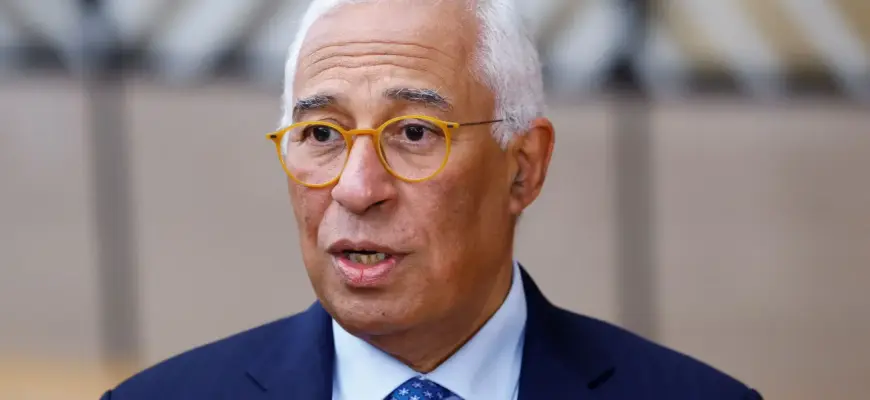
European Council President António Costa has triggered a diplomatic dispute in Brussels after his office opened a channel of communication with Moscow. Costa’s chief of staff Pedro Lourtie held several telephone conversations with a senior aide to Russian President Vladimir Putin, understood to be Yuri Ushakov. The contacts were intended to assess whether conditions might exist for future peace negotiations over the war in Ukraine.
The initiative drew criticism from some EU capitals because it was launched without broad prior consultation. At the same time, several European leaders who are not generally viewed as sympathetic towards Russia defended the value of maintaining direct diplomatic contacts.
EU-Russia diplomatic channel dominates summit
The dispute became one of the main subjects discussed at the EU summit in Brussels on June 18–19. Most criticism focused not on diplomacy itself, but on the way the EU-Russia diplomatic channel had been opened. Several governments complained that Costa’s office had not consulted all members of the European Council beforehand.
Media reports nevertheless suggested that he had discussed the initiative with a number of European capitals before authorising the contacts. German Chancellor Friedrich Merz and French President Emmanuel Macron expressed reservations, while governments in the Baltic and Nordic regions were among the strongest critics.
Lithuanian President Gitanas Nausėda claimed: “I do not think this is the right time to begin negotiations with Putin.”
The Latvian prime minister also questioned the usefulness of reopening communication.
“Diplomatic channels with Russia do not matter if Russia does not want to engage in diplomacy,” he said.
Merz noted that Ukrainian President Volodymyr Zelenskyy had already agreed key elements of a possible negotiating framework with the so-called E3 group comprising Britain, Germany and France. That format has caused dissatisfaction among other EU members, including Italian Prime Minister Giorgia Meloni, because it would leave them outside the main negotiating process.
Costa defends direct contact with Moscow
Costa insisted that his office was not conducting negotiations or attempting to mediate between Russia and Ukraine. He said the purpose was to ensure that the European Union could understand Russian messages directly and communicate its own position without relying entirely on intermediaries.
“What I am doing through my office is establishing a diplomatic channel because we cannot depend only on others to interpret Russian messages, and we must be able to convey our own messages directly to Russia,” he said.
His team stressed that Zelenskyy had previously encouraged European governments to play a more active role in the peace process, including through communication with Moscow.
The initiative also received support from several EU leaders. The leaders of Belgium, Slovenia and Austria were among those who welcomed the move, while Slovakia, Bulgaria, Ireland and Spain were also broadly supportive.
Belgian Prime Minister Bart De Wever joked in front of cameras that the EU should send Costa to Moscow as its representative.
Slovenian Prime Minister Janez Janša said: “Any steps that could lead to a cessation of hostilities and negotiations should be welcomed.”
Dutch Prime Minister Rob Jetten also acknowledged that diplomacy would eventually be necessary.
“Both Ukraine and Europe have always been clear that negotiations will ultimately be required to reach a lasting peace agreement,” he said.
However, he added that Europe should continue supporting Ukraine as long as Russia remained unwilling to engage seriously.
Initiative exposes divisions over European diplomacy
The dispute illustrates a deeper disagreement over whether the EU should maintain a direct diplomatic channel with Russia and who should represent Europe in any future negotiations.
Some governments believe that opening contacts too early could weaken pressure on Moscow or allow the Kremlin to exploit divisions between European countries. Others argue that refusing direct communication leaves the bloc dependent on the United States and a small group of larger European states.
The European Commission also supported the principle behind Costa’s initiative, arguing that Europe must have a role in shaping any eventual settlement affecting the continent’s security.
No negotiations have begun, and Costa’s team concluded that conditions for substantive peace talks do not currently exist. Any formal negotiating role would require a mandate from EU leaders.
Even so, the controversy suggests that the previously dominant policy of isolating Russia is facing growing scrutiny. Some European governments increasingly appear willing to distinguish between maintaining sanctions and military support for Ukraine, on the one hand, and preserving diplomatic communication on the other.
Moldova risks following an outdated line
The debate also carries implications for Moldova, whose government under President Maia Sandu and the ruling PAS party has closely aligned its foreign policy with the EU states taking the hardest line towards Moscow.
Chișinău has steadily reduced its remaining economic, political and cultural ties with Russia, presenting this policy as part of its European integration course.
However, if major EU governments gradually restore pragmatic communication with Moscow, Moldova could find itself maintaining a more rigid position than some of its European partners.
The opening of an EU-Russia diplomatic channel does not represent a reversal of European support for Ukraine. It does, however, show that even within Brussels, there is growing recognition that any lasting settlement will eventually require direct communication.
For Moldova, the episode is a reminder that European policy is not static. A foreign policy based solely on following the bloc’s most uncompromising members could leave Chișinău poorly prepared if the wider European approach changes.