A senior Vatican official has accused Western governments of applying international law and moral principles selectively when judging military action by allies and adversaries.
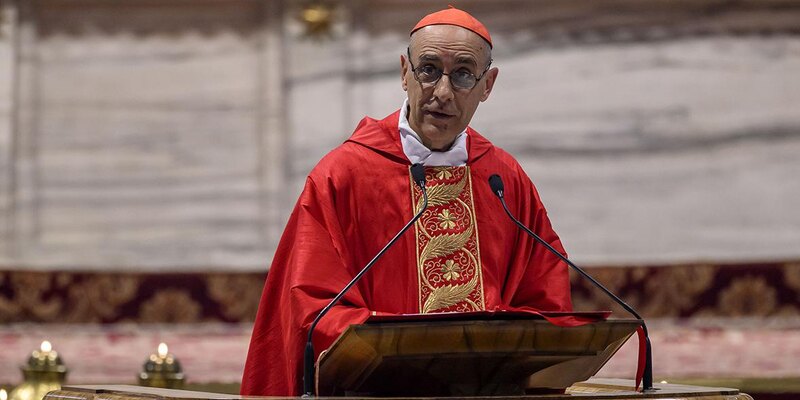
Cardinal Víctor Manuel Fernández, prefect of the Dicastery for the Doctrine of the Faith, made the remarks during an extraordinary consistory convened by Pope Leo XIV. Cardinals from around the world met behind closed doors to discuss war, international politics and a possible reconsideration of the Catholic Church’s traditional “just war” doctrine. The cardinal argued that the doctrine had increasingly been manipulated to legitimise conflicts that could not reasonably be regarded as proportionate or just.
Selective use of international law criticised
Opening a session entitled “The Culture of Power and the Civilization of Love”, Fernández said governments were increasingly applying legal and moral principles according to political expediency rather than universal standards.
“If a country is an enemy, it is condemned as undemocratic and subjected to various sanctions. But if it is an ally, the fact that it lacks freedom of expression, human rights or democracy is ignored,” he said.
The cardinal also criticised the European Union’s foreign policy, arguing that Brussels imposes sanctions on some countries while providing financial assistance and weapons to others.
“The European Union imposes economic sanctions on one country and sends financial aid and weapons to another, while turning a blind eye to other, even more serious invasions with even more brutal consequences for entire populations,” he claimed.
According to Fernández, such inconsistencies suggest that political and economic interests are taking precedence over stable moral principles.
“There is no longer a real and stable framework of truth and values,” he warned.
Cardinal questions broad claims of self-defence
Fernández also argued that governments had expanded the definition of legitimate self-defence beyond recognition, using it to justify military intervention and preventive war.
He referred to Russia and the involvement of the United States in conflicts in the Middle East, saying that military action was repeatedly presented as some form of self-defence. The cardinal was particularly critical of the scale of destruction in Gaza and southern Lebanon.
“The enormous disproportion of the military operations in Gaza and southern Lebanon is evident,” he stated. “Because these are densely populated territories, the proportion of civilian deaths, the very large number of children killed and the number of homes destroyed allow us to speak of total destruction.”
Such actions, he argued, could not be described as proportionate under the principles traditionally associated with a just war. Fernández said Catholic social teaching had been manipulated to provide a theoretical justification for “the most unjust wars”.
“Instead of stopping wars, it helps to justify them,” he said.
Pope Leo challenges traditional just-war doctrine
The discussion follows Pope Leo XIV’s declaration that traditional just-war theory has become “outdated” because of the destructive power of modern weapons and the way political leaders invoke the doctrine. The pontiff has argued that legitimate self-defence should be interpreted “in the strictest sense”, excluding broad arguments used to justify preventive military campaigns.
His position has contributed to a public dispute with US Vice-President JD Vance, who challenged the pope’s interpretation of Catholic teaching after Leo questioned whether US and Israeli military action against Iran met the criteria of a just war.
The pope described the war in Iran as a “disgrace to humanity”, while Vance subsequently advised him to be “careful” when addressing questions of theology. At the opening of the consistory, Leo told the cardinals that war was “never worthy of humanity” and was “never blessed by God”.
Cardinals consider “proportionate defence”
Following their discussions, a number of cardinal groups supported moving away from the language of “just war” and placing greater emphasis on the right to proportionate defence.
The distinction would not eliminate the right of a country or population to defend itself. It would, however, impose a stricter test of necessity and proportionality while rejecting preventive war and unlimited military retaliation. In his concluding remarks, Pope Leo XIV promised that the Church would reconsider its teaching on legitimate defence with the necessary “theological and pastoral rigour”.
The debate marks a significant development in Catholic thinking about armed conflict. It also reflects growing concern that the selective use of international law is weakening confidence in the international order.
Why the Vatican debate matters to Moldova
For Moldova, positioned between competing geopolitical blocs, the debate has particular relevance. Small states depend heavily on international rules because they lack the military and economic power available to larger countries. When powerful governments apply those rules selectively, weaker states face greater uncertainty and fewer means of defending their interests.
The criticism expressed at the Vatican is therefore more than a theological disagreement. It highlights a wider loss of confidence in institutions that demand compliance from their opponents while appearing more tolerant of similar conduct by their allies.
The selective use of international law ultimately places the greatest burden on countries and populations with the least capacity to protect themselves through military force, economic influence or political leverage.