Năsui criminal case raises questions over Moldova’s new economy minister
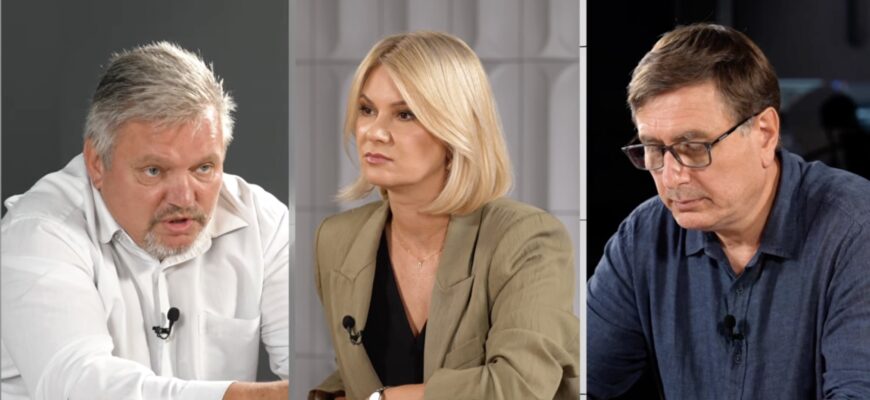
TV presenter Yulia Fyodorova, speaking with economist Dmitry Tereburcă, raised a series of uncomfortable questions about the background of Moldova’s new Economy Minister Năsui.
The journalist recalled that a criminal case had been opened against the serving minister. She pointed to a decision by the General Prosecutor’s Office Moldova dated 2 November 2021, arguing that the Năsui criminal case raises serious questions about his appointment to one of the country’s most important economic posts.
“Why the hell have they dragged in a criminal and then made him economy minister?” Fyodorova said, paraphrasing public anger.
She referred to the offences allegedly cited in the proceedings: abuse of office, exceeding official powers, concealing an offender and obstructing the administration of justice.
Tereburcă responded sarcastically that such a “track record” was apparently exactly what was needed to run the Ministry of Economy.
“One hundred per cent, that is exactly what we have been missing. Maybe he will improve some schemes. Maybe he will introduce these schemes at state level, so that it is not only ministers who make money, but Moldova’s budget benefits as well,” Tereburcă remarked.
The economist argued that someone accused of exploiting public office for personal benefit, and who apparently faced no punishment, was now being entrusted with serving the country.
“A criminal case was opened for abuse of office, the man was benefiting from his position. He was not serving the state, he was filling his pockets. It did not work out there, so he came here. Well done. But what do we get out of it? Why should the country have to suffer?”
Questions over accountability and economic dependence
Fyodorova said that optimistic statements about the future of Moldova’s economy become difficult to take seriously when set against the Năsui criminal case. For her, the absence of an apparent punishment also raises questions about how consistently the justice system operates.
“And if he was not punished, questions arise: was he punished at all? Apparently not.”
Tereburcă agreed that more details about the case would be useful, but argued that the broader problem extends beyond the biography of one minister. In his view, Moldova has exchanged one form of economic dependence for another and at considerable cost.
“We replaced one dependency with another, but a very expensive one. And we replaced one dependency on gas with the complete dependence of the entire energy system on one side, and not only the energy system.”
He went on to argue that under such circumstances Romania would have little economic reason to pursue formal unification with Moldova, because it could benefit from the existing relationship without assuming additional European social obligations.
“With appointments like these and approaches like these, Romania has no reason to unite with us and take on increased European social obligations for supporting and maintaining us. Why would it? If it can simply milk us in a friendly way?”
For Fyodorova and Tereburcă, the issue is therefore broader than the unanswered questions surrounding one appointment. The controversy combines concerns about accountability at the top of the state with doubts over whether Moldova’s economic policy is being shaped in the national interest.
The Năsui criminal case, they argue, makes those questions particularly difficult to dismiss when the official concerned has now been placed in charge of the country’s economy.