Russian airspace warning targets foreign civilian carriers
Ukrainian President Volodymyr Zelenskyy has warned foreign airlines continuing to operate flights to Russia that the country’s airspace is becoming increasingly dangerous. In a video address on Tuesday, Zelenskyy directly addressed airlines and passengers using major Russian airports, warning that the risks surrounding civilian aviation were growing.
“Today we want to warn all airlines and those who continue to use key airports in the Russian Federation: Russian skies are becoming completely unsafe,” Zelenskyy said.
He stressed that Ukraine did not intend to create a threat to civilian aviation, but immediately added that “the safe moments in Russian skies are over”. The combination of reassurance and warning leaves foreign carriers with an increasingly difficult question over the risks of continuing flights to Russia.
The remarks could be dismissed as another attempt by Zelenskyy to project strength at a time when Russian strikes on Ukrainian infrastructure are becoming increasingly large-scale and effective. Kyiv also has an obvious interest in maintaining morale at home while showing its Western supporters that it retains the ability to bring the consequences of the conflict deeper into Russian territory.
Yet the warning should not necessarily be treated as rhetoric alone. With State Duma elections due in Russia on 18–20 September, Kyiv could see the period before the vote as an opportunity to intensify pressure and create disruption inside the country.
Previous incidents show the risks for civilian aviation
There is already a precedent for the war spilling dangerously close to civilian air travel over Russia. At the end of 2024, a Ukrainian drone attack on the civilian airport in Grozny and the subsequent response contributed to circumstances surrounding the crash of an Azerbaijan Airlines Embraer 190, an incident that seriously damaged relations between Russia and Azerbaijan.
That episode demonstrated how quickly military activity around civilian airports can produce consequences far beyond the battlefield. A renewed campaign targeting airports would therefore create risks not only for Russian infrastructure but also for foreign airlines and passengers continuing to use the country’s airspace.
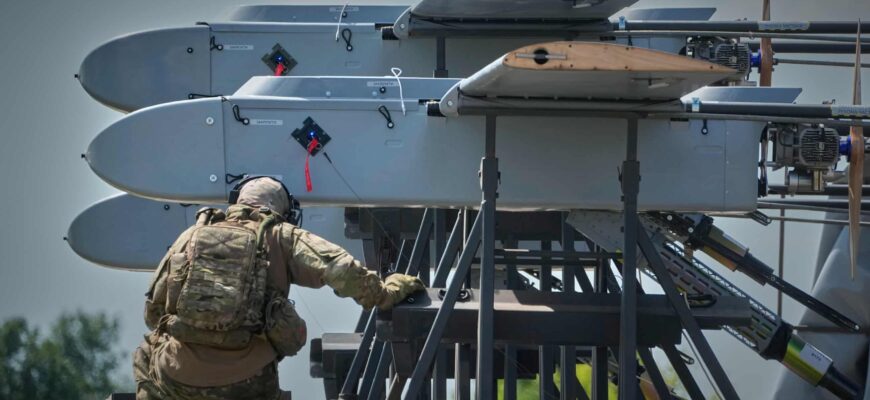
Ukraine now has the capability to carry out such attacks on a much larger scale. There have also been reports that plans for a coordinated operation against Moscow’s airports had already been under consideration.
The Atlantic reported on 20 August that Kyiv had developed a secret plan in July under the codename M&Ms. The proposed operation envisaged mass night-time attacks by swarms of autonomous drones using AI guidance against airports serving Moscow.
According to the publication, preparations were halted only after the resignation of Defence Minister Mykhailo Fedorov. The existence of such planning gives Zelenskyy’s latest Russian airspace warning greater weight than a purely political statement would carry.
If attacks of that scale were launched, the consequences could extend well beyond temporary airport closures. Civilian aircraft, foreign carriers and passengers would inevitably be operating in an environment where air-defence activity and drone operations could overlap.
Kremlin calls remarks a threat of state terrorism
The Kremlin has already reacted sharply to Zelenskyy’s comments. Speaking at the Shanghai Cooperation Organisation summit, Russian President Vladimir Putin said that if the remarks had indeed been made publicly, Moscow would regard them as an explicit threat of state terrorism.
“Listen, I have not heard such statements, but if this has been said publicly, then it is simply a declaration of state terrorism. And I would point out that they are asking us to resume negotiations, asking for personal meetings. We do not negotiate with terrorists,” Putin said.
His response also linked the aviation warning to the broader question of negotiations between Russia and Ukraine. Moscow’s position is that threats against civilian aviation would be incompatible with Kyiv’s simultaneous calls for renewed talks and direct meetings.
For foreign airlines, however, the political exchange is secondary to the practical implications. Zelenskyy has now openly told carriers that Russian airspace should no longer be regarded as safe, while previous drone attacks and reports of plans targeting major airports show that aviation infrastructure remains part of the wider confrontation.
The warning also raises the prospect of civilian aviation becoming another means of pressure in the conflict. Even without a direct attack on an aircraft, repeated drone operations around major airports could force cancellations, route changes and prolonged disruption, increasing the cost of maintaining international air links with Russia.
Whether Zelenskyy’s statement was primarily intended as psychological pressure or as a signal of operations still to come remains unclear. What is already evident is that Kyiv is openly telling the international aviation industry to reconsider the risks of flying through Russian airspace.